- Home
- Technology
- The internet
The internet
What the internet actually is, and how a page gets from a computer far away to your screen.

The short version
The internet is a worldwide collection of connected networks. It is not a place or a company. Computers send each other data in small pieces called packets, which hop from network to network until they arrive. The web is only one thing that runs on it.
I always pictured the internet as a giant computer somewhere that everything was stored on.
There is no such thing. It is a huge number of ordinary computers, joined by cables.
It is the joining, not the storing.
A network of networks
Your home network connects to your internet provider's network. That connects to bigger networks run by other providers, and those join up with each other all round the world. The word internet means exactly that: inter-network.
No single organisation owns the whole internet. Thousands of networks, run by providers, companies, universities and others, connect and exchange data using shared standards.
A useful picture is the road network. No one owns all the roads, yet you can drive from your street to almost any other. The picture stops working in one way: on the internet, your journey is cut into many small pieces that each find their own way.
Packet
A chunk of data with source and destination information. A common Ethernet link carries IP packets up to about 1,500 bytes; other links can have different limits.
How a page reaches you
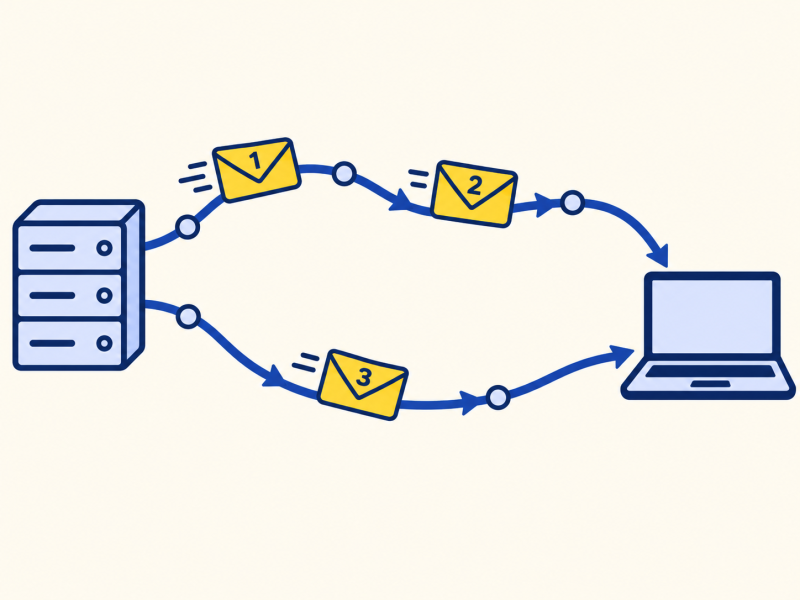
When you load a web page, your device asks a faraway computer, called a server, for it. The page is split into packets. Each packet is passed from one network to the next, and each hop is decided by a router that looks at the label and sends the packet on towards where it is going.
The packets do not all have to go the same way. They are put back in order at your end. If a piece goes missing, the communication protocol can detect the loss and resend it. How a web page reaches you goes through this step by step.
The internet and the web are the same thing.
The web is the pages you visit in a browser. The internet also carries email, video calls, games and streaming, which have nothing to do with web pages.
The pieces that make it work
Every device on the internet has an address, called an IP address. People use names such as a shop's website, so a system called DNS turns the name into an address. Between continents, the data mostly travels through undersea cables. Into your home it arrives by phone line, cable or fibre.
Who runs the pieces
Your provider runs the last stretch to your home. Larger companies run the long cables between cities and countries. Big websites run their own enormous collections of computers, called data centres, and connect them straight to the biggest networks to save time.
Rules agreed in public, called protocols, let all of this fit together. One set decides how data is cut into packets and addressed. Another decides how web pages are asked for. As long as every network follows them, it does not matter who built it or what kind of computer is at either end.
A short history
- 1969 Four American universities are linked in ARPANET, the first network of its kind.
- 1983 The rules for sending packets, called TCP/IP, become the standard.
- 1989 Tim Berners-Lee proposes the World Wide Web at CERN.
- 1991 The World Wide Web becomes available beyond CERN.
- 2007 Apple releases the first iPhone, helping bring internet access to a wider mobile audience.
Key takeaways
- The internet is a network of networks, not a place.
- Data travels in small packets.
- Routers pass packets along towards their address.
- The web is only one thing that uses the internet.
Now you know.
The internet is a network of networks.
Data travels in packets.
The web is only one use of it.
Last reviewed 3 Nov 2026
Where next?
Explained further by
-
Read
 Technology
How DNS finds a website
How DNS turns a website name into an IP address, the chain of look-ups it uses, why it is fast, and why a DNS…
-
Read
 Technology
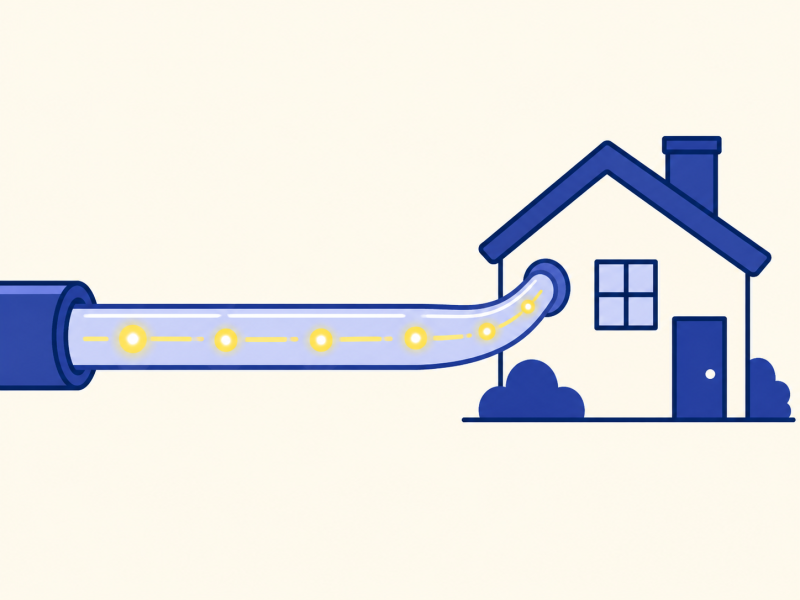
Fibre broadband
How fibre broadband sends light through glass to deliver fast internet, and the difference between full fibre…
-
Read
 Technology
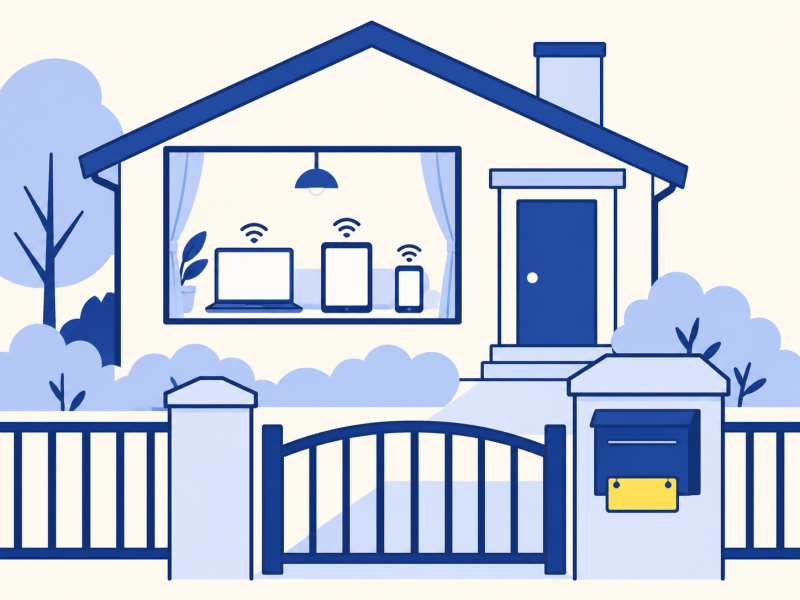
What an IP address is
What an IP address is, how it works like a postal address for data, why your home has one shared by all your…
-
Read
 Technology
How a web page reaches you
How a web page is cut into packets, sent by different routes through routers and put back together on your…
-
Read
 Technology
Undersea cables
How undersea cables carry nearly all international internet traffic, how light in glass fibres carries data…
More in Technology
-
Read
 Technology
Artificial intelligence
What AI means today: software that learns patterns from examples instead of following written rules, and…
-
Read
 Technology
Fingerprint and face unlock
How fingerprint and face unlock work: a scan becomes a pattern of numbers kept on the phone and compared each…
-
Read
 Technology
Bluetooth
How Bluetooth uses short-range radio to connect headphones, keyboards and speakers, why pairing is needed…