- Home
- Technology
- The internet
- Fibre broadband
Fibre broadband
How glass threads bring the internet into your home, and why fibre is faster than copper.
The short version
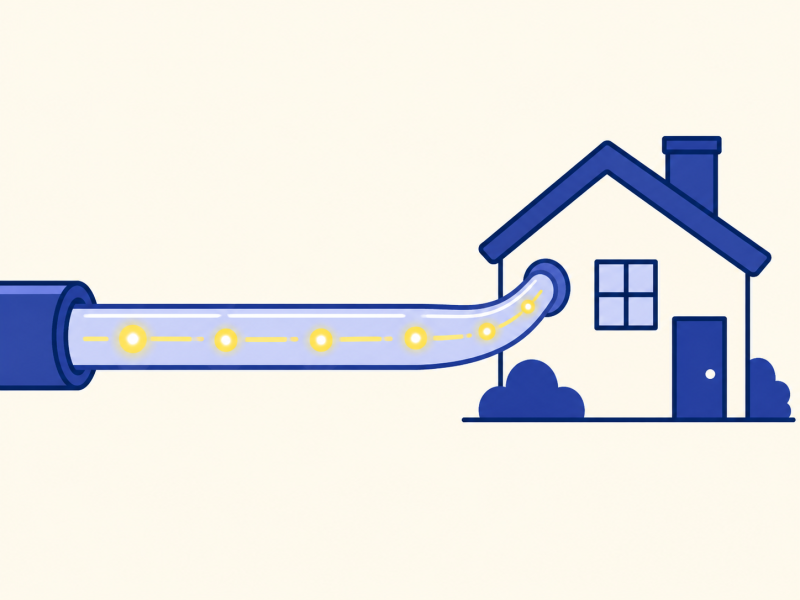
Fibre broadband sends data as pulses of light through glass threads thinner than a hair. Light loses very little on the way and can carry far more data than electricity in a copper wire. Some fibre goes all the way to your home; some stops at a street cabinet. It builds on the internet.
I always thought fibre meant my whole line was fibre.
Often only part of it is.
The last stretch to the house is the one that decides the speed.
Two kinds of fibre broadband
Full fibre
Fibre runs to your home and usually offers faster, more reliable service than part-fibre.
Part fibre
Glass goes to the green box in the street; the last stretch is the old copper phone line, which slows it.
Why light in glass is faster
A copper wire carries a signal as a changing electric current, which gets weaker with distance and picks up interference. A glass fibre carries light, which is hardly weakened over many kilometres and does not suffer interference from other cables.
Light can also be turned on and off billions of times a second, so one thread can carry a huge amount of data. Many fibres use several colours of light at once, each carrying its own stream.
Thinner than a hair
The glass core and cladding are about 0.125 millimetres across; the protective coating makes the strand thicker.
Source: Choosing broadband: full fibre and part fibre, Ofcom
Note: the speed you get also depends on your Wi-Fi, your router and your provider. See why Wi-Fi slows down.
Key takeaways
- Fibre carries data as light in glass.
- Light loses little signal, so it goes far and fast.
- Full fibre goes to your home; part fibre ends at the street.
- The last stretch decides your speed.
Now you know.
Fibre sends light, not electricity.
Full fibre reaches the house.
Part fibre stops at the street.
Last reviewed 3 Nov 2026
Where next?
Builds on

More in The internet
-
Read
 Technology
How DNS finds a website
How DNS turns a website name into an IP address, the chain of look-ups it uses, why it is fast, and why a DNS…
-
Read
 Technology
What an IP address is
What an IP address is, how it works like a postal address for data, why your home has one shared by all your…
-
Read
 Technology
How a web page reaches you
How a web page is cut into packets, sent by different routes through routers and put back together on your…