- Home
- Technology
- Artificial intelligence
Artificial intelligence
What AI is today, how it learns from examples, and what it can and cannot do.
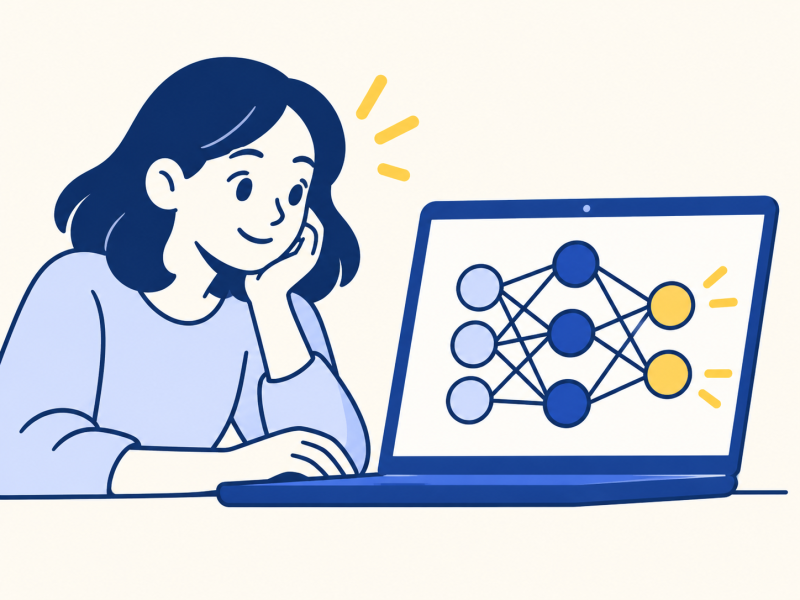
The short version
Much current AI learns patterns from examples rather than relying on hand-written rules. With labelled photos it can learn to recognise cats; with text it learns to predict what comes next. Pattern matching is not the same as human understanding.
I always pictured AI as a computer that thinks like a person, only faster.
It does not. It finds patterns in examples.
It is very good at that, and that is all it is doing.
Rules versus examples
An ordinary program follows rules a person wrote: if the total is over £50, apply free delivery. That works when you can say the rule. But no one can write rules for how to spot a cat in a photo, or what a sentence should say next. There are too many exceptions.
The alternative is machine learning. You show the computer thousands or millions of examples, each with the right answer, and let it adjust itself until it gets them right. It ends up with its own rules, in a form no human could read, packed into a huge list of numbers.
Three common jobs
Recognising
The spotterFinds faces in photos, turns speech into text, spots a fault in a scan.
Predicting
The forecasterGuesses what you want to watch, or if a payment looks like fraud.
Generating
The makerWrites text, makes pictures, or composes music in the style of its examples.
How a chatbot fits in
A chatbot is a kind of generator. It learns patterns from text and produces a reply by predicting one token at a time. A token may be a word or part of a word. How a chatbot is trained goes into the process, and why AI makes things up follows from it.
Learning in a network
The numbers that hold what the system has learned are arranged in a structure loosely inspired by the brain, called a neural network. How a neural network learns shows how adjusting those numbers produces a skill.
Billions
The number of adjustable numbers, called parameters, in a large chatbot. Each one is tuned a tiny amount during training.
AI knows things in the way a person does.
It stores patterns, not understanding. It can produce a fluent, confident answer without any sense of whether it is true, and it has no goals or feelings of its own.
The field has moved through periods of excitement and slowdown. Larger datasets and more computing power have helped machine-learning systems handle more complex tasks.
A short history
- 1950 Alan Turing asks whether a machine can think, in a famous paper.
- 1956 The term artificial intelligence is first used, at a workshop in the United States.
- 1997 A computer, Deep Blue, beats the world chess champion.
- 2016 AlphaGo beats a top player at the board game Go.
- 2022 Chatbots reach the public, and millions try them.
Where it helps and where to be careful
AI is good where there are plenty of examples and an occasional mistake is acceptable: suggesting a word, sorting photos, spotting likely faults for a person to check. It is poorer where an error is costly and the system cannot explain itself. It can also copy the biases in its examples, such as unfair patterns in old records.
Note: this explains how it works in general. It is not advice for your situation. For a decision about your health, money or legal position, check an official source or ask a qualified professional.
Key takeaways
- AI learns patterns from examples.
- Programmers write the learning method, not the rules.
- Chatbots predict the next word.
- It does not understand the world in the human sense; it detects patterns and produces outputs from them.
- It can inherit biases from its examples.
Now you know.
AI learns from examples.
It finds patterns.
It does not understand them.
Last reviewed 3 Nov 2026
Where next?
Explained further by
-
Read
 Technology
Why AI makes things up
Why chatbots sometimes state false things confidently: they predict likely words rather than check facts, and…
-
Read
 Technology
How a chatbot is trained
How a chatbot is trained: it reads vast amounts of text, learns to predict the next word, and is shaped by…
-
Read
 Technology
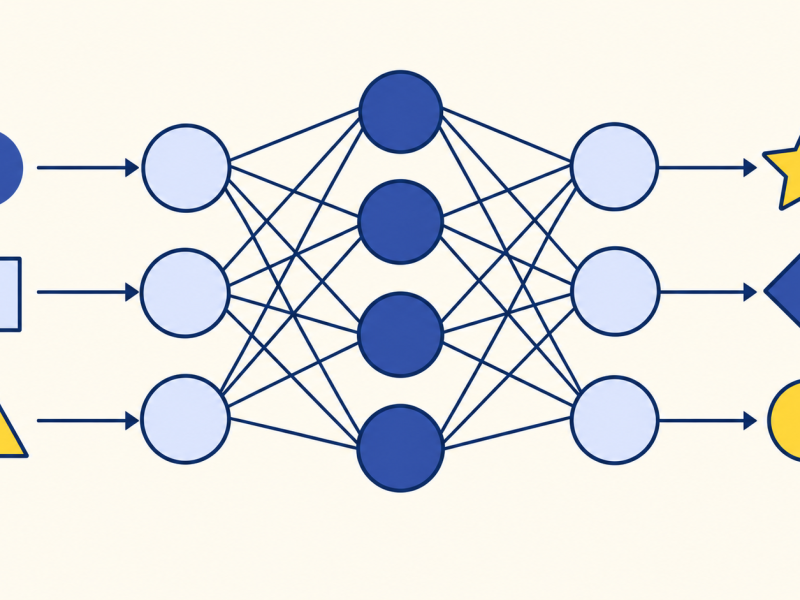
How a neural network learns
How a neural network learns: layers of simple units with adjustable weights, a guess checked against the…
More in Technology
-
Read
 Technology
Fingerprint and face unlock
How fingerprint and face unlock work: a scan becomes a pattern of numbers kept on the phone and compared each…
-
Read
 Technology
Bluetooth
How Bluetooth uses short-range radio to connect headphones, keyboards and speakers, why pairing is needed…
-
Read
 Technology
The cloud
What the cloud is: someone else's computers in a data centre that you reach over the internet, why that is…