- Home
- Technology
- The internet
- Undersea cables
Undersea cables
Why almost all the internet between continents travels along cables on the sea floor.

The short version
Nearly all the internet between continents travels along cables lying on the sea floor, not through satellites. Each cable contains thin glass fibres that carry pulses of light. There are several hundred of them around the world. It builds on the internet.
I always assumed international data went through satellites.
It mostly goes through the sea.
Cables are faster, cheaper and carry far more.
A cable the width of a hose
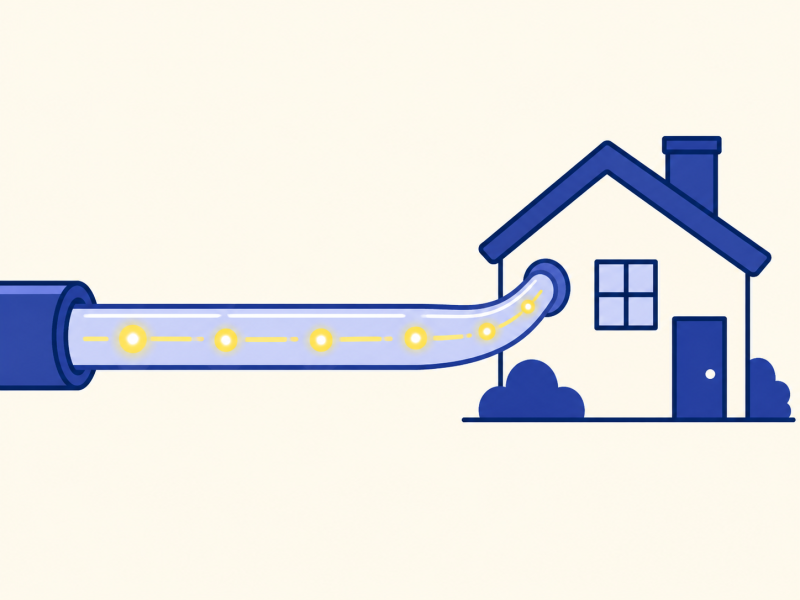
An undersea cable is about as thick as a garden hose in the deep ocean. In the middle are a few pairs of glass fibres, each thinner than a hair. Around them are layers of steel wire, copper and plastic. Near the coast, where anchors and fishing nets are a danger, the cable is thicker and is buried in the sea bed.
Data travels as flashes of laser light inside the fibre. Light bounces along the glass, and every 50 to 100 kilometres a repeater boosts it, powered by electricity sent along the cable itself.
More than 600 systems
The approximate number of submarine cable systems in service worldwide in 2026; the count changes as cables are built and retired.
Laying and mending
Special ships lay the cable, unrolling it from huge tanks as they sail. Cables sometimes break, usually because of fishing, anchors or earthquakes. Repair ships find the break, haul the cable up from the sea bed, and splice in a new section. It can take days or weeks.
Because several routes often connect the same regions, operators can reroute traffic around a break, though detours may cause congestion.
Sources: TeleGeography's Submarine Cable Map and the International Cable Protection Committee. Figures are approximate.
Key takeaways
- Most intercontinental data goes through the sea, not space.
- The cables are about as thick as a hose.
- Data moves as pulses of light in glass.
- Repair ships mend breaks, and traffic reroutes.
Now you know.
The internet crosses oceans by cable.
Data travels as light in glass.
Ships can mend them.
Last reviewed 3 Nov 2026
Where next?
Builds on

More in The internet
-
Read
 Technology
How DNS finds a website
How DNS turns a website name into an IP address, the chain of look-ups it uses, why it is fast, and why a DNS…
-
Read
 Technology
Fibre broadband
How fibre broadband sends light through glass to deliver fast internet, and the difference between full fibre…
-
Read
 Technology
What an IP address is
What an IP address is, how it works like a postal address for data, why your home has one shared by all your…