
The short version
The water on Earth is used over and over. The Sun evaporates water from the sea, lakes and plants. It rises, cools into clouds and falls as rain or snow. Then it runs over the land, soaks into the ground or freezes, and in the end flows back to the sea.
I always imagined rain as new water, made in the clouds.
Most of the water falling on you has passed through oceans, rivers, plants and ice many times.
Almost all the water on Earth is reused again and again.
The Sun lifts water into the air
The Sun warms the surface of the sea, lakes and rivers, and some of the water turns to invisible gas called water vapour. This is evaporation. Plants also release water vapour through tiny holes in their leaves, called transpiration. Most of the water that enters the air comes from the oceans.
The air carries the vapour upwards. As moist air rises, it expands and cools. When it cools enough, water vapour condenses on tiny particles into droplets or ice crystals, forming clouds. This is condensation, and the drops together make a cloud.
Round and round
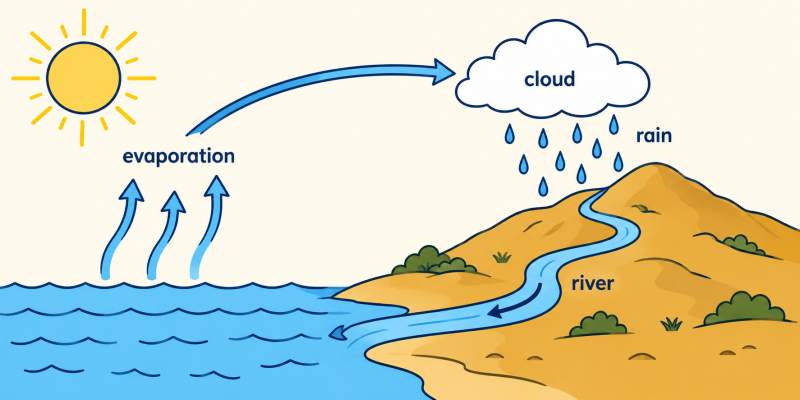
The picture shows the whole loop. The Sun lifts water from the sea. The vapour rises and forms clouds. The wind blows the clouds over the land, where the water falls as rain or snow. It runs downhill in streams, joins rivers, and returns to the sea. Then it starts again.
There is no start or end. Any drop of water on Earth could be anywhere in the cycle.
The cycle does not follow neat steps. Water can skip a stage: snow can sit on a mountain as ice for years, or a puddle can evaporate within hours.
How long water stays in each place
Approximate residence times. They vary by location and depth.
Where the rain goes
When rain or snow falls, it has three main places to go.
Some runs over the surface into streams and rivers. This is runoff, and it is how most rivers begin: rain on high ground collects into trickles, then streams, then rivers. Some soaks into the soil, where plants take it up or it sinks deeper to become groundwater, which feeds springs and rivers slowly over months and years. And some falls as snow and stays frozen.
Rivers carry dissolved minerals with them, which is how the sea became salty. About 97% of the Earth's water is salt water in the oceans. Only about 2.5% is fresh, and most of that is frozen in ice caps and glaciers or underground.
Water gets used up.
Drinking, washing and growing food do not destroy water. It returns to the cycle. What can run short is fresh water in the right place at the right time.
Where did Earth's water come from?
Scientists think most of Earth's water arrived early in its history, delivered by water-rich asteroids that hit the young planet, and trapped in its rocks. Later, volcanoes released some of it as steam. Comets may have added a little, but they now look like a smaller part of the story.
This is still being studied, and the exact mix is debated. What is clear is that very little water is gained or lost today. The water in your glass is part of a supply that has been going round for billions of years.
Sources:
Key takeaways
- The Sun's heat drives the water cycle.
- Evaporation lifts water; condensation makes clouds.
- Rain runs off, soaks in, or freezes.
- Most of the Earth's water is salt water in the oceans.
- Water is reused, not used up.
Now you know.
Water is never made or lost. It goes round.
The Sun lifts it, the cold turns it into clouds, and gravity brings it back down.
The rain falling on you has been here for billions of years.
Last reviewed 3 Nov 2026
Where next?
More in The World
-
Read
 The World
Seasons
Seasons come from the tilt of the Earth, not its distance from the Sun. See why days lengthen, why summer is…
-
Read
 The World
The planets
The eight planets of our Solar System, why some are rocky and some are giant balls of gas, and the rule that…
-
Read
 The World
Phases of the Moon
The Moon's phases come from seeing its sunlit half from a changing angle. See why the cycle takes 29.5 days…