
The short version
The Moon always has one half lit by the Sun. As it orbits the Earth, we see that lit half from a changing angle, so the Moon seems to grow and shrink. At new moon the lit side faces away from us, and at full moon it faces us. The cycle takes about 29.5 days.
I always thought the phases of the Moon were the Earth's shadow creeping across it.
That is an eclipse, and eclipses are rare.
The phases are the same half-lit Moon, seen from a different angle each night.
The Moon is always half lit
The Moon makes no light of its own. It reflects sunlight, and at any moment the Sun lights up the half of the Moon that faces it. The other half is in night, as is the half of the Earth facing away from the Sun.
The Moon travels once round the Earth in about 27 days. As it goes, the angle between the Sun, the Earth and the Moon keeps changing. We always look from the Earth, so how much of the lit half we can see depends on where the Moon is.
You can try this yourself. Stand in a dark room with a lamp on one side and hold a ball at arm's length. Turn slowly on the spot, keeping hold of the ball. You are the Earth, the ball is the Moon, and the lit part of the ball goes through the same phases.
One Moon, eight views
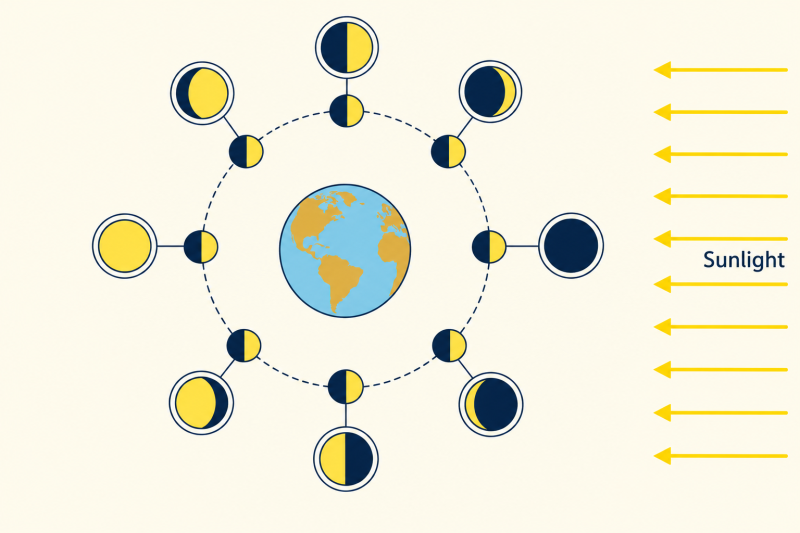
In the picture, the Sun is far off to the right. The Moon is shown at eight points around the Earth. At each point, half of it is lit: the side facing the Sun. What changes is how much of that lit half is turned towards us.
When the Moon is between us and the Sun, we see its dark side and the Moon seems to vanish. When the Earth is between the Moon and the Sun, we see all of the lit side.
The Moon takes about 27 days to go round the Earth, but the phases repeat every 29.5 days. The reason is in the technical detail below.
The four main phases
New moon
invisibleThe Moon is between us and the Sun. Its lit half faces away from us, so we cannot see it.
First quarter
half litThe Moon has made a quarter of its trip round the Earth. From here, half of the face we can see is lit.
Full moon
fully litThe Earth is between the Sun and the Moon. All of the face we can see is lit.
Last quarter
half litThe Moon is three-quarters of the way round. The other half of the face is lit.
Growing and shrinking
When the lit part is growing, from new moon to full, the Moon is waxing. When it is shrinking, from full to new, it is waning. A lit part smaller than half is a crescent. A lit part bigger than half is called gibbous (GIB-us).
The phases are the same around the world, though the Moon appears rotated when seen from the other hemisphere.
On average, the Moon rises about 50 minutes later each day, the same delay that makes high tide later each day. A full moon rises at sunset, and a new moon rises with the Sun, which is why you never see it.
Why we always see the same face
The Moon spins on its axis once for every trip round the Earth. Because the two take the same time, the same side always faces us. This is no coincidence. Over billions of years, the Earth's pull (gravity) slowed the Moon's spin until it matched its orbit. This is called tidal locking, or synchronous rotation. The far side is not permanently dark: sunlight reaches both hemispheres over the course of a lunar month.
There is a dark side of the Moon.
There is a far side, which we never see from Earth, but it gets as much sunlight as the near side. At new moon, when we see nothing, the far side is fully lit.
How eclipses are different
The Moon's orbit is tilted by about 5 degrees compared with the Earth's path around the Sun. Most months, the Moon passes a little above or below the line from the Sun to the Earth. Only when the three line up closely do we get an eclipse.
In a lunar eclipse, at full moon, the Moon passes into the Earth's shadow and turns a dull red. In a solar eclipse, at new moon, the Moon's shadow falls on a patch of the Earth and blocks the Sun for people standing there.
400
The Sun is about 400 times wider than the Moon, and about 400 times further away. That is why they look nearly the same size in our sky.
Why the cycle is 29.5 days, not 27
The Moon goes once round the Earth in 27.3 days, measured against the stars. But phases depend on where the Sun is, not the stars.
While the Moon is going round, the Earth has also moved about a twelfth of the way round the Sun, so the Sun is now in a different direction. The Moon has to travel for about two more days to catch up to the same angle with the Sun. Add the two together and you get 29.5 days from one new moon to the next.
Sources:
- Moon phases, NASA Science
- The Moon, Royal Observatory Greenwich
- Eclipses and the Moon, NASA Science
Note: never look at the Sun directly, even during a partial eclipse. Use proper eclipse glasses.
Key takeaways
- Half of the Moon is always lit by the Sun.
- Phases come from seeing that half from different angles.
- Waxing means growing; waning means shrinking.
- The same side of the Moon always faces us.
- Eclipses are rare because the orbits are tilted.
Now you know.
The Moon is always half lit.
We see more or less of that half as the Moon goes round.
The phases are not a shadow. They are a change of view.
Last reviewed 3 Nov 2026
Where next?
More in The World
-
Read
 The World
Seasons
Seasons come from the tilt of the Earth, not its distance from the Sun. See why days lengthen, why summer is…
-
Read
 The World
The planets
The eight planets of our Solar System, why some are rocky and some are giant balls of gas, and the rule that…
-
Read
 The World
The greenhouse effect
The greenhouse effect is gases in the air slowing the escape of heat, keeping Earth about 33 °C warmer. See…