
The short version
We have seasons because the Earth is tilted. As it travels round the Sun, first one half leans towards it and then the other. The half leaning towards the Sun gets longer days and more direct sunlight, so it is summer there and winter on the other side of the world.
I always thought summer happened when the Earth was closer to the Sun, and winter when it was further away.
It is the other way round for us in the UK. The Earth is closest to the Sun in early January.
The Earth is tilted
The Earth does two things at once. It spins once a day, which gives us day and night. It also travels once round the Sun every year, about 365 and a quarter days, which gives us the seasons.
The spin is around an imaginary line through the North and South Poles, called its axis. It leans about 23.4 degrees from upright: a line at right angles to the flat path Earth takes around the Sun.
Over the course of a year, the axis keeps pointing in almost the same direction in space. So in June the northern half of Earth leans towards the Sun, and in December it leans away.
One tilt, two summers
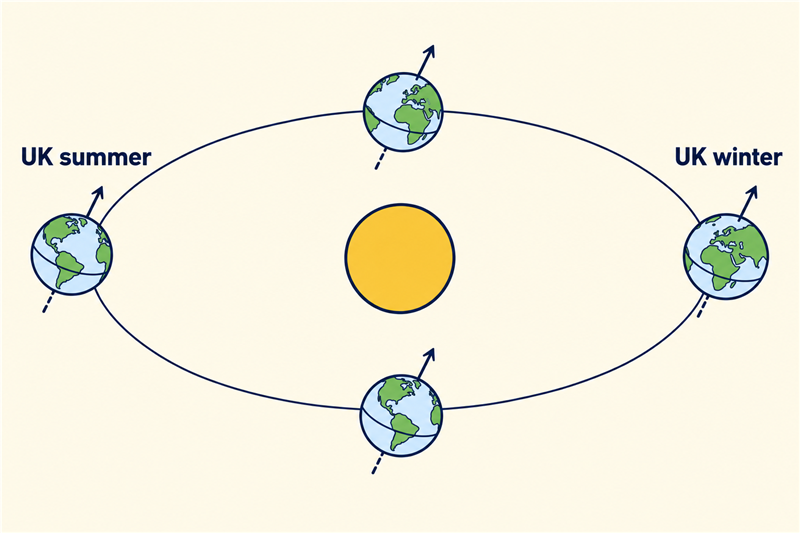
When the north leans towards the Sun, the UK has summer. At that moment the south leans away, so Australia has winter. Half a year later it swaps. That is why Christmas is hot in Sydney.
The tilt stays almost fixed over a year, but the Sun's position relative to it changes. That is what gives us the seasons.
Seasons happen because the Earth is closer to the Sun in summer.
Earth is closest to the Sun in early January, during UK winter. It receives slightly more solar energy then, but the 3.4% distance change cannot explain why the two hemispheres have opposite seasons.
Why leaning towards the Sun means warmer
Leaning towards the Sun does two things, and both warm you up.
First, the days get longer. In midsummer the UK has about 16 and a half hours of daylight, so the ground has more time to heat up. In midwinter it has under 8, and the ground has more time to cool.
Second, the Sun climbs higher in the sky. High sunlight lands on the ground almost head-on, so each patch of ground gets a concentrated dose. Low winter sunlight arrives at a slant and is spread over a bigger area, so each patch gets less. Torch a wall from straight on, then from a low angle, and you can see the same effect.
Hours of daylight in London
The four turning points of the year
The dates move by a day or so from year to year. The names are for the northern half of the world.
Spring equinox
Day and night are about the same length, and the days are getting longer.
Summer solstice
The north leans furthest towards the Sun, so this is the day with the most daylight.
Autumn equinox
Day and night are about the same length again, and the days are getting shorter.
Winter solstice
The north leans furthest away, so this is the day with the least daylight.
23.4°
The Earth's tilt. A small lean from upright, yet it is enough to give us every season.
Near the equator, and near the poles
The tilt matters less the closer you are to the equator. Places near it have days that stay close to 12 hours all year, so they do not get four seasons. Many have a wet season and a dry season instead.
Near the poles it matters most. Inside the Arctic Circle the Sun does not set at all around midsummer, and it does not rise for weeks around midwinter. These long bright and dark spells make the seasons especially noticeable there.
Why July is hotter than June
The longest day is in June, but the hottest weeks in the UK usually come in July and August. The land and the sea are still soaking up heat for weeks after the solstice, and each day they take in more than they lose. The sea warms and cools slowly, so it holds on to the heat. The warmest time arrives once the heat coming in has finally been matched by the heat going out. The same delay explains why January and February are often colder than the shortest day in December.
Sources:
- Facts About Earth — NASA, accessed 2026
- Earth’s orbital distances — NASA, accessed 2026
- The four seasons — Met Office, accessed 2026
- London daylight tables — timeanddate.com, 2026
Daylight and seasonal dates are approximate. Figures are for the UK unless stated.
Key takeaways
- The Earth's axis is tilted by about 23 degrees.
- The axis points in almost the same direction over one year.
- Summer is when your half leans towards the Sun.
- Distance from the Sun plays almost no part.
- The two halves of the world have opposite seasons.
Now you know.
The Earth is tilted, and it stays tilted all year.
As it goes round the Sun, each half takes a turn leaning towards it.
That lean gives longer days and higher sunlight, which is what we call summer.
Last reviewed 3 Nov 2026
Where next?
More in The World
-
Read
 The World
The planets
The eight planets of our Solar System, why some are rocky and some are giant balls of gas, and the rule that…
-
Read
 The World
Phases of the Moon
The Moon's phases come from seeing its sunlit half from a changing angle. See why the cycle takes 29.5 days…
-
Read
 The World
The greenhouse effect
The greenhouse effect is gases in the air slowing the escape of heat, keeping Earth about 33 °C warmer. See…