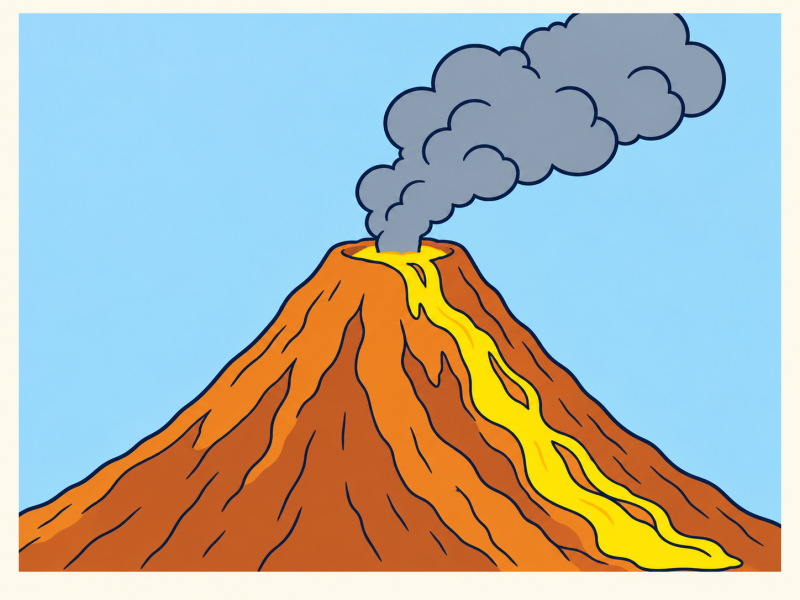
The short version
A volcano is an opening where molten rock, called magma, reaches the surface. The rock deep underground is mostly solid, and it only melts in particular places, mostly where the Earth's plates meet. Runny magma flows out gently, while thick magma traps gas and can explode.
I always pictured a volcano as a mountain sitting on a lake of liquid fire.
The rock under our feet is solid, almost all the way down. It melts only in a few special places.
A volcano is solid rock that has found a reason to melt.
Why rock melts
Under the thin crust we live on lies the mantle, a thick layer of hot rock. It is solid, though over millions of years it creeps slowly, like very stiff dough. For rock to melt, something has to change.
There are two main ways. In one, rock rises towards the surface and the pressure on it falls, which lets it melt even without getting hotter. In the other, water is added to hot rock, which lowers the temperature at which it melts. This happens where one plate of the Earth's crust slides under another and carries seawater down with it.
The new molten rock is lighter than the rock around it, so it rises. Underground it is called magma. Once it reaches the surface it is called lava.
Inside a volcano
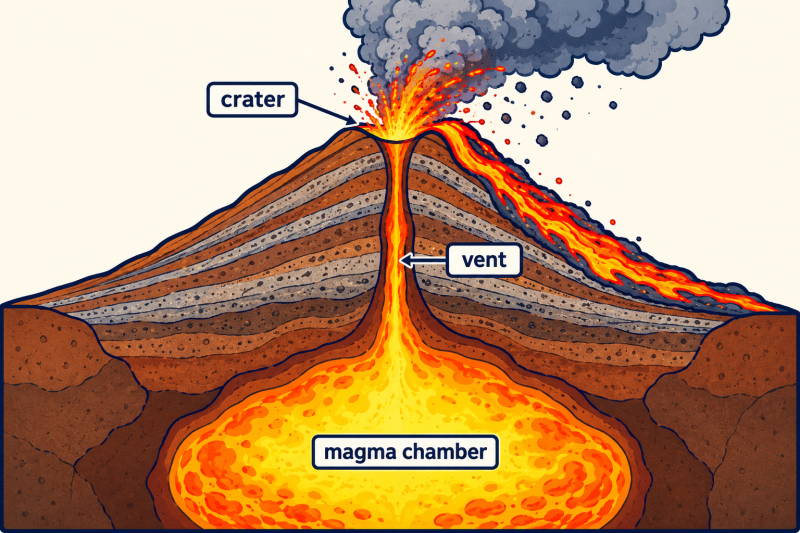
Magma gathers in a large pocket called a magma chamber. As more arrives, the pressure builds. Eventually the magma forces its way up through cracks, along a channel called a vent, and out of an opening at the top.
Each eruption leaves behind a layer of lava or ash. Over many eruptions these layers pile up and build the cone shape of the volcano.
The magma chamber is not a cave full of liquid. It is mostly hot, crystal-filled rock with pockets of melted rock between.
Gentle or explosive?
Magma has a lot of gas dissolved in it. How it behaves at the surface depends on how thick it is.
Runny magma lets the gas bubble out easily, and the lava flows. This is what happens in Hawaii, where lava runs down the slopes in glowing rivers.
Thick, sticky magma holds the gas in. The pressure builds until the magma blows apart in an explosion, throwing ash and rock into the air. It is like shaking a bottle of fizzy drink and then opening it. Mount St Helens in the USA erupted this way in 1980.
Three kinds of volcano
Shield volcano
wide and gentleRunny lava flows a long way before it sets, building broad, gently sloping mountains. Hawaii's volcanoes are like this.
Stratovolcano
steep and dangerousLayers of ash and lava build a tall cone. Eruptions can be explosive. Vesuvius and Mount Fuji are examples.
Caldera
a giant craterA huge eruption empties the magma chamber and the ground collapses into it, leaving a wide hollow. Yellowstone is one.
Under a volcano there is a huge lake of liquid rock.
The magma is held in pockets and channels in solid rock, like water in a sponge. The mantle beneath is solid, not liquid.
Where volcanoes are
Volcanoes are not spread evenly. Most lie along the edges of the plates that make up the Earth's crust, where plates pull apart or one slides under another. Around the edge of the Pacific Ocean runs a long chain of volcanoes known as the Ring of Fire, which holds about three-quarters of the world's active volcanoes.
Some volcanoes, such as Hawaii, are in the middle of a plate, above a long-lived hot spot in the mantle. Iceland has both: it sits on a gap where two plates are moving apart, and above a hot spot.
There are no active volcanoes in Great Britain. The hills of Arthur's Seat in Edinburgh and the Giant's Causeway in Northern Ireland are what is left of ancient eruptions, long extinct.
Famous eruptions
- AD 79 Vesuvius buries the Roman towns of Pompeii and Herculaneum in ash.
- 1815 Tambora in Indonesia erupts, and the following summer is cold across Europe.
- 1883 Krakatoa explodes, and the bang is heard nearly 5,000 kilometres away.
- 1980 Mount St Helens erupts in the USA.
- 2010 Ash from Iceland's Eyjafjallajökull closes airspace across much of Europe for days.
How volcanoes helped make the air and the sea
Volcanoes do more than build mountains. They also release gases from the Earth's interior: water vapour, carbon dioxide, sulphur dioxide and chlorine compounds. Over billions of years these gases helped build up the atmosphere and the oceans.
Some of the chloride in the sea's salt probably began as volcanic gas. See why the sea is salty.
Each year, between 50 and 70 volcanoes erupt somewhere in the world, most of them small.
Sources:
Key takeaways
- Magma forms where solid rock melts, by lower pressure or added water.
- Magma is molten rock underground; lava is the same rock at the surface.
- Runny magma flows; thick, gassy magma explodes.
- Most volcanoes lie along the edges of the Earth's plates.
- There are no active volcanoes in Great Britain.
Now you know.
A volcano is solid rock that has melted and risen.
Runny magma flows. Thick magma traps gas and explodes.
Most volcanoes sit where the Earth's plates meet.
Last reviewed 3 Nov 2026
Where next?
More in The World
-
Read
 The World
Seasons
Seasons come from the tilt of the Earth, not its distance from the Sun. See why days lengthen, why summer is…
-
Read
 The World
The planets
The eight planets of our Solar System, why some are rocky and some are giant balls of gas, and the rule that…
-
Read
 The World
Phases of the Moon
The Moon's phases come from seeing its sunlit half from a changing angle. See why the cycle takes 29.5 days…