
The short version
A planet is a round world that orbits the Sun and is gravitationally dominant in its orbital neighbourhood. Our Solar System has eight: four small rocky ones close to the Sun, and four giants far out. Pluto is a dwarf planet because it shares its neighbourhood with many other icy objects.
I always pictured the planets as a tidy row of balls, close together, like the poster on a school wall.
In real life they are separated by enormous empty gaps. The poster leaves out the best part.
What makes something a planet
In 2006 the International Astronomical Union (IAU), the organisation that sets many astronomy standards, agreed on three rules for planets in our Solar System. A planet must:
- orbit the Sun, which means travel around it on a curved path;
- be big enough for its own gravity to pull it into a round shape;
- have become gravitationally dominant in its orbital neighbourhood. It does not have to sweep up every small asteroid, but no other body of similar size shares its zone.
Eight worlds pass all three. In order from the Sun they are Mercury, Venus, Earth, Mars, Jupiter, Saturn, Uranus and Neptune. Planets do not make their own visible light. We see them because they reflect sunlight.
Pluto stopped being a planet because it is too small.
Size is not the rule. Pluto is round and orbits the Sun, but it has not cleared its orbital neighbourhood. It shares the Kuiper Belt with many icy objects. Its small size is not why it is a dwarf planet.
Four kinds of world
Planets are not all alike. Astronomers sort them into groups, and Pluto belongs to a separate group of dwarf planets.
Rocky planets
Solid ground, a metal core, and few or no moons.
Gas giants
Huge, with no solid surface you could stand on.
Ice giants
Rich in water, ammonia and methane beneath hydrogen-and-helium atmospheres.
Dwarf planets
Big enough to be round, but they share their orbit with other objects.
Mostly empty space
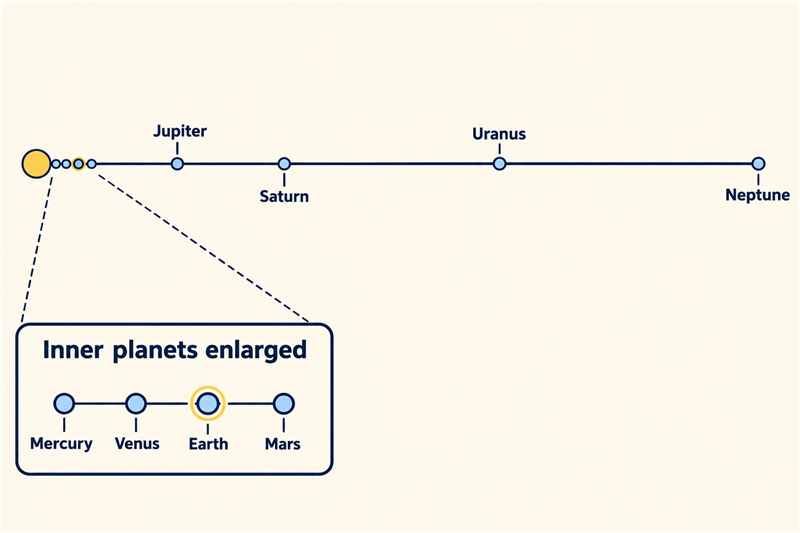
Draw the Solar System to scale and the planets almost vanish. The four rocky planets sit close to the Sun, and then there is a long gap before Jupiter. After Saturn the gaps get wider still.
School posters squash the distances so that everything fits. The sizes and the gaps cannot both be drawn to scale on one page.
How far from the Sun
A year is different on each planet
A planet's year is the time it takes to go once round the Sun. The nearer the Sun, the shorter the year. Mercury takes 88 Earth days. Earth takes 365. Neptune takes about 165 Earth years; it completed its first full orbit since its discovery in 1846 in 2011.
Distance changes the light too. Sunlight takes about 8 minutes to reach Earth. It takes about 4 hours to reach Neptune, so the light there is far weaker.
464°C
The average surface temperature of Venus. Its thick carbon dioxide atmosphere traps heat, making it hotter than Mercury, which is closer to the Sun.
Why the small planets are close and the giants are far
The Solar System began as a spinning cloud of gas and dust around the young Sun. Close to the Sun it was too hot for ice to survive, so only rock and metal could stick together. Those materials are rare, so the planets that grew there stayed small.
Further out, beyond a distance called the frost line, it was cold enough for water to freeze. Ice was plentiful, so planets grew much larger there. Once a planet grew massive enough, its gravity could pull in the hydrogen and helium gas around it. That is how Jupiter and Saturn became giants. Uranus and Neptune formed farther out, where there was less gas left to collect.
Astronomers think the planets then moved from where they first formed. This is a leading explanation, but the details are still being worked out.
Sources:
- IAU Resolutions B5 and B6, 2006
- NASA, About the Planets, accessed 2026
- NASA, Planetary Fact Sheet, accessed 2026
- NASA, Neptune exploration, accessed 2026
- NASA, Solar System facts, accessed 2026
- NASA, Solar System temperatures, accessed 2026
Key takeaways
- A planet orbits the Sun, is round, and has cleared its path.
- There are eight: four rocky and four giants.
- Pluto is a dwarf planet because it shares its path.
- The gaps between planets are far bigger than the planets.
- The nearer the Sun, the shorter the year.
Now you know.
A planet is a round world that rules its own path around the Sun.
Eight worlds qualify, and Pluto lost its place because of company, not size.
Between them lies mostly empty space.
Last reviewed 3 Nov 2026
Where next?
More in The World
-
Read
 The World
Seasons
Seasons come from the tilt of the Earth, not its distance from the Sun. See why days lengthen, why summer is…
-
Read
 The World
Phases of the Moon
The Moon's phases come from seeing its sunlit half from a changing angle. See why the cycle takes 29.5 days…
-
Read
 The World
The greenhouse effect
The greenhouse effect is gases in the air slowing the escape of heat, keeping Earth about 33 °C warmer. See…