- Home
- Technology
- Wi-Fi
Wi-Fi
How your phone, laptop and TV talk to the internet without a wire.
The short version
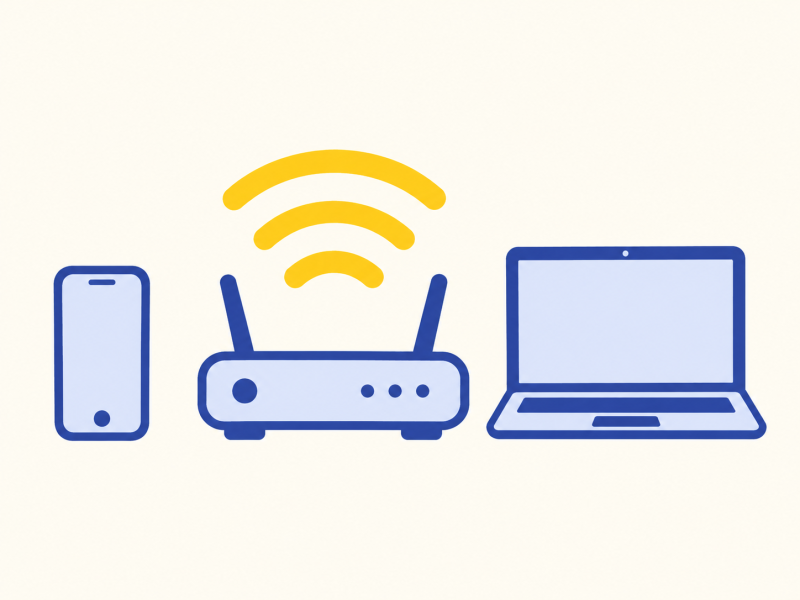
Wi-Fi is radio communication between your devices and a home router. The router passes data to and from your broadband connection, usually through a modem or fibre box. Devices send requests and receive replies over the radio link.
I always thought Wi-Fi was the internet, coming into the house through the air.
It is not. In a typical home, broadband arrives through a phone, cable or fibre connection.
Wi-Fi is only the last few metres.
What the router does
Your broadband connection reaches a modem or fibre box. The router connects to it, often by a cable. It passes data between your home and the internet, and runs a small radio network for your devices.
When your phone asks for a web page, it sends the request as radio waves. The router catches them, sends the request down the cable, receives the page, and broadcasts it back. All of that takes a few thousandths of a second.
Radio you cannot see
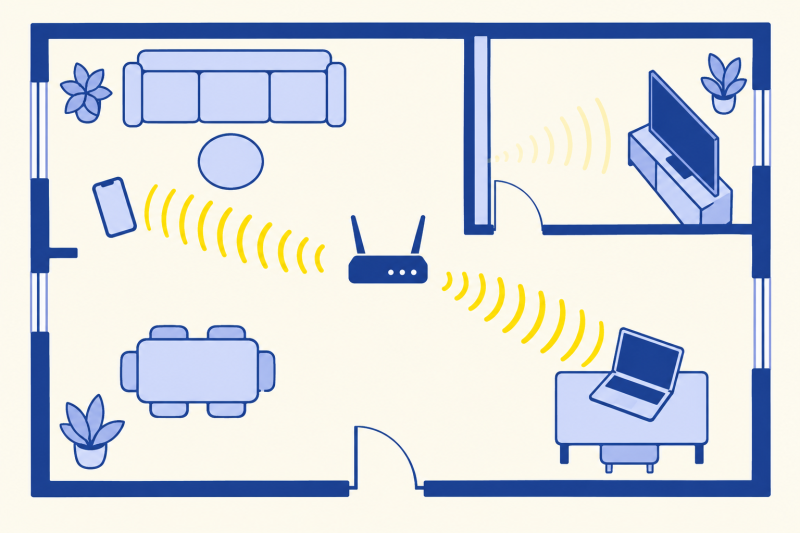
Wi-Fi uses radio waves at higher frequencies than broadcast radio. A home router uses a low-power signal; walls and distance quickly weaken it.
The waves carry data by changing very slightly, billions of times a second. Your device reads those changes as ones and zeros.
Signal strength, radio channel and legal power limits affect how far a network reaches. Nearby networks can also compete for airtime.
Two bands, two trade-offs
Many routers use the 2.4 GHz and 5 GHz bands. Some newer devices also support 6 GHz, which needs compatible equipment at both ends.
2.4 GHz
Longer reachOften travels further and through walls better, but can be slower and more crowded.
5 GHz
Higher capacityOften supports faster links nearby, but its signal usually weakens more through distance and walls.
Wi-Fi speed is the same thing as your broadband speed.
Your broadband speed measures the internet connection into your home. Wi-Fi adds another link that can become the bottleneck. A Wi-Fi link or local file transfer can be faster than your broadband plan.
2.4 billion cycles a second
The frequency of a 2.4 GHz Wi-Fi signal. Your router and a nearby device agree on which of dozens of channels to use, and switch if one gets crowded.
Why it is not instant everywhere
Radio waves get weaker as they spread out, and every wall, floor and mirror takes some away. Brick, concrete and water are worst. That is why the signal is strong in the room with the router and poor in the back bedroom.
Your devices share the airtime too. Only one device can talk on a channel at a time, so they take very quick turns. With many devices in use, each waits a little longer for a turn. Why Wi-Fi slows down explains this in more detail, and mesh systems and range extenders explain how to cover a bigger house.
How data gets onto a radio wave
The router splits your data into small packets. For each one it picks a pattern of tiny changes to the wave's strength and timing. Newer Wi-Fi uses patterns with thousands of possible combinations, so each tiny change carries many bits at once.
The receiver measures the wave and works out which pattern was sent. If the signal is clear, it can read complicated patterns and go fast. If it is noisy or weak, both ends switch to simpler patterns that are easier to get right. This is why your speed drops as you walk away from the router.
Note: a Wi-Fi password protects what you send over the air by scrambling it. Without a password, anyone in range could read it. See passwords and encryption.
Key takeaways
- Wi-Fi is radio between your devices and the router.
- The router is the gateway between your home devices and broadband.
- Walls and distance weaken the signal.
- Devices share airtime, so many devices slow each other.
- The 5 GHz band is faster; 2.4 GHz goes further.
Now you know.
Wi-Fi is radio.
The router is the bridge to the internet.
Walls and sharing are why it slows.
Last reviewed 3 Nov 2026
Where next?
Explained further by
-
Read
 Technology
Mesh and range extenders
How Wi-Fi range extenders and mesh systems spread a signal through a big house, why one halves your speed…
-
Read
 Technology
Why Wi-Fi slows down
Why Wi-Fi gets slow: distance, walls, crowded channels and too many devices sharing the same airtime, and…
More in Technology
-
Read
 Technology
Artificial intelligence
What AI means today: software that learns patterns from examples instead of following written rules, and…
-
Read
 Technology
Fingerprint and face unlock
How fingerprint and face unlock work: a scan becomes a pattern of numbers kept on the phone and compared each…
-
Read
 Technology
Bluetooth
How Bluetooth uses short-range radio to connect headphones, keyboards and speakers, why pairing is needed…