- Home
- Technology
- Streaming
Streaming and compression
How a film plays before it has finished arriving, and how huge files get small enough to send.

The short version
Streaming means playing something while it is still arriving. The film is cut into short pieces, each is squeezed small by compression, and your device plays one piece while it fetches the next. If the pieces arrive too slowly, you see the spinning circle, called buffering.
I always thought streaming was a different thing from downloading.
It is downloading, with the file playing as it comes in.
The difference is that nothing is kept.
Download versus stream
When you download a film, your device fetches the whole file, stores it, and plays it afterwards. When you stream, your device fetches a few seconds at a time, plays them, and throws them away. You can start straight away, and nothing fills your storage, but you need a steady connection to keep going.
How the pieces arrive
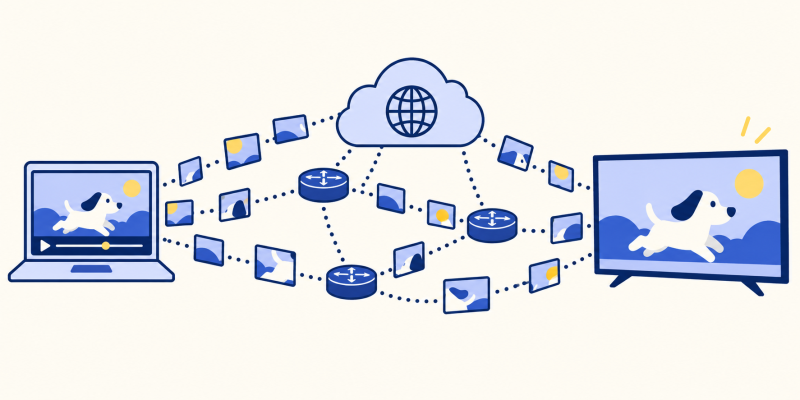
The film is stored on a server as many short clips, usually a few seconds each. Your device asks for the first, starts playing, and asks for the next while the first is playing. It keeps a few clips ahead in a short waiting line called a buffer.
If the connection slows, the buffer drains. When it is empty, the picture stops until more arrives. That is buffering.
Each clip is stored in several qualities. If your speed drops, the device quietly switches to a lower one rather than stop.
Why it starts quickly and looks sharp
Big services keep copies of popular films on servers close to you, in many towns and inside internet providers' own buildings. Your device downloads from the nearest, which is quicker than a distant one and spares the long-distance cables. Without this, every viewer in the country would fetch from the same place.
Squeezing it small
A raw film is enormous. A single hour of uncompressed high-definition video would fill hundreds of gigabytes. So the video is compressed: it is stored in a form that is much smaller, and unpacked on your device. How MP3s and JPEGs shrink files explains the tricks. How video streaming works goes through the process step by step.
How much speed you need
Typical speeds for a good stream, in megabits per second.
Streaming uses no data on your device.
It uses a lot. An hour of high-definition video is typically two to three gigabytes. That matters if you pay for your mobile data by the amount.
Note: the speeds are typical guides, and different services and quality settings differ. Check what your provider recommends.
Why a stream can get worse and better in the same film
Your device measures how quickly each clip arrives. If it is slow, it asks for the next clip in a lower quality, which is smaller. If it is quick, it moves up again. This is why a film may look blocky for a few seconds after you start it, or after a poor patch, then sharpen.
The system is called adaptive streaming. The aim is never to stop playing, even at the cost of looking worse for a short time.
Key takeaways
- Streaming plays a film while it arrives.
- Short clips are fetched a few ahead.
- Buffering is the buffer running empty.
- Quality adjusts to your speed.
- Compression makes it possible at all.
Now you know.
Streaming plays as it arrives.
A buffer keeps it smooth.
Compression shrinks the file.
Last reviewed 3 Nov 2026
Where next?
Explained further by
-
Read
 Technology
How MP3s and JPEGs shrink
How compression makes files smaller by removing detail your senses will not miss, and the difference between…
-
Read
 Technology
How video streaming works
What happens when you press play on a streamed video: the request, the nearby server, the first clips, the…
More in Technology
-
Read
 Technology
Artificial intelligence
What AI means today: software that learns patterns from examples instead of following written rules, and…
-
Read
 Technology
Fingerprint and face unlock
How fingerprint and face unlock work: a scan becomes a pattern of numbers kept on the phone and compared each…
-
Read
 Technology
Bluetooth
How Bluetooth uses short-range radio to connect headphones, keyboards and speakers, why pairing is needed…