- Home
- Technology
- Streaming
- Video streaming
How video streaming works
Step by step, from pressing play to the picture appearing.
The short version
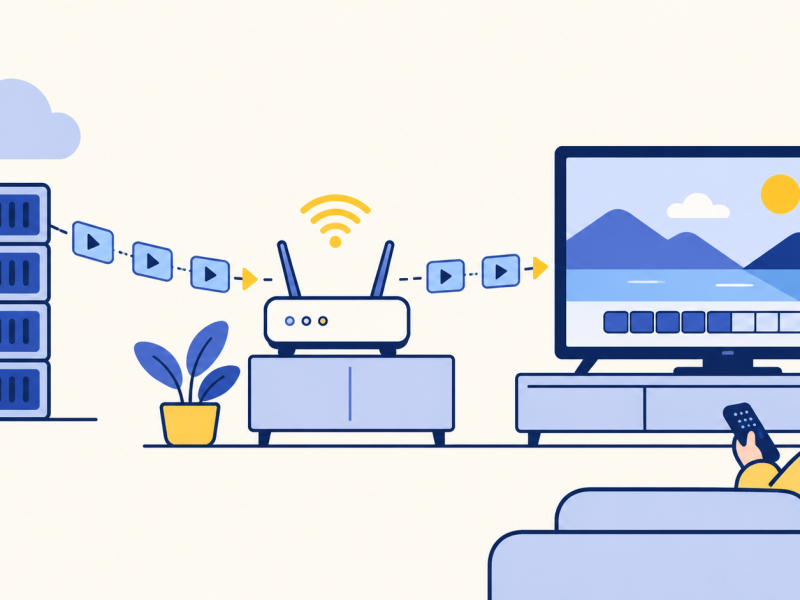
When you press play, your device asks a server for a list of the film's short clips, fetches the first, starts playing it, and carries on fetching ahead. The server nearest you provides them, and the quality shifts with your connection. It builds on streaming and compression.
I always thought the film travelled to me like a video call.
It is closer to a conveyor belt of short clips.
The device decides what to ask for next.
Press play
- Your device asks the service for the film. The service checks your account and replies with a list of the clips and the qualities available.
- Your device measures its connection and picks a quality to start.
- It fetches the first clips from a nearby server and starts playing at once.
- It keeps fetching ahead, aiming to stay about half a minute in front of what you see.
- If the connection changes, it moves up or down in quality.
Live and recorded
A recorded film can be prepared in advance in every quality. A live event is different: it must be captured, compressed and sent within seconds. The delay between the real event and your screen is usually several seconds, which is why a goal can reach your phone after a neighbour's cheer.
Key takeaways
- A video is a list of short clips.
- Your device asks for them a few ahead.
- A nearby server supplies them.
- Quality changes with your speed.
- Live video has a short delay.
Now you know.
The device asks for each clip.
The nearest server answers.
The quality adapts.
Last reviewed 3 Nov 2026