- Home
- Technology
- Printers
Printers
How a machine puts a page onto paper, using ink droplets, heat, or a layer-by-layer build.
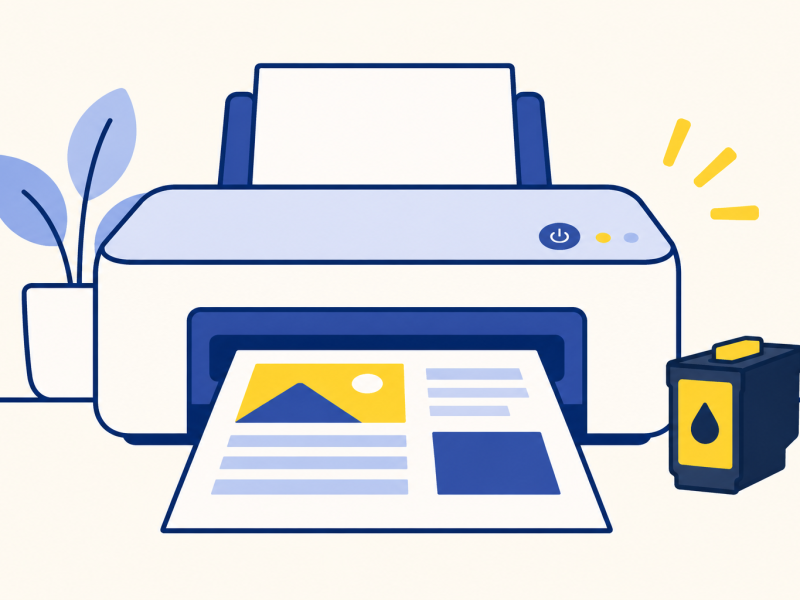
The short version
A printer puts the right coloured dots in the right places on paper. An inkjet fires tiny droplets of ink. A laser printer uses static electricity to make a powder stick in the shape of the page, then melts it on. A 3D printer builds an object in layers.
I always thought the printer drew each letter, like a pen.
It does not know what a letter is. It places thousands of dots.
The page is a grid of dots, like a screen.
A page is a grid of dots
Your computer works out the picture as a grid of dots, and sends the grid to the printer. The printer's job is to put a dot, or leave a gap, at each place. A typical home printer lays down hundreds of dots to the centimetre, which is why the dots blend into solid-looking letters and photographs.
Colour from four inks
Most colour printers use cyan, magenta, yellow and black. Tiny dots of these are placed side by side, or overlapping, and your eye blends them into other colours. Inkjet vs laser shows how the two kinds apply them.
Three kinds of printer
Inkjet
The dropletFires tiny drops of liquid ink onto the paper. Good for photographs.
Laser
The powderFuses a fine powder, called toner, onto the paper with heat. Fast and sharp for text.
3D printer
The builderLays down material layer by layer to build an object. See 3D printing.
A few picolitres
A picolitre is one trillionth of a litre. Inkjet printers use drops that small, though the exact size varies by printer and print setting.
Printers are cheap to run.
The printer is often sold cheaply and the ink is where the money is made. Over its life, a printer can cost much more in ink or toner than to buy.
Printing from the internet or a phone
Most printers connect over Wi-Fi. Your phone or laptop sends the page as data, and the printer turns it into dots with its own small computer.
Why a printed page needs to dry
Inkjet ink is a liquid, so a wet page can smudge for a moment, and special paper helps it soak in. A laser page comes out warm and dry, but toner is a plastic powder melted onto the surface, so a freshly printed laser page may slightly curl.
Paper and sharpness
Print sharpness is measured in dots per inch. Most home printers manage 600 or more, which is why text looks crisp. Photos look best on paper that holds the ink at the surface, which is why photo paper is coated.
Ordinary office paper weighs 80 grams per square metre. Heavier paper feels more solid, but is harder for some printers to feed through.
Key takeaways
- A printer places dots in a grid.
- Colour comes from four inks blended by the eye.
- Inkjets fire ink; lasers melt powder.
- The running cost can exceed the printer's price.
Now you know.
A page is a grid of dots.
Colour is four inks.
Ink can cost more than the printer.
Last reviewed 3 Nov 2026
Where next?
Explained further by
-
Read
 Technology
3D printing
How 3D printing works: software slices a design into layers, and a printer melts plastic or hardens resin to…
-
Read
 Technology
Inkjet vs laser
How inkjet printers fire ink through tiny nozzles and laser printers use static electricity and heated toner…
More in Technology
-
Read
 Technology
Artificial intelligence
What AI means today: software that learns patterns from examples instead of following written rules, and…
-
Read
 Technology
Fingerprint and face unlock
How fingerprint and face unlock work: a scan becomes a pattern of numbers kept on the phone and compared each…
-
Read
 Technology
Bluetooth
How Bluetooth uses short-range radio to connect headphones, keyboards and speakers, why pairing is needed…