- Home
- Technology
- Artificial intelligence
- AI mistakes
Why AI makes things up
Why a chatbot can sound completely sure and still be wrong.
The short version
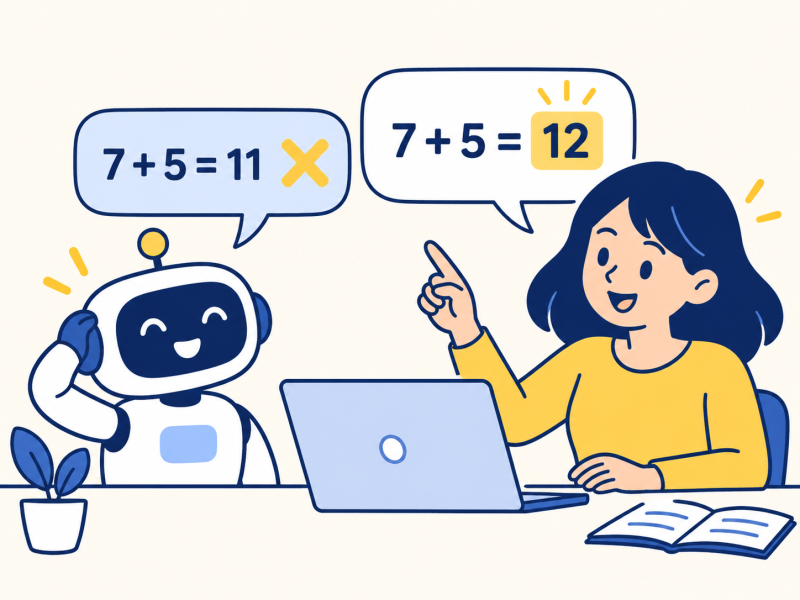
A chatbot writes what is likely to come next, not what has been checked. When it knows little, it still produces fluent, confident text, and some of that is false. The mistakes are called hallucinations. They can be reduced but not removed, so anything that matters needs checking. It builds on how a chatbot is trained.
I always assumed that if a chatbot did not know something, it would say so.
Often it does not.
Sounding right is what it was trained to do.
Likely is not true
The model learned to produce text that looks like text people write. A confident, detailed answer looks very like a correct one. If the facts it learned are thin or conflicting, the pattern still wants to be completed, so it fills the gap with something plausible: a made-up name, a date, or a reference that does not exist.
A language model does not reliably know when its answer is wrong. It generates likely text, and its confidence in the wording is not proof that the claim is true.
A chatbot lies on purpose.
Lying needs an intention to deceive. A chatbot has no intentions. It is following patterns, and a wrong answer is a failure of those patterns.
Catching mistakes
Ask for sources, then check that they exist and say what is claimed. Be most careful with names, numbers, quotes and recent events. Ask the same question another way, and see if the answers agree. For anything medical, legal or financial, treat the answer as a starting point and ask a professional.
Tools that let a chatbot search first, then answer from what it found, reduce the problem, since the answer can be tied to a real page.
Note: this explains how it works in general. It is not advice for your situation. For a decision about your health, money or legal position, check an official source or ask a qualified professional.
Key takeaways
- A chatbot predicts likely words.
- It has no built-in check for truth.
- Fluent text can be wrong.
- Check names, numbers and sources.
Now you know.
Likely is not true.
Confident is not correct.
Check what matters.
Last reviewed 3 Nov 2026