- Home
- Everyday Life
- Tumble dryer
Tumble dryer
How a tumble dryer gets the water out of your washing, and why a heat pump dryer costs much less to run.
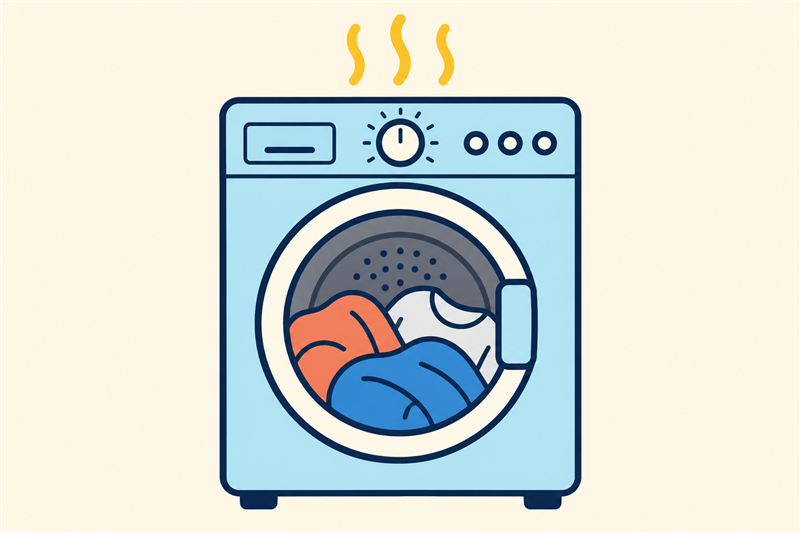
The short version
A tumble dryer blows warm air through clothes as the drum turns. The air carries water away through a hose or into a tank. Heat pump dryers reuse much of their warmth, so they often use less energy; savings vary by model.
I always assumed a tumble dryer boiled the water out of my clothes.
The water never boils. It evaporates into warm air, and the air does the work.
Drying is evaporation
Wet washing dries because water turns to vapour. That happens at any temperature, as a puddle shows, but warm air takes up vapour much faster than cold air.
A dryer uses a fan to blow air over a heater and through the tumbling clothes. Tumbling matters as much as the heat. It keeps lifting and separating the fabric so the air reaches every part. The air leaves full of water vapour, and something has to deal with that damp air.
Many dryers use a moisture sensor to decide when to stop. In some models, metal bars inside the drum measure how easily electricity passes through the clothes: wet fabric conducts better than dry fabric.
Three ways to get rid of the damp air
What happens to the damp air is the main difference between dryers.
Vented
sends it outsideA hose carries the damp, warm air through a window or wall, and fresh air is warmed to replace it.
Condenser
catches the waterThe damp air is cooled so the water turns back into liquid and drips into a tank you empty.
Heat pump
reuses the heatA sealed circuit cools the air to remove the water, then uses the same heat to warm the air again.
Inside a heat pump dryer
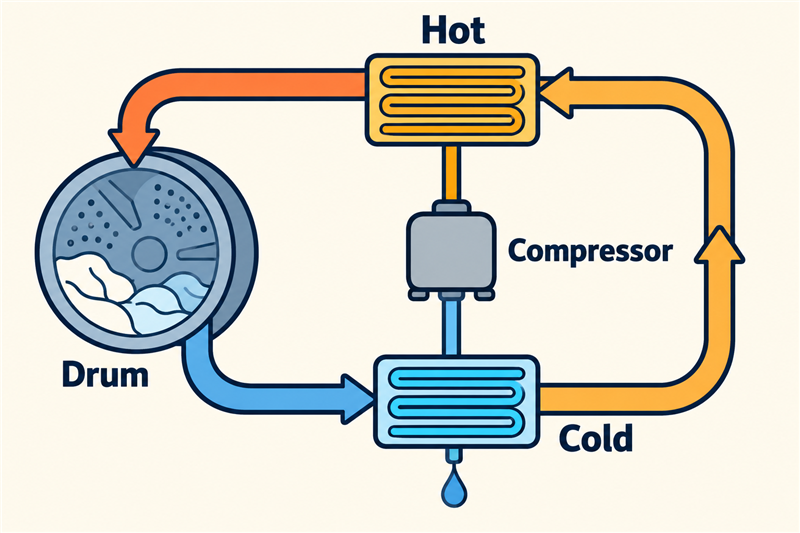
The air goes round a closed loop. It passes through the clothes, then over a cold part that makes water condense and drain away, then over a hot part that warms it again before it returns to the drum. The machine collects the water rather than venting damp air outside.
Most of the heat in the other types leaves with the air, which is why they cost more to run.
Less energy
Heat pump dryers often use substantially less energy than conventional dryers, but the difference varies by model and test conditions.
What makes drying cost money
A tumble dryer is one of the most expensive appliances in the home to run, because heating air takes a lot of energy and most of that heat is lost. You can cut the cost in three ways.
Spin the washing as fast as the fabric allows, because water removed by the washing machine does not need heating. Do not overfill the drum, because the air cannot reach crowded clothes. And clean the lint filter after every load. Fluff blocks the air, makes the dryer work harder, and can be a fire risk.
To see how running costs relate to power, read power and watts.
How a heat pump dryer reuses its heat
A heat pump dryer has two heat exchangers joined by a pipe of refrigerant, the same kind of liquid as in a fridge. A compressor keeps it moving.
The first exchanger, the evaporator, is cold. Damp air from the drum passes over it, cools below its dew point, and the water condenses out and drips away. At the same time, the refrigerant inside takes up heat from the air and starts to evaporate.
The compressor squeezes that vapour, which makes it hot. The second exchanger, the condenser, gives the heat back to the now dry air. The air flows into the drum, warm and thirsty, and the cycle repeats.
The drum runs at a lower temperature than in other types, so clothes are treated more gently. The cycle is often longer.
Sources: US Department of Energy guidance on heat-pump dryer energy savings. Compare the energy labels for specific models; savings vary.
Key takeaways
- Clothes dry by evaporation into warm moving air.
- Tumbling matters as much as the heat.
- Vented, condenser and heat pump dryers deal with the damp air differently.
- Heat pump dryers reuse heat and often use substantially less energy than conventional dryers.
- A faster spin and a clean filter both help.
Now you know.
A dryer does not boil the water; it evaporates it.
Most of the cost is lost heat.
A heat pump dryer reuses the heat.
Last reviewed 3 Nov 2026
Where next?
More in Everyday Life
-
Read
 Everyday Life
Washing machine
How a washing machine fills, heats, tumbles, rinses and spins, and why detergent and gentle tumbling clean…
-
Read
 Everyday Life
Charging an electric car
How charging an electric car works: the difference between kW and kWh, how long a charge takes at home and on…
-
Read
 Everyday Life
Car brakes
How car brakes work: fluid carries your foot's push to each wheel, pads squeeze a disc, and why doubling…