- Home
- Everyday Life
- Washing machine
Washing machine
What happens behind the round window, and why the fast spin removes water rather than cleaning.

The short version
A washing machine fills a drum with water and detergent, then tumbles your clothes slowly through it. On warm or hot cycles it heats the water. Detergent loosens dirt and water carries it away. At the end the drum spins very fast to throw most of the water out, so your clothes are damp rather than dripping.
I always assumed the drum spun round and round to scrub the clothes clean.
It turns slowly and tumbles them. The fastest spin comes at the end, and it removes water rather than dirt.
What happens in one wash
Most front-loading programmes follow these steps, though some add a pre-wash or extra rinse.
- Fill. A valve opens and water runs in, flushing detergent from the drawer on its way.
- Heat. In a typical UK front-loader, an electric element heats water for a warm or hot cycle. A cold setting may skip this step.
- Wash. The drum turns slowly. Ridges on its inside lift the clothes and let them fall back into the water, again and again.
- Drain. A pump pushes the dirty water out through the waste pipe.
- Rinse. Clean water runs in and the tumbling repeats, to wash the detergent out.
- Spin. The drum speeds up and throws out most of the remaining water.
A safety lock keeps the door closed during the wash. It releases when the machine judges it is safe to open.
Four things that clean your clothes
A useful cleaning model groups the main influences into four: detergent, movement, heat and time. They work together, but the balance depends on the fabric, soil and programme.
Detergent
Surfactants help water carry away oily soil; other ingredients target other stains.
Tumbling
Clothes fall through the water and rub against one another and the drum.
Heat
Warmer water can help detergents work and oily soil loosen.
Time
A longer cycle gives the other cleaning factors more time.
Inside the machine
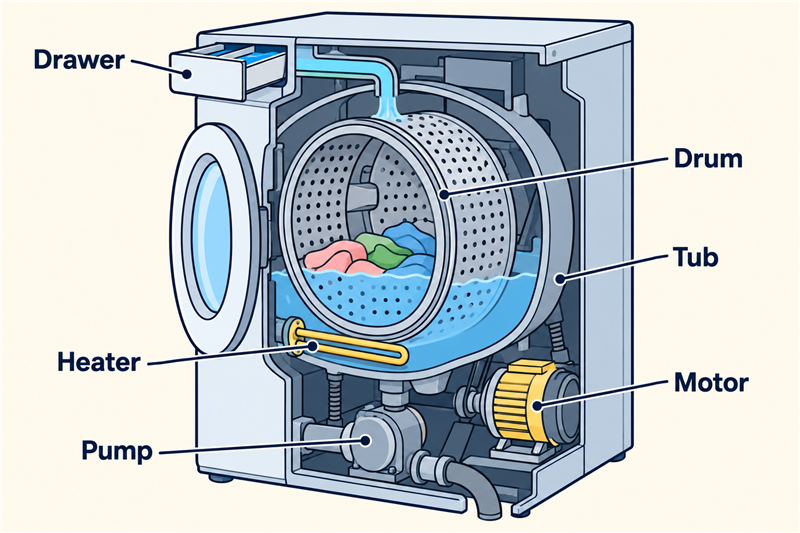
Your clothes sit in an inner drum full of small holes. It spins inside an outer tub that holds the water. A motor turns the drum, a heater warms the water, and a pump empties the tub.
The tub is only part filled. Clothes are lifted out of the water and dropped back in, rather than floating in it.
How detergent lifts dirt
Dirt sticks to fabric in different ways. Grease and oil are hard for water to carry away. Detergent contains cleaning agents called surfactants. Each molecule has two ends: one that mixes with water and one that is attracted to oil and grease.
The grease-loving ends attach to oily soil while the water-loving ends stay in the wash water. This helps loosen and disperse the soil so rinse water can carry it away. Detergents can also contain other ingredients, such as enzymes, that target different stains.
More detergent gives cleaner clothes.
Adding more than the recommended amount does not automatically make clothes cleaner. Excess detergent can leave residue or create more suds, which can make rinsing harder.
Why a hot wash uses more energy
Warming water takes energy, so a cooler wash usually uses less electricity. The motor and pump use electricity too. Energy Saving Trust notes that lower temperatures use less energy.
Spinning faster removes more water, which cuts the time clothes need to dry. Many front-loaders can spin between 1,000 and 1,600 turns a minute, though the maximum depends on the model. If you want to see how a running cost turns up on your bill, read why an electricity bill can be so high.
About 550 times gravity
The acceleration at the edge of a 50 cm drum spinning at 1,400 turns a minute. The drum holds the clothes against its wall while water escapes through the holes.
How the machine knows how much water is in it
Many front-loaders use a pressure sensor to monitor the water level. A narrow air tube connects the lower tub to the sensor. As water rises, it compresses the air in the tube and raises the pressure. The sensor signals the control board when the water reaches the target level.
As the tub drains, the pressure drops, telling the control board that most of the water has gone.
Some machines estimate the load and adjust the amount of water. During the spin, sensors can detect an uneven load; the machine may slow down and try to redistribute the clothes before speeding up again.
Sources:
- Energy Saving Trust: machine energy, accessed 2026
- Beko: spin speed, accessed 2026
- Bosch: pressure switch, accessed 2026
- Bosch: sensors, accessed 2026
- ACI: surfactants, accessed 2026
- Miele: Sinner's Circle, 2019
Spin estimate: 50 cm drum, 1,400 rpm. Figures are approximate.
Key takeaways
- The drum tumbles to wash; the final fast spin removes water.
- Detergent, movement, heat and time all do part of the cleaning.
- Detergent wraps dirt so that water can carry it away.
- A hotter wash usually uses more energy to warm the water.
- Extra detergent does not clean better.
Now you know.
Your clothes are cleaned by detergent and slow tumbling, not by speed.
The final fast spin removes water, not dirt.
And a hot wash uses extra energy to warm its water.
Last reviewed 3 Nov 2026
Where next?
More in Everyday Life
-
Read
 Everyday Life
Charging an electric car
How charging an electric car works: the difference between kW and kWh, how long a charge takes at home and on…
-
Read
 Everyday Life
Car brakes
How car brakes work: fluid carries your foot's push to each wheel, pads squeeze a disc, and why doubling…
-
Read
 Everyday Life
Dishwasher
How a dishwasher cleans with spinning spray arms, hot water, detergent, rinse aid and salt, and why you do…