- Home
- Everyday Life
- Car brakes
Car brakes
What happens when you press the pedal, and why braking distance grows so quickly with speed.
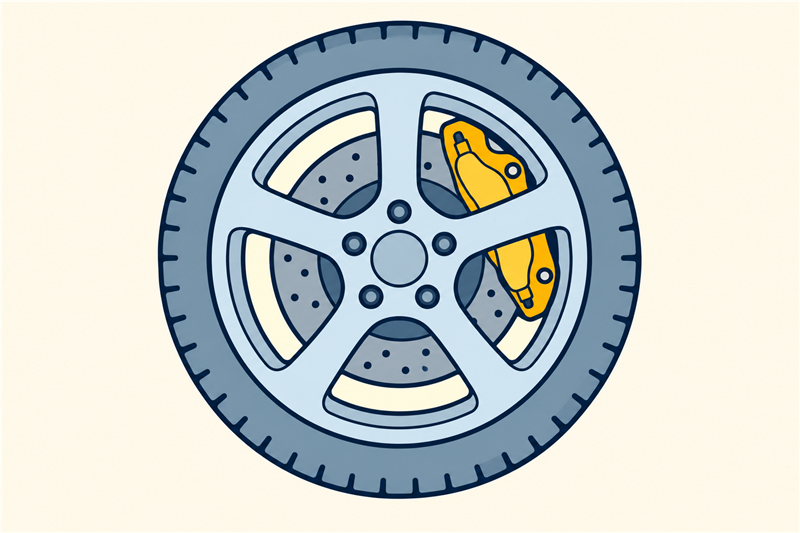
The short version
When you press the brake pedal, you push brake fluid through pipes to each wheel. There it squeezes pads against a spinning disc, and friction turns the car's movement into heat. With the same grip and braking force, doubling your speed means about four times the braking distance.
I always assumed the pedal pulled a cable, like the brakes on a bicycle.
In a car, the pedal pressurises brake fluid, which carries the push to the pads at each wheel.
From your foot to the wheel
The pedal pushes a piston into a cylinder full of brake fluid. The fluid is hard to compress, so pressure travels through the pipes to a piston at each wheel.
That piston presses brake pads against both sides of a metal disc that spins with the wheel. The pads grip the disc, and the friction slows the wheel and the car. A part called a servo multiplies the force of your foot, so you do not have to push as hard as the brakes need.
Inside a disc brake
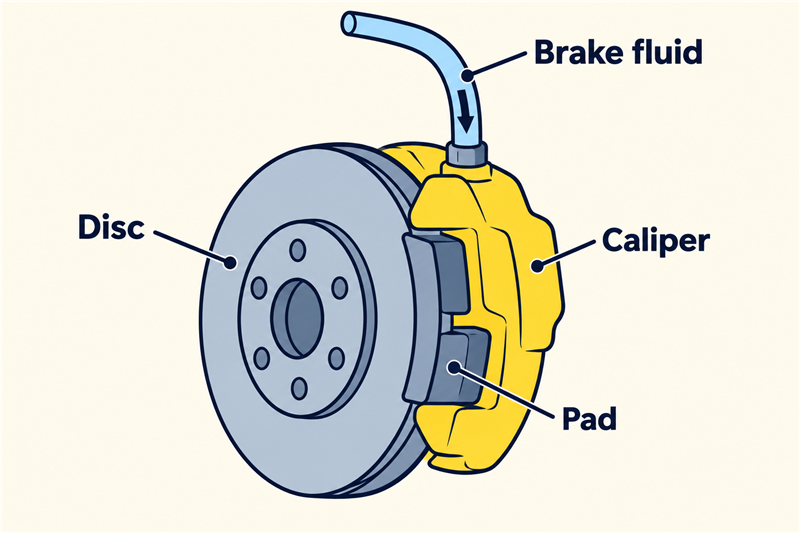
The caliper is the clamp that holds the pads either side of the disc. When fluid pushes the piston, the pads close on the disc like fingers squeezing a spinning plate.
The fluid works because a small push on a small piston turns into a bigger push on a bigger piston. That is how a modest push on the pedal becomes a very strong grip.
Where the energy goes
A moving car has movement energy. Brakes do not destroy it, they turn it into heat. The discs can become hot enough to glow in extreme cases. This is why brakes can fade on a long, steep descent if they are used continuously.
Braking also shifts weight onto the front wheels, in the same way you are pushed forwards when a bus stops. Because the front tyres are pressed harder onto the road, the front brakes generally do more work.
Doubling your speed doubles your braking distance.
A car's movement energy rises with the square of speed, so doubling speed means four times the energy to remove. With the same grip and braking force, braking distance is about four times longer, not twice. Reaction distance is separate.
Typical stopping distances in dry conditions
These include the distance travelled while you react, as well as the braking distance.
What electric cars do differently
Many electric cars can slow down in a second way. When you lift off the accelerator, the turning wheels drive the motor as a generator. It slows the car and sends some electricity back to the battery. This is called regenerative braking.
This can mean the pads and discs work less often. When you press the pedal, many electric cars blend regenerative braking with the ordinary pads and discs. How much each system contributes depends on the car and driving conditions.
What anti-lock brakes do
If you brake so hard that a wheel stops turning while the car is still moving, the tyre skids. A rolling tyre can keep steering grip on many road surfaces; a locked tyre slides. On loose gravel or snow, a locked wheel can sometimes stop in a shorter distance, but steering control is reduced.
Anti-lock brakes, or ABS, help prevent that. A sensor measures how fast each wheel is turning. If a wheel is about to lock, the system briefly lowers brake pressure at that wheel, then raises it again, many times a second.
The wheels keep rolling, which helps you steer during hard braking. You may feel the pedal pulse. That is the system working. ABS does not always shorten stopping distance; on some loose surfaces, a locked wheel can stop sooner.
Sources:
- Highway Code, rule 126, accessed 2026
- Bosch, ABS, accessed 2026
- US Department of Energy, regenerative braking, accessed 2026
- Bosch, brake booster, accessed 2026
The 4× comparison assumes unchanged grip and braking force. Highway Code figures are typical dry-road guides.
Key takeaways
- Brake fluid carries the push of your foot to each wheel.
- Pads squeeze a disc and friction creates heat.
- The front brakes do most of the work.
- With the same grip, doubling speed means about four times the braking distance.
- ABS keeps the wheels rolling so you can steer.
Now you know.
Your foot pushes fluid, and the fluid squeezes the brakes.
Braking turns movement into heat.
And on the same road, twice the speed needs about four times the distance.
Last reviewed 3 Nov 2026
Where next?
More in Everyday Life
-
Read
 Everyday Life
Washing machine
How a washing machine fills, heats, tumbles, rinses and spins, and why detergent and gentle tumbling clean…
-
Read
 Everyday Life
Charging an electric car
How charging an electric car works: the difference between kW and kWh, how long a charge takes at home and on…
-
Read
 Everyday Life
Dishwasher
How a dishwasher cleans with spinning spray arms, hot water, detergent, rinse aid and salt, and why you do…