- Home
- The Human Body
- Muscles
Your muscles
How muscles pull, why they work in pairs, and what a pulled muscle really is.

The short version
A muscle can only pull, never push. It is made of bundles of fibres that slide over each other and shorten when a nerve signal arrives. Because muscles can only pull, they work in pairs: one bends a joint and the other straightens it again.
I always assumed muscles pushed my arm straight as well as bending it.
They can't. They only ever shorten.
So straightening your arm needs a second muscle.
Muscles pull, tendons connect
The muscles you move on purpose, such as those in your arms and legs, are called skeletal muscles. Each is attached to bones by tough cords called tendons. When the muscle shortens, it pulls on the bone, and the joint bends.
The biceps, at the front of your upper arm, pulls your forearm up. To lower it again, the triceps at the back shortens and pulls it down. While one works, the other relaxes. This is called a working pair.
Three types of muscle
Skeletal
You control itMoves your bones, and tires with use.
Cardiac
Heart onlyBeats on its own without tiring, for life.
Smooth
Works on its ownLines the gut and blood vessels, and works without you thinking.
How a fibre shortens
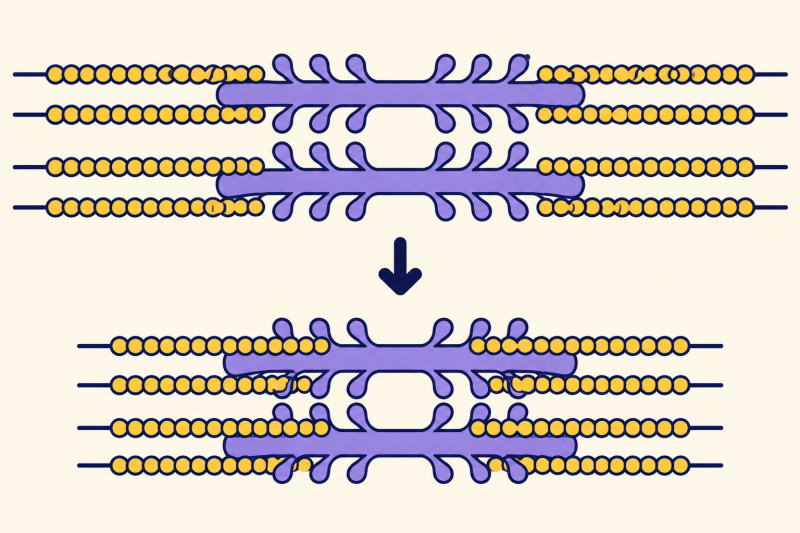
Inside every muscle fibre are long strands of two proteins, actin and myosin. Tiny parts of the myosin grab the actin and pull it along, then let go and grab again, rather like a row of people pulling in a rope hand over hand. The strands slide past each other and the fibre gets shorter.
This needs energy, which the muscle gets from the food you eat and the oxygen your blood brings, and some of it is released as heat. That is why you warm up when you exercise.
A nerve signal triggers each contraction. For more about that, read how your brain sends signals.
About 600
The approximate number of skeletal muscles in the human body. Counts vary depending on how they are divided.
What a pulled muscle is
A pulled muscle, also called a strain, is a small tear in the fibres, or in the tendon, caused by stretching too far or too suddenly. The torn fibres bleed a little and the area becomes sore and swollen. Severity varies. The body repairs the damaged tissue over time; recovery can take days or weeks depending on the injury.
Lactic acid causes the soreness you feel a day or two after exercise.
Lactate levels fall relatively quickly after exercise. Soreness that develops a day or two later is linked to changes in muscle after unfamiliar or strenuous activity, not lactic acid left behind.
How muscles get bigger
When muscles are challenged repeatedly, training can stimulate the existing fibres to grow. Adaptation depends on the exercise, recovery and nutrition; muscle damage is not required for progress.
Muscle gets bigger because the existing fibres get thicker, not because you grow lots of new fibres. And if you stop using a muscle, the fibres shrink again.
Note: this explains how it works in general. It is not advice for your situation. For a decision about your health, money or legal position, check an official source or ask a qualified professional.
Sources: NHS: sprains and strains; Dudley Group NHS: sprains and strains. Muscle counts are approximate and vary by definition.
Key takeaways
- Muscles can only pull, never push.
- Tendons attach muscles to bones.
- Muscles work in opposing pairs.
- Fibres shorten as protein strands slide.
- A pulled muscle is a small tear.
Now you know.
Muscles only pull.
So they work in pairs.
And next-day soreness is tiny tears, not lactic acid.
Last reviewed 3 Nov 2026
Where next?
More in The Human Body
-
Read
 The Human Body
Your eyes
How the eye focuses light onto the retina, how rods and cones work, how we see colour, and what colour…
-
Read
 The Human Body
Your ears
How the ear turns air vibrations into sound through the eardrum, three tiny bones and the cochlea, and how…
-
Read
 The Human Body
Sleep
What happens during sleep, how the sleep stages and body clock work, why the brain stays active at night and…