- Home
- The Human Body
- Ears
Your ears
How your ears turn vibrations into sound, and how they also keep you upright.

The short version
Sound is vibrating air. Your outer ear funnels it to the eardrum, three tiny bones pass the vibration on, and a fluid-filled spiral called the cochlea turns it into nerve signals. Next to the cochlea, three small loops of fluid sense head movement, which is how your ears help you balance.
I always assumed my ears only did hearing.
They also tell your brain which way is up.
An infection affecting the inner ear can disturb balance and make you feel as if the room is spinning.
Catching the sound
The part you can see is the outer ear. Its curved shape collects sound and guides it down the ear canal to the eardrum, a thin sheet of skin stretched across the end. Sound waves make the eardrum vibrate.
Behind the eardrum is the middle ear, an air-filled space. Three tiny bones, the hammer, anvil and stirrup, pass the vibration across it. They are the smallest bones in the body, and together they make the vibration stronger before it reaches the inner ear.
Inside the inner ear
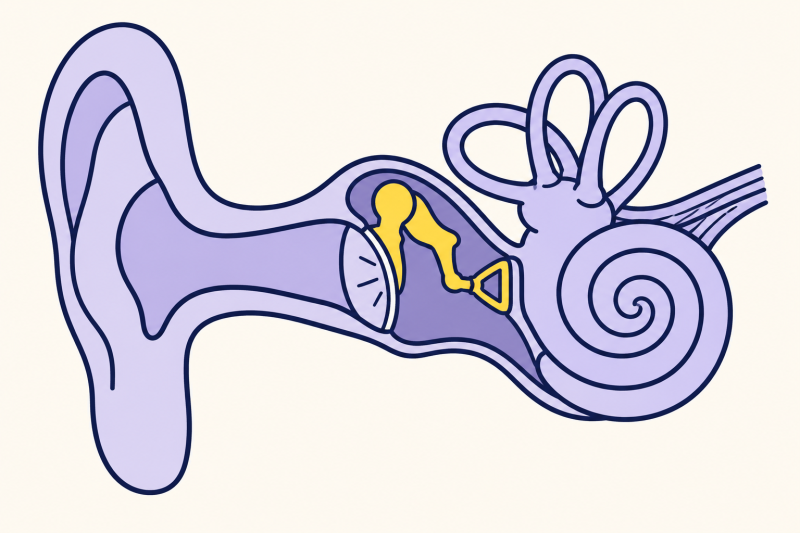
The cochlea (KOCK-lee-uh) is a small, fluid-filled spiral tube shaped like a snail shell. When the stirrup bone pushes on it, waves travel through the fluid. Thousands of tiny hair cells lining the tube bend as the waves pass, and each one turns its movement into an electrical signal.
Different parts of the spiral respond to different pitches. High notes are picked up near the start of the spiral and low notes near the far end.
Hair cells in humans do not grow back if they are damaged. That is why loud noise can cause lasting hearing loss.
About 15,000
The approximate number of hair cells in one cochlea. This is a tiny number compared with the 120 million light cells in an eye.
How loud things are (decibels)
How you keep your balance
Next to the cochlea are three small fluid-filled loops, called the semicircular canals, each facing a different direction. When your head turns, the fluid in the matching loop lags behind for a moment, bending tiny hairs that tell the brain which way you are turning.
If you spin round and round, the fluid keeps moving after you stop. Your brain gets a signal that you are still spinning, while your eyes say you are not. That mismatch is the dizzy feeling.
Ear wax means your ears are dirty.
Wax is made by the ear itself. It traps dust and protects the skin of the canal, and it moves slowly out of the ear on its own. Poking into the ear with cotton buds can push wax in.
Why the middle ear bones matter
Sound is carried by air outside the ear, but by fluid inside the cochlea. Moving fluid takes much more force than moving air, and most sound would bounce off the surface of the fluid.
The eardrum is much larger than the part of the stirrup that touches the cochlea, and the three bones act as a lever. Together they concentrate the force, which makes it possible to move the fluid. Without this, we would hear far less.
Note: this explains how it works in general. It is not advice for your situation. For a decision about your health, money or legal position, check an official source or ask a qualified professional.
Sources: Leeds Teaching Hospitals: the ear; Yorkshire Auditory Implant Service: how we hear; Royal Free London: protecting your hearing. Sound levels vary with distance and environment.
Key takeaways
- The eardrum vibrates when sound arrives.
- Three tiny bones strengthen the vibration.
- Hair cells in the cochlea make nerve signals.
- Hair cells do not grow back.
- Fluid loops in the inner ear sense balance.
Now you know.
Hearing is vibration turned into signals.
Hair cells do not grow back.
And your ears also keep you balanced.
Last reviewed 3 Nov 2026
Where next?
More in The Human Body
-
Read
 The Human Body
Your eyes
How the eye focuses light onto the retina, how rods and cones work, how we see colour, and what colour…
-
Read
 The Human Body
Sleep
What happens during sleep, how the sleep stages and body clock work, why the brain stays active at night and…
-
Read
 The Human Body
Your lungs
How the lungs move oxygen into the blood and carbon dioxide out, what the diaphragm does, and why carbon…