- Home
- The Human Body
- Brain signals
How signals travel
How nerves carry messages, and why you pull your hand away before you feel the pain.
The short version
Your nervous system is a network of nerve cells, called neurons. Each sends a tiny electrical pulse along its length, and passes the message to the next cell using chemicals. Signals can travel faster than 100 metres a second, and some reactions, called reflexes, are handled by the spinal cord without waiting for the brain.
I always assumed I felt pain first and then pulled my hand away.
The withdrawal movement can start before you consciously feel pain. The spinal cord sends a rapid signal to the muscles while signals also travel to the brain.
One cell, one message
A neuron is a cell with a long, thin fibre called an axon. When it is triggered, an electrical pulse runs along the axon. It is not electricity flowing like current in a wire. It is a wave of charged atoms, called ions, moving in and out through the cell's surface, one section after another.
Some axons are wrapped in a fatty coating called myelin, which makes the pulse jump along much faster.
How fast signals travel
The gap between cells
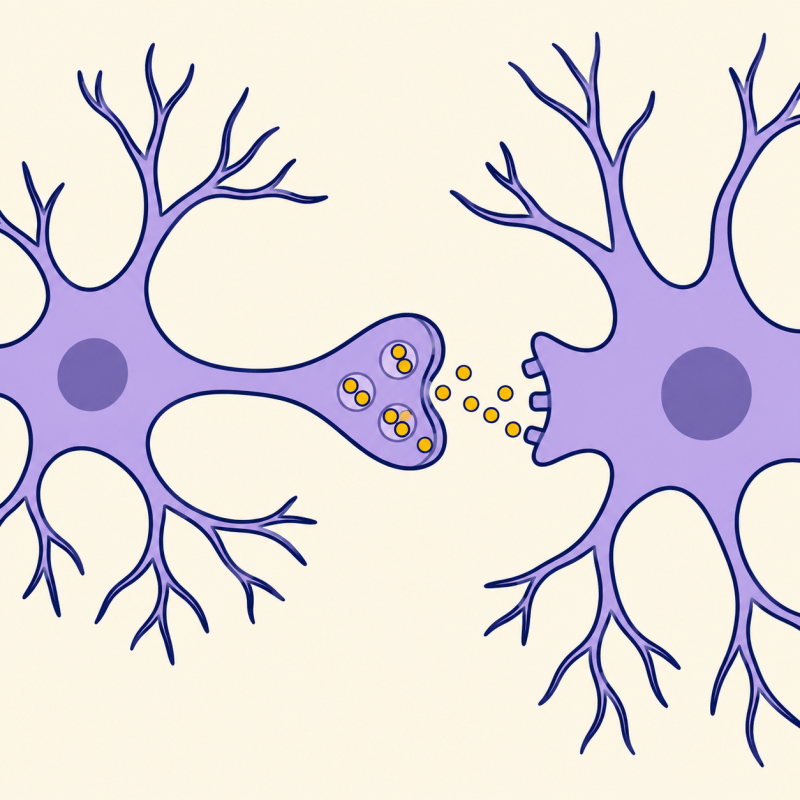
Neurons do not quite touch. At the end of an axon is a tiny gap, called a synapse. When the pulse arrives, the cell releases chemicals, called neurotransmitters, that cross the gap and trigger the next cell.
The brain has about 86 billion neurons, and each can connect with thousands of others.
About 20 watts
The power used by the human brain, about the same as a dim light bulb, which is around a fifth of your body's energy at rest.
Why reflexes are so fast
A signal from the brain to your hand and back takes time. For a hot pan, there is a shortcut. The pain signal runs up the nerve to the spinal cord, and there it meets a nerve cell that sends a command straight back to the arm muscles. The hand moves before the signal reaches the brain.
This loop is called a reflex arc. Signals also reach the brain, where pain is consciously perceived; the movement can begin first.
We only use 10% of our brains.
Brain imaging and the effects of injury show that many brain regions have roles; activity changes with the task. The popular claim that we use only 10% of the brain is false.
Why signals do not weaken as they travel
A pulse along an axon is renewed at every step. Each section of the cell's surface is triggered by the one before it and sets off a fresh pulse, rather like a line of dominoes where each one stands back up.
That is why a pulse that travels a metre from your foot to your spine is as strong at the end as at the start. It is also all-or-nothing: a neuron either fires or it does not. The strength of a sensation is carried by how often it fires.
Note: this explains how it works in general. It is not advice for your situation. For a decision about your health, money or legal position, check an official source or ask a qualified professional.
Sources: Herculano-Houzel (2009), human neuron count; standard neuroscience references for nerve signalling and reflexes. Speeds and power are approximate.
Key takeaways
- Neurons carry electrical pulses along axons.
- Chemicals carry the message across each gap.
- Myelin makes pulses much faster.
- Reflexes are handled by the spinal cord.
- The brain has about 86 billion neurons.
Now you know.
Signals are pulses, not wires of current.
Chemicals carry them across the gaps.
And reflexes skip the brain.
Last reviewed 3 Nov 2026
Where next?
More in The Human Body
-
Read
 The Human Body
Your eyes
How the eye focuses light onto the retina, how rods and cones work, how we see colour, and what colour…
-
Read
 The Human Body
Your ears
How the ear turns air vibrations into sound through the eardrum, three tiny bones and the cochlea, and how…
-
Read
 The Human Body
Sleep
What happens during sleep, how the sleep stages and body clock work, why the brain stays active at night and…