- Home
- The Human Body
- Heart
Your heart
How a fist-sized muscle pumps blood round your body, and what makes it beat on time.
The short version
The heart is a fist-sized muscle that works as two pumps side by side. The right side sends blood to the lungs for oxygen, and the left side sends it round the body. It beats about 100,000 times a day, set off by its own natural pacemaker.
I always assumed the heart was one pump with one job.
It is two pumps joined together, doing two different jobs.
Each beat sends blood out of both at once.
Four chambers, two circuits
The heart has four chambers. The two small upper ones, the atria, receive blood. The two larger lower ones, the ventricles, push it out.
Blood that has been round the body, and has given up its oxygen, arrives on the right side. The right ventricle sends it to the lungs, where it picks up oxygen. It returns to the left side, and the left ventricle, the strongest part of the heart, pumps it out to the rest of the body. For more about that exchange, read how your lungs work.
Inside the heart
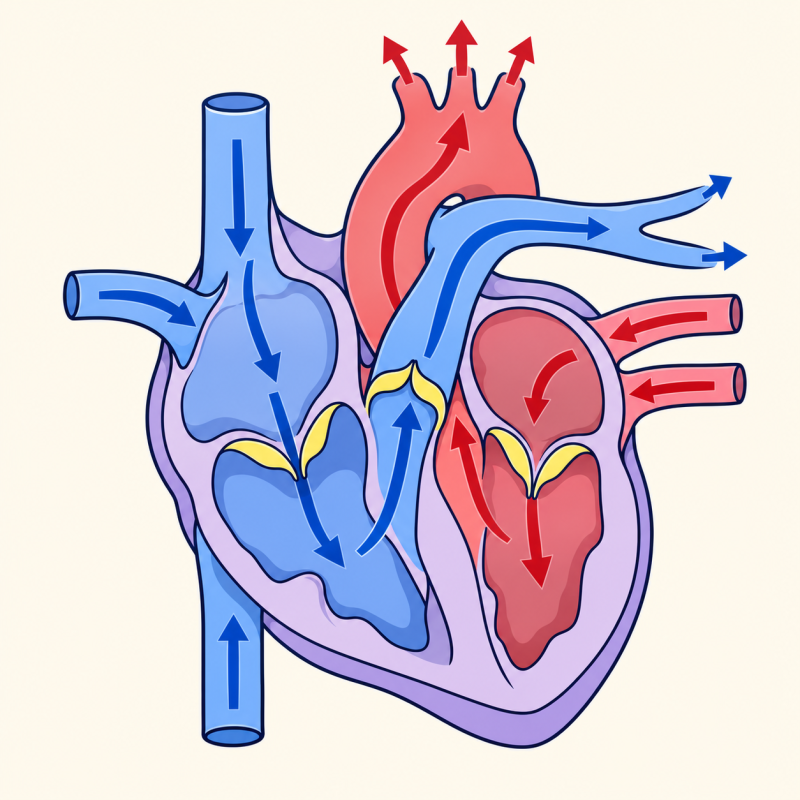
Between the chambers, and at the exits, are four valves. They are flaps that open to let blood through one way, and close to stop it flowing back.
The "lub-dub" sound of a heartbeat is the sound of the valves closing, not of the muscle itself.
About 100,000
The number of times the heart beats each day. At rest it moves about five litres of blood a minute, roughly the amount in your whole body.
What makes it beat
The heart does not wait for instructions from the brain. A small patch of special cells in the upper right chamber, called the sinoatrial node, sends out a tiny electrical pulse about 60 to 100 times a minute at rest. The pulse spreads across the atria, which squeeze, then pauses briefly and passes to the ventricles, which squeeze next. That small delay lets each chamber fill before it empties.
The brain and hormones do not start each beat, but they can speed it up or slow it down. That is why your heart races when you are frightened or exercising.
Your heart is on the left side of your chest.
It sits in the middle, between the lungs, and is tilted so the pointed tip faces left. That is where you feel the beat most strongly, which is why it seems to be on the left.
The heart needs blood too
The blood inside the chambers does not feed the heart muscle. The muscle gets its own supply from the coronary arteries, which run over the surface of the heart.
If one of these arteries is blocked, usually by a clot forming on a fatty build-up in the artery wall, the part of the muscle it supplies is starved of oxygen. That is a heart attack. It is different from a cardiac arrest, where the heart's electrical system fails and it stops pumping effectively. The two are often confused.
How the pulse you can feel is made
Each time the left ventricle squeezes, it sends a wave of pressure along the arteries. Arteries are slightly elastic, so you can feel the wave stretch them as it passes. That is your pulse.
You can feel it where an artery runs close to the skin, such as at the wrist or the side of the neck. Counting it for a minute gives your heart rate. It is usually normal for it to be anywhere between 60 and 100 beats a minute at rest.
Note: this explains how it works in general. It is not advice for your situation. For a decision about your health, money or legal position, check an official source or ask a qualified professional. If you have chest pain, call 999.
Sources: NHS; British Heart Foundation; standard physiology textbooks. Figures are typical adult values and vary. Figures are for the UK unless stated.
Key takeaways
- The heart is two pumps side by side.
- Right side to the lungs, left side to the body.
- Valves keep blood flowing one way.
- A small group of cells sets the heartbeat.
- A heart attack is a blocked artery, not a cardiac arrest.
Now you know.
The heart is two pumps in one.
Its own pacemaker sets the beat.
And a heart attack is a blocked artery.
Last reviewed 3 Nov 2026
Where next?
More in The Human Body
-
Read
 The Human Body
Your eyes
How the eye focuses light onto the retina, how rods and cones work, how we see colour, and what colour…
-
Read
 The Human Body
Your ears
How the ear turns air vibrations into sound through the eardrum, three tiny bones and the cochlea, and how…
-
Read
 The Human Body
Sleep
What happens during sleep, how the sleep stages and body clock work, why the brain stays active at night and…