- Home
- The Human Body
- Lungs
Your lungs
How air gets from your nose into your blood, and why you breathe faster when you run.
The short version
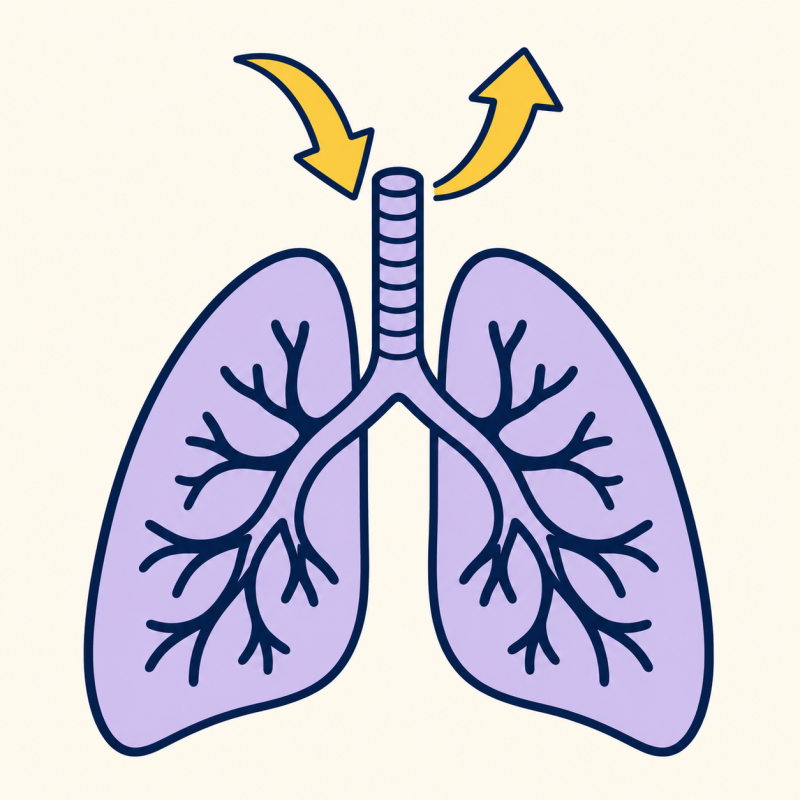
When you breathe in, your diaphragm pulls down and air rushes along branching tubes into hundreds of millions of tiny air sacs in your lungs. Oxygen passes through the thin walls into the blood, and carbon dioxide passes back out. Rising carbon dioxide is usually the main signal that makes you breathe faster; oxygen levels matter too.
I always assumed my body breathed to get more oxygen.
It mostly breathes to get rid of carbon dioxide.
Hold your breath and the urge you feel is the carbon dioxide.
How air moves in
You have no muscles in your lungs that pull air in. The main breathing muscle is the diaphragm, a sheet of muscle under the lungs. When it tightens it flattens and moves down, and the muscles between your ribs lift them. The space in your chest gets bigger, the pressure inside drops below that of the air outside, and air flows in.
When the muscles relax, the chest gets smaller and air is pushed out. At rest, an adult breathes about 12 to 20 times a minute.
The branching tubes
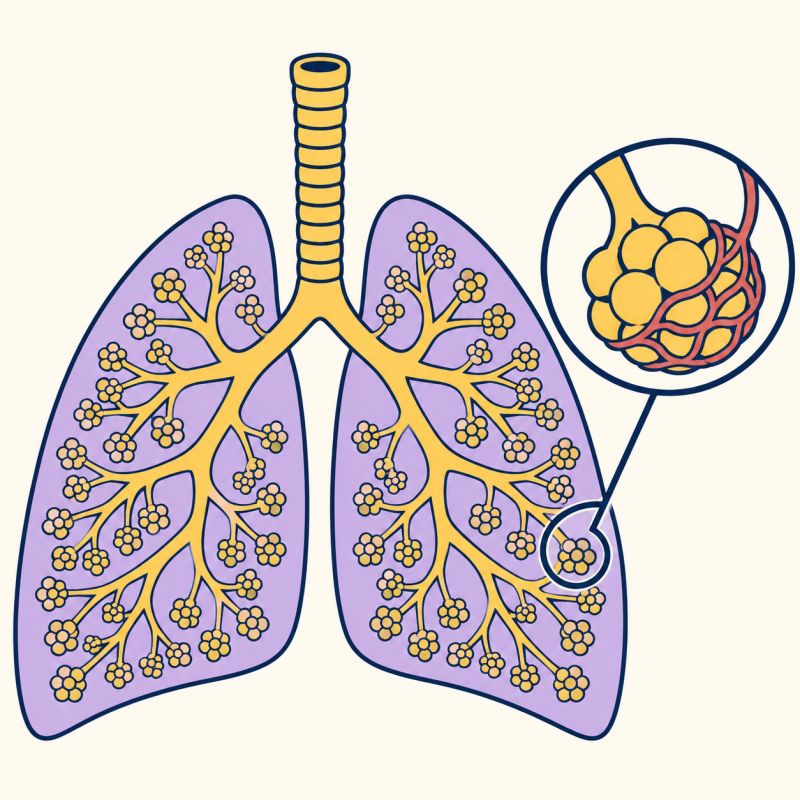
Air passes down the windpipe, which splits into two main tubes, one for each lung. These split again and again, like the branches of a tree, getting narrower each time. The smallest ends in clusters of tiny air sacs called alveoli (al-VEE-oh-lye).
Each alveolus is wrapped in a net of tiny blood vessels. The wall between the air and the blood is far thinner than a human hair, so gases pass through easily.
There are hundreds of millions of alveoli in your lungs. Spread out flat, their surface would cover roughly 50 to 75 square metres.
Swapping the gases
Oxygen moves from the air in the alveoli into the blood, because there is more of it in the air than in the blood arriving from the body. Carbon dioxide, a waste gas made by your cells, moves the other way. The blood that has picked up oxygen goes to the heart, which pumps it round the body.
What is in the air you breathe out (approximate percentages)
16%
The share of oxygen in the air you breathe out. Air you breathe in is about 21%, so you use only about a quarter of the oxygen in each breath.
Why you breathe harder when you run
Sensors in the brain and blood vessels respond mainly to carbon dioxide and the acidity it creates in the blood. Oxygen levels also influence breathing, especially when they fall. When your muscles work harder, they make more carbon dioxide. The level rises, the brain senses it, and it tells your breathing muscles to work faster and deeper. This is why you pant when you run, and why you can only hold your breath for so long.
We breathe in oxygen and breathe out carbon dioxide.
Breathed-out air is still about 16% oxygen. That leftover oxygen is why mouth-to-mouth breathing can help a person who has stopped breathing.
Why the lungs do not collapse
The outside of each lung and the inside of the chest wall are lined with thin, slippery membranes with a tiny amount of fluid between them. The fluid holds the two surfaces together, rather like two wet sheets of glass.
When the chest expands, the lung is pulled out with it. If air gets between the layers, for example after an injury, the lung can lose that pull and collapse. A tube can be used to remove the air and let the lung expand again.
Note: this explains how it works in general. It is not advice for your situation. For a decision about your health, money or legal position, check an official source or ask a qualified professional. If you are short of breath for no clear reason, get medical help.
Sources: NHS: exercise and lung conditions; Cambridge University Hospitals: breathing patterns. Air percentages are approximate; exhaled air varies.
Key takeaways
- The diaphragm pulls air in.
- Branching tubes end in tiny air sacs.
- Oxygen and carbon dioxide swap through thin walls.
- Breathed-out air still contains oxygen.
- Carbon dioxide drives the urge to breathe.
Now you know.
Your diaphragm pulls the air in.
Gases swap in tiny air sacs.
And it is carbon dioxide that makes you breathe.
Last reviewed 3 Nov 2026
Where next?
More in The Human Body
-
Read
 The Human Body
Your eyes
How the eye focuses light onto the retina, how rods and cones work, how we see colour, and what colour…
-
Read
 The Human Body
Your ears
How the ear turns air vibrations into sound through the eardrum, three tiny bones and the cochlea, and how…
-
Read
 The Human Body
Sleep
What happens during sleep, how the sleep stages and body clock work, why the brain stays active at night and…