- Home
- Technology
- Satellites
- GPS
How GPS works
The satellites behind satnav, why they need a clear sky, and how accurate they are.
The short version
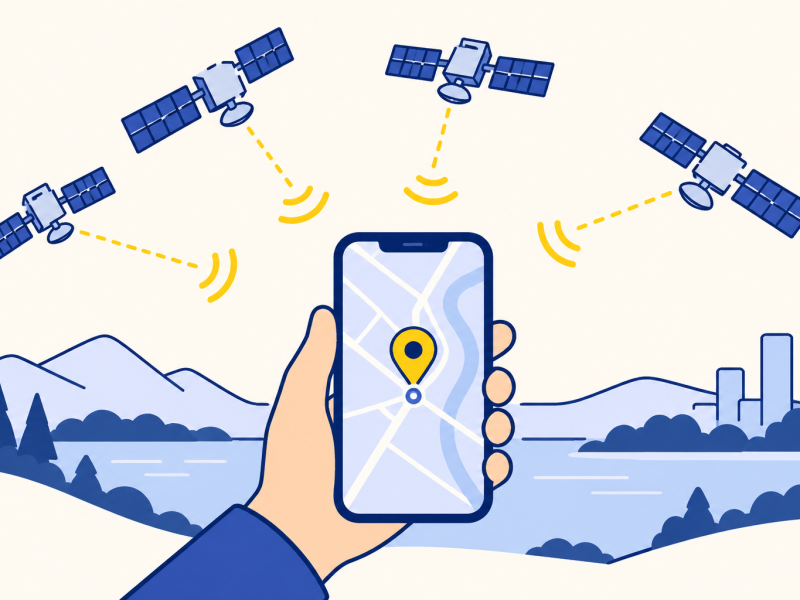
GPS is a constellation of about thirty satellites. A receiver compares signals from at least four to calculate its position, usually within a few metres outdoors. Buildings and terrain can block the signals. It builds on satnav and satellites.
I always thought GPS was a sort of tracking.
GPS itself is one-way: satellites broadcast and a receiver calculates its position. A phone may separately share location through apps or a mobile network.
Nothing is sent to them at all.
The constellation
The satellites orbit about 20,200 km up, arranged in six paths so that wherever you stand, at least four are in view. They circle the Earth about twice a day. All of them carry very accurate atomic clocks.
GPS is operated by the United States. Other global navigation systems include Europe’s Galileo, Russia’s GLONASS and China’s BeiDou. Many phones use several systems, which can improve availability and accuracy.
Where it struggles
GPS signals are weak and travel in straight lines. They pass through glass and thin roofs, but not well through concrete, so indoors a phone often loses them. In narrow streets between tall buildings the signals bounce off walls, which makes the position wobble.
Phones fill the gaps using nearby Wi-Fi networks and mobile masts, whose positions are known, and by sensing movement.
About 5 metres
The typical accuracy of a phone's GPS in the open. Special receivers that correct for errors can do much better, to a few centimetres.
Note: the system is run by governments and is free to use. Accuracy and availability can change, for example if a signal is jammed. Other systems act as a backup.
Timing is the real product
What GPS really provides is the time. Each satellite carries atomic clocks, and receivers use them to work out position. Banks, mobile networks and power grids also use the signal as a reference clock, which is why a GPS fault can matter far beyond satnavs.
Sources: How GPS works, GPS.gov, GPS accuracy, GPS.gov
Key takeaways
- About thirty satellites carry accurate clocks.
- At least four are in view anywhere.
- Your device only listens.
- Concrete and tall buildings spoil the signal.
Now you know.
GPS is a broadcast.
Four satellites fix a position.
Other systems help too.
Last reviewed 3 Nov 2026