- Home
- Technology
- Satellites
- Satellite TV and internet
Satellite TV and internet
What the dish on the wall does, and how satellite broadband differs from the old kind.
The short version
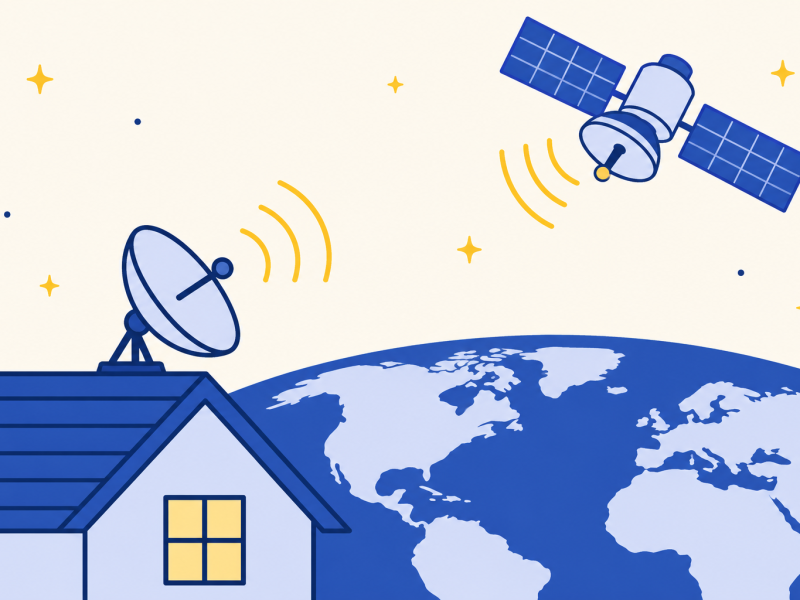
A satellite dish is a curved reflector that gathers a weak radio signal and focuses it on a receiver near the dish. Television satellites sit in a fixed spot 36,000 km up, so the dish never needs to move. Newer internet satellites are much lower and move across the sky. It builds on satellites.
I always wondered why dishes point at a bare patch of sky.
There is a satellite there. You can't see it.
It is too far away to see.
The dish
The signal from a satellite 36,000 km away is very faint by the time it arrives. The dish is curved so that all the signal falling on its surface bounces towards a single point, where a small receiver sits on an arm in front. The bigger the dish, the more signal it collects.
The receiver, called an LNB, converts the signal to a lower frequency that can travel down a cable to the set-top box.
Aiming and weather
A dish must be aimed accurately at the satellite; even a small alignment error can weaken reception. Heavy rain can weaken the signal for a while, which is called rain fade.
Low-orbit internet satellites are different. They move across the sky in minutes, so the flat dish tracks them electronically, switching from one satellite to the next. Because they are closer, the delay is much shorter than with older satellite broadband.
Key takeaways
- A dish focuses a faint signal on a receiver.
- TV satellites hover over one spot, so the dish is fixed.
- Low-orbit internet satellites pass over quickly.
- Rain can weaken the signal.
Now you know.
A dish is a mirror for radio.
TV satellites stay put.
Internet satellites move, so the dish must follow.
Last reviewed 3 Nov 2026