- Home
- Technology
- Contactless payments
Contactless payments
How tapping a card or phone pays without a PIN, and why a copied signal is useless.
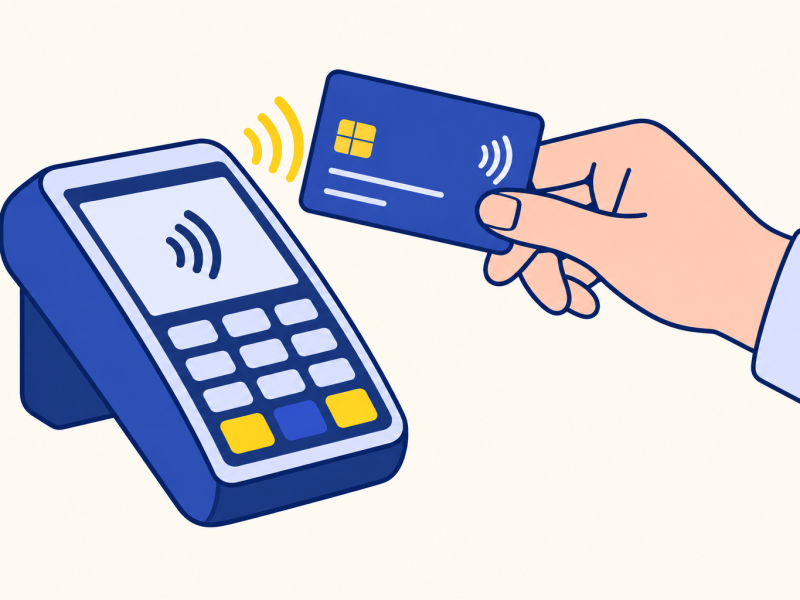
The short version
A contactless card has no battery: the reader powers its chip by radio. The chip creates transaction data to help stop a copied payment being replayed. A payment limit reduces the risk if you lose a card.
I always wondered how a card with no battery could talk to a machine.
The machine powers it, from a few centimetres away.
The card is only borrowing a little of the reader's energy.
A card powered by the air
Inside the card is a chip joined to a coil of fine wire. The reader gives out a weak radio field at 13.56 MHz. When the card is within about four centimetres, the field makes a tiny current in the coil, in the same way a transformer works without a wire between its coils, and that is enough to wake the chip.
The chip and reader then swap short messages, and the chip sends its answer. All of this happens in a fraction of a second, and the card never has to touch anything.
A code used only once
In an EMV payment, the device sends transaction data and a cryptogram calculated using secret keys and transaction-specific information, including a value supplied by the reader. The cryptogram helps the issuer or terminal check that the transaction is genuine; the card number may also be transmitted. The bank can check the code with its own copy of the key.
A captured cryptogram is designed for one transaction and should not authorize a different one. Payment security also depends on the terminal, issuer checks and transaction data.
£100
The standard UK contactless limit for a single card payment is £100. Issuers can also ask for PIN verification after a sequence of taps. Limits vary by country and may change; check your bank for current rules.
Someone can steal money by brushing past you with a reader.
Contactless works over a short range, and transaction-specific cryptograms help prevent replay. No payment system is risk-free, so report a lost card promptly.
Other ways
A card tap uses the same short-range radio as a phone payment: see phone payments. For paying with a PIN, chip and PIN explains what the chip does.
Note: this explains how it works in general. It is not advice for your situation. For a decision about your money, check an official source or ask a qualified professional. Figures are for the UK.
Lost or stolen cards
A lost card can be blocked by the bank at once, which also stops contactless payments. The limit on a tap means that, in the time before it is blocked, only small amounts can be spent without the PIN. Rules protect customers against payments they did not authorise, though the details depend on the bank and the circumstances, so a bank should be told straight away.
Source: EMVCo on payment security describes transaction cryptograms and one-time security codes.
Key takeaways
- The reader powers the card through radio.
- It works only within a few centimetres.
- The chip makes a one-time code for each payment.
- A limit protects against a lost card.
Now you know.
The reader powers the card.
Each payment has its own code.
A copied code is useless.
Last reviewed 3 Nov 2026
Where next?
Explained further by
-
Read
 Technology
Chip and PIN
How the chip on a bank card makes a one-time code for each payment, checks your PIN, and why this beat the…
-
Read
 Technology
How phone payments work
How paying with a phone works: NFC radio, a stand-in number called a token, and your fingerprint, face or…
More in Technology
-
Read
 Technology
Artificial intelligence
What AI means today: software that learns patterns from examples instead of following written rules, and…
-
Read
 Technology
Fingerprint and face unlock
How fingerprint and face unlock work: a scan becomes a pattern of numbers kept on the phone and compared each…
-
Read
 Technology
Bluetooth
How Bluetooth uses short-range radio to connect headphones, keyboards and speakers, why pairing is needed…