- Home
- How Things Work
- Electricity
- National Grid
The National Grid
How electricity gets from a power station to your socket, and why pylons carry such a high voltage.
The short version
Electricity is made in power stations, wind farms and solar farms, then sent across the country at very high voltage, up to 400,000 volts, on pylons. Transformers step the voltage down in stages until it reaches your home at 230 volts. It builds on what electricity is.
I always assumed the power was sent at the same voltage it arrives.
It is sent at about 1,700 times that, then stepped down.
Higher voltage means less wasted on the way.
Why such a high voltage?
Power is voltage multiplied by current. To send a lot of power, you can use a high voltage with a small current, or a low voltage with a large current. The wires heat up and waste energy in proportion to the square of the current. So the trick is to use a very high voltage and a small current, which keeps the wasted energy low.
The journey
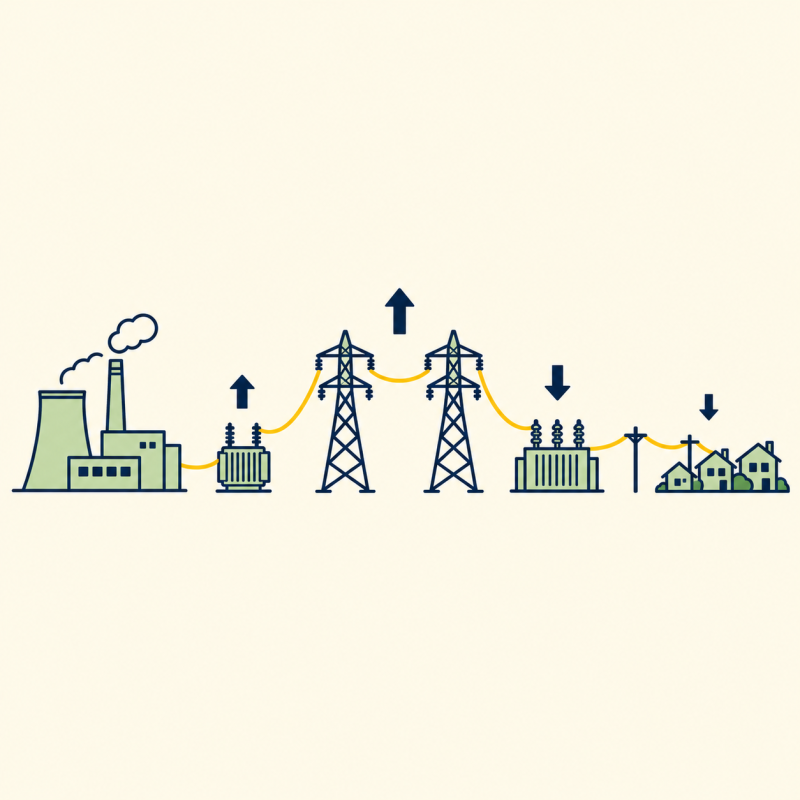
A power station makes electricity at about 25,000 volts. A transformer steps it up to 275,000 or 400,000 volts for the long-distance lines on pylons. Substations step it down to 132,000 volts, then to tens of thousands, and finally a transformer on your street brings it down to 230 volts for homes.
A transformer changes the voltage of alternating current using two coils of wire. It cannot work with direct current, which is one reason mains uses AC.
Keeping it in balance
Electricity storage is available, but most supply still needs to be balanced against demand in real time. If demand rises, for example when many kettles go on at the end of a popular programme, more power has to be supplied within seconds.
The National Energy System Operator (NESO) coordinates Great Britain’s electricity system and balances supply with demand, using generators, storage and other system services. If supply and demand fall out of step, the frequency of the whole grid drifts from 50 hertz, and it is kept within a narrow range.
400,000 volts
The highest voltage on the main transmission lines in Great Britain, about 1,700 times the 230 volts at a socket.
Sources: NESO: how electricity moves around Great Britain; NESO: transmission voltage. Transmission voltages are typical values and vary by network.
Key takeaways
- Power travels at very high voltage to waste less.
- Transformers step the voltage up and down.
- Homes receive 230 V.
- Supply and demand must balance at every moment.
Now you know.
Pylons carry a huge voltage.
Transformers step it down.
And supply must match demand every second.
Last reviewed 3 Nov 2026
Where next?
Builds on
More in Electricity
-
Read
 How Things Work
Ohm's law
How Ohm's law links voltage, current and resistance in a simple rule, with a worked example you can check…
-
Read
 How Things Work
Power and watts
What a watt is, how power relates to voltage and current, what a kilowatt-hour on your bill means and how to…
-
Read
 How Things Work
Household electricity
How household electricity works in the UK: mains voltage, alternating current, the consumer unit, circuit…