- Home
- How Things Work
- Central heating
Central heating
How a boiler, a pump and some pipes warm every room, and what the thermostat is really doing.
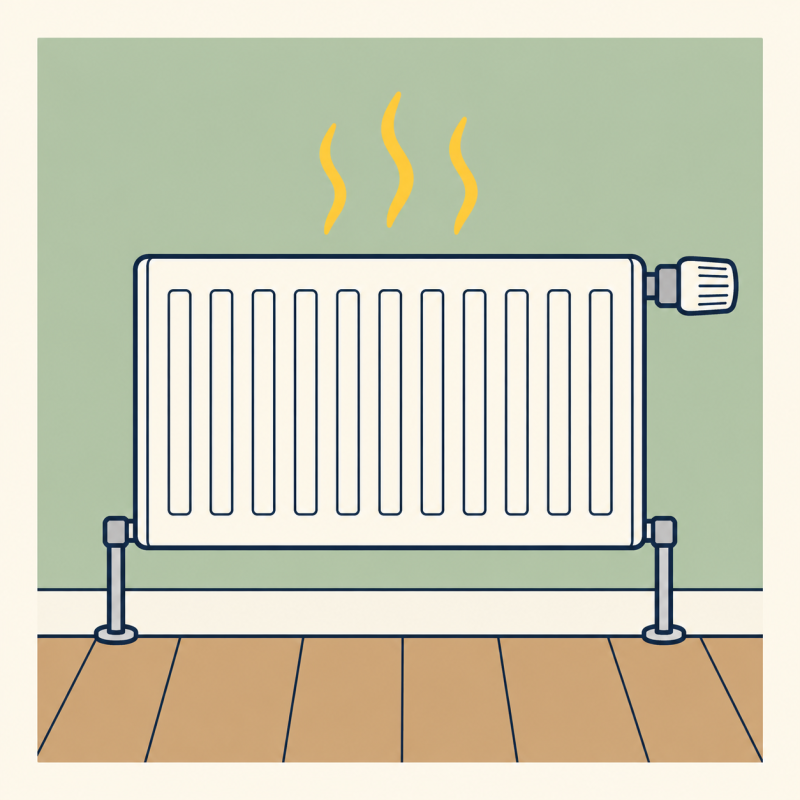
The short version
A boiler heats water, a pump sends it round a loop of pipes to the radiators, and the water comes back cooler to be heated again. A thermostat switches the boiler on and off to hold a set temperature. The radiators mostly warm a room by heating the air next to them, which then circulates.
I always assumed turning the thermostat up made the house heat faster.
It doesn't. A thermostat is a switch, not an accelerator.
It only decides when to stop.
A loop of hot water
At the centre is the boiler. In a typical radiator system, it heats water to a flow temperature often set somewhere around 60 to 80°C; settings vary by system and controls. A pump pushes that hot water through pipes to each radiator. The radiator gives off heat to the room, and the cooler water flows back to the boiler to be heated again. It is a closed loop, and the same water goes round and round.
How a radiator warms a room
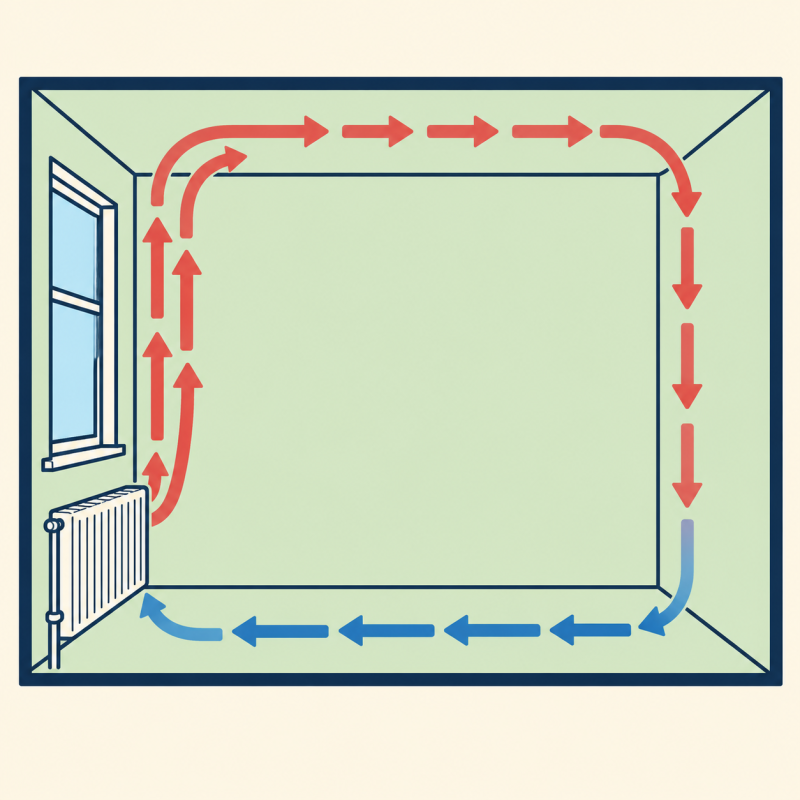
Despite the name, a radiator gives out only a part of its heat as radiation, the kind you feel on your face. Most of it warms the air next to it. That air gets lighter and rises, and cooler air flows in at the bottom to replace it. The result is a slow circle of moving air called convection, which spreads the warmth round the room.
That is why a radiator is often under a window: the rising warm air meets the cold air coming off the glass.
What the thermostat and valves do
In a basic system, a room thermostat measures air temperature and calls for heat when the room is below its setting, then stops the call when the target is reached. Modern controls may also modulate the heat output. A thermostatic radiator valve, on a single radiator, works the same way for that room only: it shuts off the flow of hot water when the room reaches the temperature it is set to.
Three common boiler types
Combi boiler
Heats on demandHeats water for taps directly when you open one, so it needs no tank.
System boiler
Tank and boilerHeats a stored cylinder of hot water, with the main parts built in.
Regular boiler
Tank and headerUses a cylinder, plus tanks in the loft; common in older houses.
Condensing boilers
Condensing boilers recover extra heat when water vapour in the flue gas condenses against a cool heat exchanger. Their efficiency depends on the boiler and operating conditions.
Why radiators have a bleed screw
Air can get into the loop of water, and a pocket of it at the top of a radiator stops hot water filling that part, so the top stays cool while the bottom is hot. A small screw at the top, called a bleed valve, lets the trapped air out until water comes through. Over time, a loop that keeps filling with air may have a leak or a corroding part that needs a heating engineer to check.
A higher thermostat setting heats the house faster.
The boiler heats the water at the same rate either way. On a basic on/off system, a higher setting asks for heat for longer; it does not increase the boiler’s maximum output. Some modern systems adjust output as well.
Why heating a house takes so long
A house has a lot of thermal mass: the walls, the floors and the furniture all have to warm up, not only the air. And at the same time heat is escaping through walls, windows and roofs.
So the temperature rises slowly until the heat coming in matches the heat leaving. Better insulation reduces what leaves, which is why it matters more than turning the thermostat up. For another way of heating, read about heat pumps.
Note: gas work on boilers and gas pipes must be done by a suitably qualified Gas Safe registered engineer. Sources: HSE: gas safety for homeowners; Energy Saving Trust: heating controls; boiler flow temperature. System behaviour and settings vary.
Key takeaways
- A boiler heats water; a pump circulates it.
- Radiators warm mainly by moving air.
- A thermostat is an on and off switch.
- Valves control individual rooms.
- Condensing boilers capture extra heat.
Now you know.
Hot water goes round a loop.
Radiators warm the air.
And a thermostat only decides when to stop.
Last reviewed 3 Nov 2026
Where next?
More in How Things Work
-
Read
 How Things Work
Electricity
What electricity is, how voltage, current, resistance and power fit together, why a kettle uses more than a…
-
Read
 How Things Work
Batteries
How a battery makes electricity from a chemical reaction, why some can be recharged, what volts and…
-
Read
 How Things Work
A fridge
How a fridge works by moving heat out with a refrigerant, a compressor and coils, why the back is warm and…