- Home
- Everyday Life
- Heat pumps
Heat pumps
How a heat pump can give you three units of heat for every unit of electricity, and why it works in the cold.
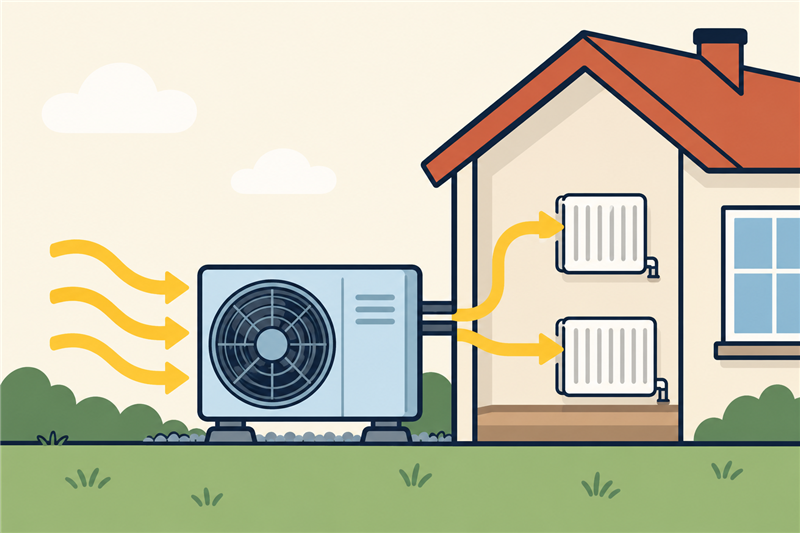
The short version
A heat pump does not make heat. It moves heat from the outside air, the ground or water into your home, using a fridge-style cycle. Because moving heat takes less energy than making it, a heat pump can deliver about three units of heat for every unit of electricity it uses.
I always assumed a heat pump turned electricity into heat, like an electric fire.
It moves heat that is already there. It works like a fridge, but it cools the outdoors and warms your house.
Moving heat instead of making it
Even outdoor air at freezing point holds a lot of heat. It feels cold to us, but it is far above absolute zero, the coldest temperature possible. A heat pump collects some of that heat and carries it indoors.
It does this with a sealed circuit of liquid called a refrigerant, the same kind of substance used in a fridge. The refrigerant boils at a very low temperature, so it can absorb heat from cold air. A compressor squeezes the vapour, which makes it hot. The hot vapour passes through a coil inside the home, gives up its heat to the heating water, and turns back to liquid. The cycle repeats.
The cycle
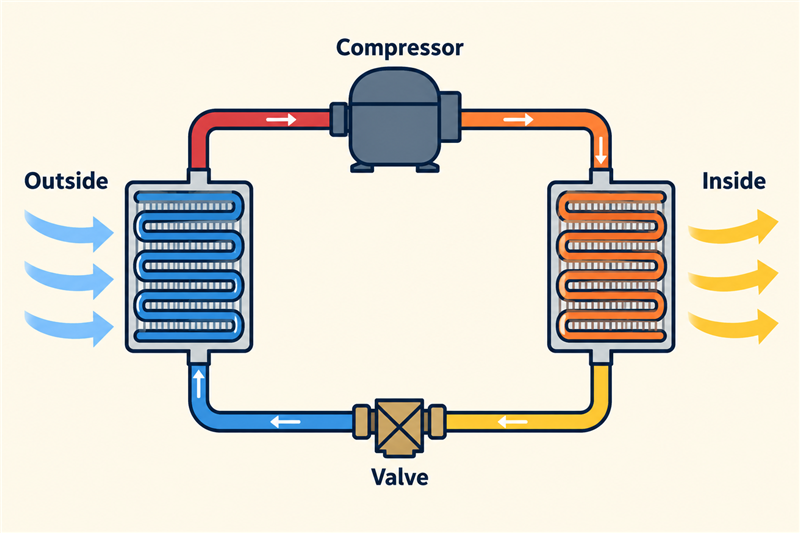
Outside, the refrigerant absorbs heat and boils. The compressor then raises its pressure and temperature. Inside, it releases that heat and condenses, and a valve lets its pressure drop so that it can start again.
Moving a unit of heat takes far less energy than making one, which is why the result can be more than the energy you put in.
Why it can give more than it uses
The electricity in a heat pump is not turned into heat. It drives the compressor and the fan. The heat itself comes mainly from the air. So the heat you get out can be greater than the electricity you put in.
The ratio is called the coefficient of performance (COP) at a particular moment. Across a whole year, seasonal performance is often around 3, meaning about three units of heat for each unit of electricity, though the result depends on the system, home and weather. A boiler also loses some energy through its flue.
About 3 kWh
The heat a typical heat pump delivers for each 1 kWh of electricity it uses over a year. The exact number depends on the weather and the house.
Where the heat comes from
Heat pumps are named after their source of heat.
Air source
the outside airThe most common type, with a fan unit outside the home.
Ground source
the soilPipes buried in the garden collect the steady warmth underground, and it works well all year.
Air to air
the outside airHeats the room's air directly, like an air conditioner that also heats.
What changes in the home
A heat pump works best when it heats water to a lower temperature than a boiler does, often 35 to 45 degrees rather than 60 to 80. A lower flow temperature is more efficient, but it means the radiators give out less heat.
So a home often needs larger radiators, underfloor heating or better insulation to stay warm. A tank for hot water is also usually needed. The system may run for longer, steadier periods than a boiler. Its outdoor unit makes some noise, so siting and installation matter.
Heat pumps do not work in cold weather.
They work in freezing weather, and many are designed to run well below minus 15 degrees. They become less efficient as it gets colder. Heat pumps are common in Scandinavia, where winters are far colder than in the UK.
The four steps inside
A heat pump has four parts joined by a pipe full of refrigerant: an evaporator, a compressor, a condenser and an expansion valve.
In the evaporator, cold, low-pressure liquid refrigerant flows through a coil in the outside air. The air is warmer than the refrigerant, so heat flows into it and the refrigerant boils into a gas.
The compressor squeezes the gas. Squeezing raises both its pressure and its temperature, to well above the temperature of your heating water.
In the condenser, a coil inside the home, the hot gas gives up heat to the water and turns back into a liquid. The expansion valve then lets the pressure fall suddenly, which cools the liquid to below the temperature of the outside air, and the cycle starts again.
Sources: Energy Saving Trust on heat pump performance and how COP and seasonal performance differ. Actual performance depends on the weather, system and home.
Key takeaways
- A heat pump moves heat; it does not make it.
- It uses the same cycle as a fridge.
- A good one delivers about three times the electricity it uses.
- Lower water temperatures make it more efficient.
- It still works in freezing weather.
Now you know.
A heat pump moves heat from outside to inside.
It uses a fridge-style cycle.
That is why it can give out more heat than the electricity it uses.
Last reviewed 3 Nov 2026
Where next?
More in Everyday Life
-
Read
 Everyday Life
Washing machine
How a washing machine fills, heats, tumbles, rinses and spins, and why detergent and gentle tumbling clean…
-
Read
 Everyday Life
Charging an electric car
How charging an electric car works: the difference between kW and kWh, how long a charge takes at home and on…
-
Read
 Everyday Life
Car brakes
How car brakes work: fluid carries your foot's push to each wheel, pads squeeze a disc, and why doubling…