- Home
- How Things Work
- Batteries
Batteries
How a battery turns chemicals into electricity, and what happens when you recharge it.
The short version
A battery stores chemicals, not electricity. When you connect it to a circuit, a chemical reaction pushes electrons out of one end and takes them back at the other, and that flow is the current. A rechargeable battery has a reaction that can be run backwards by pushing current in.
I always assumed a battery was a tank of electricity.
It is a store of chemicals that are ready to react.
The electricity appears when you let them.
Two ends and a gap
Every battery has two ends, called electrodes, made of different materials, and between them a substance called the electrolyte, often a liquid or paste. One electrode is keen to give up electrons, and the other is keen to take them.
The electrolyte lets charged atoms, called ions, pass between the electrodes, but not electrons. So the electrons can only get across by going round the outside, through your torch or phone. That flow of electrons is the current, and the strength of the chemical reaction sets the push, the voltage.
Inside a battery
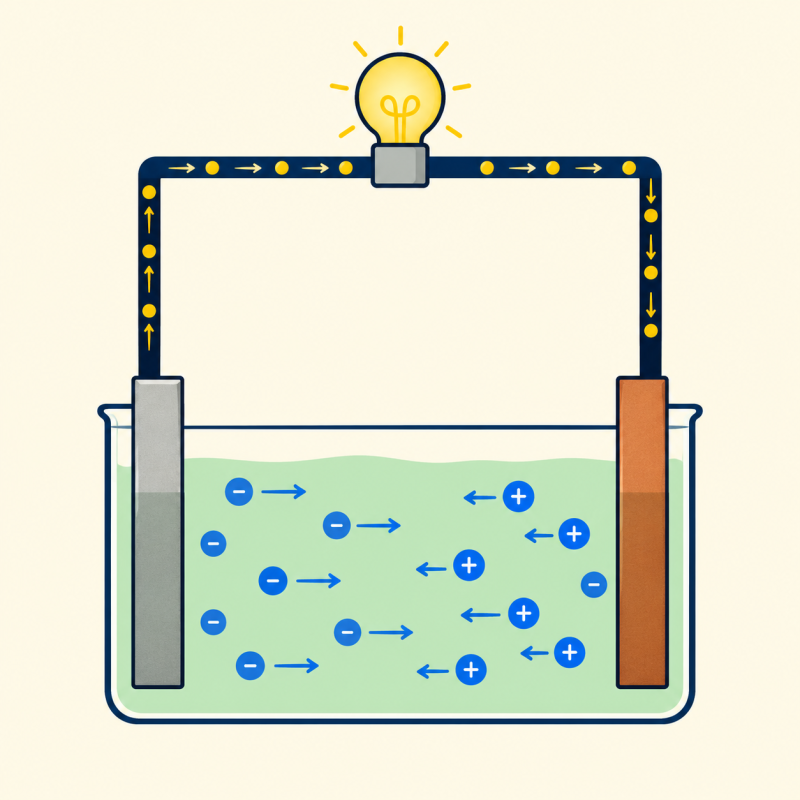
A single alkaline AA cell gives about 1.5 volts. A lithium-ion cell, such as one in a phone, has a nominal voltage around 3.6 to 3.7 volts. To get more voltage, cells are joined in a row, which is what the stack of cells in a car battery or an old torch does.
A battery is finished when one of the chemicals has been used up. The reaction slows, and the voltage drops.
Why batteries struggle in the cold
Cold can temporarily reduce how much power and usable energy many batteries can deliver; the effect depends on battery chemistry. Some apparent capacity returns as a battery warms. High temperatures can speed up ageing, especially in lithium-ion batteries.
Energy stored, in watt-hours
Why some can be recharged
In a disposable battery, the reaction cannot easily be reversed. In a rechargeable battery it can. When you plug it in, a charger pushes current the other way, forcing the ions and electrons back to where they started. The battery is then ready to give them up again.
Each cycle causes a little wear, so after hundreds or thousands of charges a rechargeable battery holds less than it did.
A short history
- 1800 Alessandro Volta makes the first battery, a stack of metal discs.
- 1859 Gaston Planté makes the first rechargeable lead-acid battery.
- 1991 Sony sells the first commercial lithium-ion battery.
- 2019 The Nobel Prize in Chemistry goes to the inventors of lithium-ion batteries.
Volts, amp-hours and watt-hours
A battery's voltage is the push it gives. Its capacity is often given in amp-hours (Ah) or milliamp-hours (mAh), which is how much current it could supply and for how long. A 3,000 mAh battery could, in theory, give 3,000 milliamps for one hour.
To compare batteries with different voltages, multiply the voltage by the capacity to get watt-hours (Wh). A 3,000 mAh cell at 3.7 volts holds about 11 Wh. For more about watts, read power and watts.
Sources: US Department of Energy: how batteries work; Nobel Prize in Chemistry 2019: lithium-ion batteries. Available power and energy vary with temperature, battery chemistry and model.
Key takeaways
- A battery stores chemicals, not electricity.
- Electrons flow round the outside circuit.
- Ions cross the gap inside the battery.
- Charging runs the reaction backwards.
- Capacity is in watt-hours.
Now you know.
A battery stores chemicals.
Electrons go the long way round.
And charging reverses it.
Last reviewed 3 Nov 2026
Where next?
More in How Things Work
-
Read
 How Things Work
Electricity
What electricity is, how voltage, current, resistance and power fit together, why a kettle uses more than a…
-
Read
 How Things Work
A fridge
How a fridge works by moving heat out with a refrigerant, a compressor and coils, why the back is warm and…
-
Read
 How Things Work
Central heating
How central heating works, from the boiler and pump to radiators, thermostats and valves, and how the main…