The short version
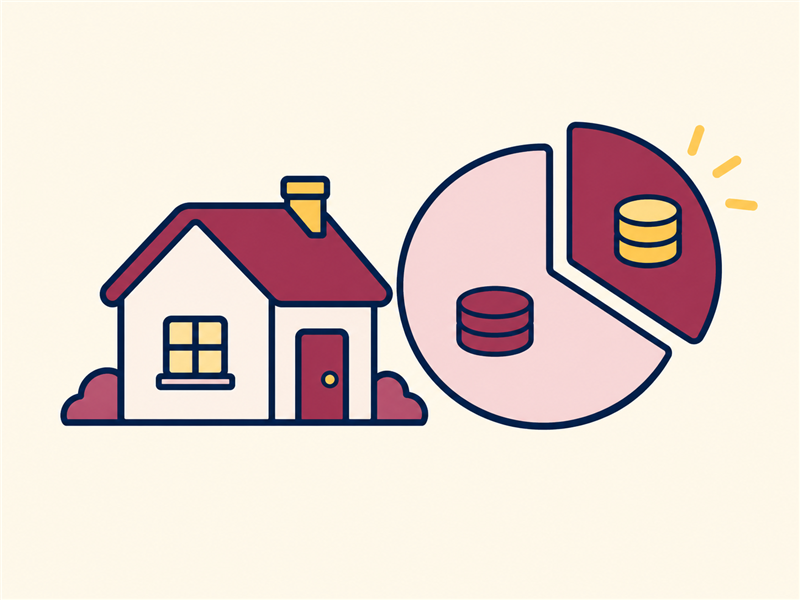
A mortgage is a loan to buy a home, with the home as security. On a repayment mortgage, each payment pays the interest for the month and repays a little of the loan. Early on most of the payment is interest, because the debt is still large.
I always thought a mortgage payment paid off an equal slice of the house each month.
It does not.
At the start, most of it goes to the lender's interest.
A loan with your home as security
A mortgage is a loan used to buy property. You usually pay a deposit, part of the price from your own savings, and borrow the rest. The lender holds a legal claim on the property, so if you stop paying it can take it back and sell it.
Because of that security, mortgage rates are normally lower than other loans. The loan usually runs for 25 years or more, which keeps each monthly payment smaller.
What each payment is made of
On a repayment mortgage, the monthly payment is fixed, but it is split in two. First the lender takes the month's interest, worked out on what you still owe. The rest repays the loan itself, called capital.
At the start you owe the most, so the interest is the biggest. As the debt falls, the interest falls, so more of the same payment goes to capital.
Interest in a monthly payment
A £200,000 loan over 25 years at 5% costs about £1,169 a month. This shows how much of that payment is interest.
£150,754
The interest over the whole 25 years on that £200,000 loan at 5%, if the rate never changed. You would repay about £350,754 in total.
Two ways to borrow
Repayment
Pays the loan offEach payment covers interest and some capital, so the debt reaches zero by the end.
Interest-only
Pays the interestYou pay only the interest each month. The full loan is still owed at the end, so you need a plan to repay it.
Why the rate matters so much
A small change in rate has a big effect on a loan this long. Lenders offer rates that are fixed for a period or that move with Bank Rate. See fixed and variable rates for how they differ.
There can also be fees, for arranging the loan or for repaying it early. The APR gathers some of them into one figure: see APR and AER.
Why the balance changes slowly at first
The payment is calculated so that, if the rate and schedule stay as agreed, the loan is repaid by the end of the term. At the start, a larger balance means more interest is due for each month. Later, as payments reduce the balance, the interest part shrinks and the capital part grows. If the rate changes, the lender may recalculate the payment or the time left, depending on the mortgage terms. Fees and insurance are separate costs and are not included in the worked example above.
Note: this explains how it works in general. It is not advice for your situation. For a decision about your money, check an official source or ask a qualified professional. Your home may be repossessed if you do not keep up repayments on a mortgage.
Sources: MoneyHelper (Money and Pensions Service), mortgage guides; Financial Conduct Authority, mortgage rules. Worked figures are examples at a fixed 5% over 25 years.
Key takeaways
- A mortgage is a loan secured on your home.
- Each payment covers interest and some capital.
- Early payments are mostly interest.
- Interest-only leaves the whole loan to repay later.
- A small change in rate adds up over many years.
Now you know.
Early payments are mostly interest.
Later ones are mostly capital.
The home is the security.
Last reviewed 3 Nov 2026
Where next?
Explained further by
More in Finance
-
Read
 Finance
Interest
How interest works: the price of borrowing money, why it grows your savings and your debts, and what a rate…
-
Read
 Finance
Inflation
What inflation is, how the UK measures it, why prices keep rising, who aims to keep it at 2%, and why falling…
-
Read
 Finance
How banks work
How a bank works: why your balance is a promise rather than a pile of cash, how banks lend, what stops them…