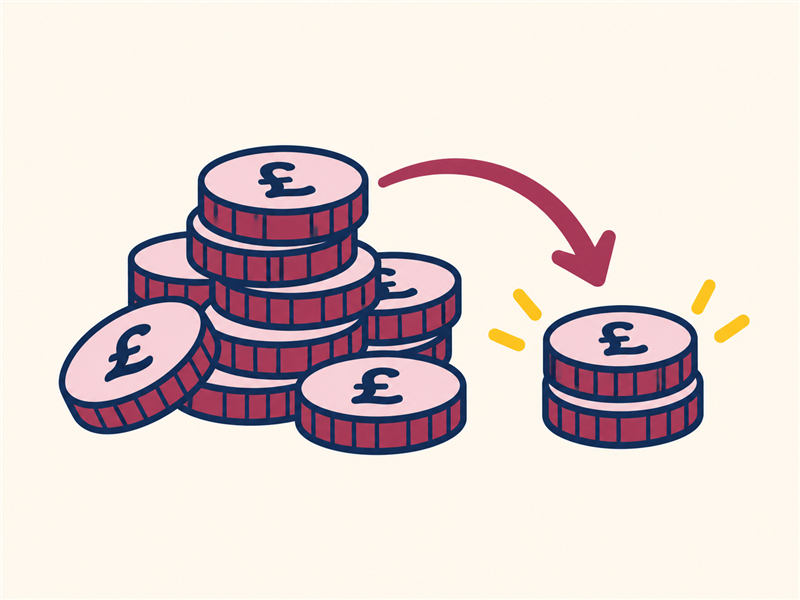
The short version
Interest is the price of borrowing money. If you borrow, you pay it. If you save, the bank is borrowing from you, so it pays you. The rate is that price as a percentage of the amount, usually for one year.
I always thought interest was a bonus a bank gave you for being a good saver.
It is a return on money you let an institution hold.
The bank funds lending in several ways; your deposit is not matched to one borrower.
Interest is a price
Money is useful, and having it now is worth more than having it later. So when one person lends money to another, the borrower pays a fee for the use of it. That fee is interest.
The fee is quoted as a rate: a percentage of the amount borrowed, for a period of time, usually a year. A rate of 4% a year on £1,000 means £40 for each year the money is borrowed.
£5
Lend £100 for a year at 5% and the interest is £5. The lender ends up with £105. The borrower must find the extra £5 from somewhere.
One idea, two sides
The rate is the same kind of number whichever side of the deal you are on.
Saving
You are the lenderThe bank pays interest on your deposit. Deposits are one source of funding for a bank, alongside other sources.
Borrowing
You are the borrowerYou get money now and pay it back with interest, which is the cost of having it early.
Where the bank makes its money
A bank may pay interest on deposits and charge interest on loans. The difference between rates is one source of income, alongside fees and other services. A savings rate is often lower than a loan rate, though the gap varies.
Bank Rate influences many borrowing and savings rates, but lenders set their own rates. The Bank of England changes Bank Rate partly to meet its inflation target; see inflation.
Banks pay interest because they want to reward their customers.
Banks pay interest because your money is useful to them. They lend it to other people at a higher rate and keep the difference.
What a rate does not tell you
A rate is only half the story. The other half is how often the interest is added, and whether you leave it in. Interest that is added to the pot starts earning interest of its own, which is called compound interest.
When you compare accounts or loans, two other figures are quoted: AER and APR. They are designed to make rates easier to compare, and they are worth knowing the difference between.
Simple interest and compound interest
Simple interest is worked out on the original amount only. £1,000 at 5% simple interest pays £50 every year, so after 3 years it has earned £150.
Compound interest is worked out on the amount including interest already added. After year one the pot is £1,050, so year two's interest is 5% of £1,050, which is £52.50. After three years the interest is £157.63.
Most savings accounts and nearly all debts use compound interest. A few loans use simple interest, which is usually stated in the paperwork.
Note: this explains how it works in general. It is not advice for your situation. For a decision about your money, check an official source or ask a qualified professional. Rates change often; the figures here are examples.
Sources: Bank of England, what are interest rates? and what banks do; MoneyHelper, savings and borrowing guides. Figures are for the UK unless stated.
Key takeaways
- Interest is the price of borrowing money.
- A rate is the price as a percentage, usually a year.
- Savers lend to the bank; borrowers pay it.
- A bank charges more than it pays, and keeps the gap.
- Interest on interest makes a pot grow faster.
Now you know.
Interest is a price.
Savers are lenders.
Debtors are payers.
The same rate cuts both ways.
Last reviewed 3 Nov 2026
Where next?
Explained further by
-
Read
 Finance
Compound interest
How compound interest works: interest on interest, why growth is slow at first and then speeds up, and the…
-
Read
 Finance
APR and AER
What APR and AER mean on loans, credit cards and savings accounts, why they differ from the plain interest…
More in Finance
-
Read
 Finance
Inflation
What inflation is, how the UK measures it, why prices keep rising, who aims to keep it at 2%, and why falling…
-
Read
 Finance
How banks work
How a bank works: why your balance is a promise rather than a pile of cash, how banks lend, what stops them…
-
Read
 Finance
Mortgages
How a repayment mortgage works: what each payment covers, why the first years are mostly interest…