- Home
- Everyday Life
- Dishwasher
Dishwasher
What happens inside, and why you should scrape your plates rather than rinse them.

The short version
A dishwasher sprays warm, soapy water at your dishes from spinning arms, filters out food scraps, and reuses wash water during the main wash. Detergent does the cleaning, rinse aid helps water run off, and the drying method depends on the machine. A full load often uses less water than washing by hand.
I always rinsed my plates before loading them, and wondered what the machine was for.
I had it the wrong way round. The machine is built to deal with the food, so the rinsing is its job.
What happens in one wash
Many programmes follow this general pattern, though the temperature, timing and number of rinses vary by model and setting.
- Fill. A valve lets in a few litres of water. This is all the machine holds at one time.
- Heat. The machine warms the water. Wash temperatures vary by model and programme; 50–65°C is a common range.
- Wash. A pump pushes the water up to the spray arms, which squirt it at the dishes. It runs back to the bottom, through a filter, and goes round again.
- Drain. A second pump sends the dirty water down the waste pipe.
- Rinse. Clean water runs in, often hot, with rinse aid added.
- Dry. Many machines use condensation: the hot dishes warm the air, and moisture condenses on the cooler inner walls. Some models use a fan, an opening door or another drying system.
Inside the machine
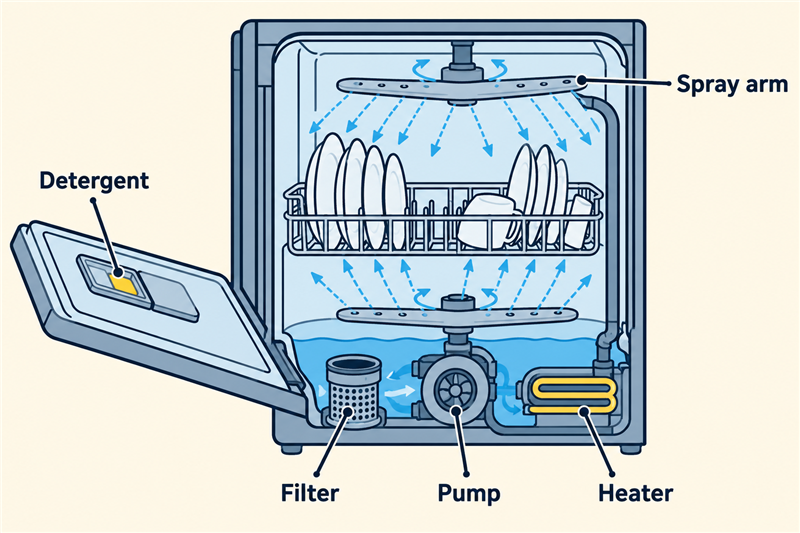
The spray arms hold the water jets, and the filter at the bottom catches food so it does not block the pump. The same few litres are used over and over, which is why a dishwasher uses so little water.
Many spray arms have no motor. The water leaving the jets pushes them round, like a garden sprinkler.
Three things you top up
Many dishwashers use these three products; follow the appliance manual, especially for salt if the machine has a built-in water softener.
Detergent
does the cleaningMany detergents contain enzymes that help break down food residues such as starch and protein.
Rinse aid
stops the spotsIt makes water run off in a sheet, so it does not dry in drops that leave marks.
Dishwasher salt
supports the softenerIn machines with a built-in water softener, it helps soften hard water and reduce limescale.
Rinsing your plates first gets them cleaner.
Scrape off the scraps and load them. The detergent works on the food that is left, and the filter catches the rest. Rinsing first uses a lot of water for very little gain.
Why it can use less water than you
A modern dishwasher can use around 10 to 14 litres of water for a cycle, though the amount varies by model and programme. It reuses wash water during the main wash. Washing the same dishes in a sink under a running tap can use more.
That depends on you. A full load is much better than a half-empty one, and washing by hand in a bowl can still win. The detergent works in the same way as in a washing machine: it loosens the dirt so that the water can carry it off.
50–65°C
One common wash-temperature range. Actual temperatures depend on the machine and programme.
How the machine knows the dishes are clean
Some machines have an automatic programme that adjusts itself. The key part is a sensor with a tiny light beam shone through the wash water. Clean water lets most of the light through. Water full of food scatters it, so less light reaches the other side.
The control board reads that difference. If the water is still cloudy after the first wash, it adds another rinse or lengthens the cycle. If the water is nearly clear, it can finish sooner and save energy.
The same idea is used in some washing machines. It also explains why the same programme can take different lengths of time on different days.
Sources: Bosch on dishwasher drying and rinse aid, Bosch UK on dishwasher salt and rinse aid. Water use and programme details vary by model; check your handbook.
Key takeaways
- A dishwasher reuses a few litres of water through the wash.
- Detergent cleans; rinse aid prevents spots; salt softens the water.
- Scrape plates, but do not rinse them first.
- A full load uses the least water per dish.
- Many machines dry by letting moisture condense on the cooler inner walls; drying systems vary.
Now you know.
A dishwasher sprays the same water again and again.
It is built to deal with the food, so you do not have to.
Many machines dry dishes with condensation; some also use a fan or open the door.
Last reviewed 3 Nov 2026
Where next?
More in Everyday Life
-
Read
 Everyday Life
Washing machine
How a washing machine fills, heats, tumbles, rinses and spins, and why detergent and gentle tumbling clean…
-
Read
 Everyday Life
Charging an electric car
How charging an electric car works: the difference between kW and kWh, how long a charge takes at home and on…
-
Read
 Everyday Life
Car brakes
How car brakes work: fluid carries your foot's push to each wheel, pads squeeze a disc, and why doubling…