- Home
- Everyday Life
- Tyre pressure
Tyre pressure
How the air in a tyre holds up the car, where to find the right number, and why it changes with the weather.
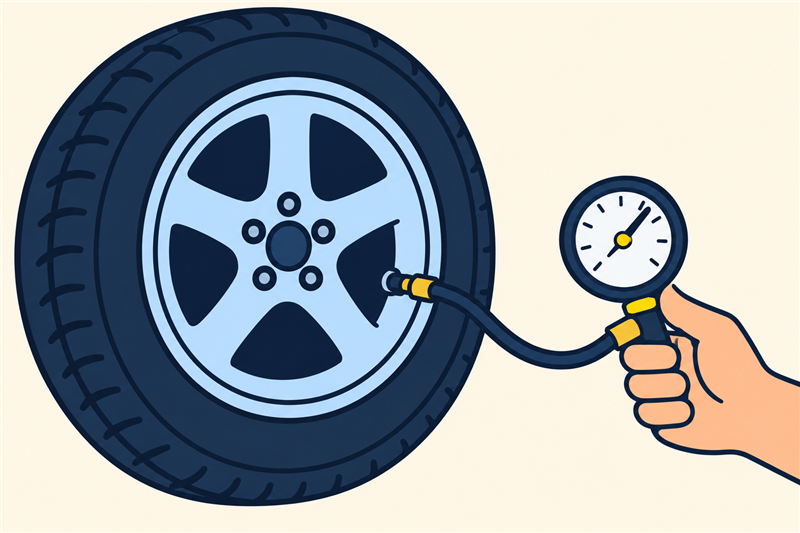
The short version
Your car sits on four patches of rubber. Air pressure and the tyre's structure work together to support the car. The right pressure is in your car's handbook, not on the tyre sidewall. Incorrect pressure can affect handling, tyre wear and fuel use. Pressure readings fall as tyres get colder, so check them regularly.
I always inflated my tyres to the big number printed on the side of the tyre.
That is the maximum the tyre can take. The right number is somewhere else.
What the air does
A tyre's air pressure and strong casing work together to support the car. Where the tyre touches the road, the casing flexes and the pressure inside helps carry the load. The patch of tyre touching the road, called the contact patch, is only about the size of your hand.
As a rough illustration, a 1,400-kilogram car puts about 350 kilograms of load on each tyre if the load is shared evenly. Dividing that load by 2.2 bar gives an idealised area of about 160 square centimetres. Real tyres also support load through their casing, and the load is not always shared evenly, so this is only an approximation. At otherwise similar conditions, higher pressure tends to reduce the contact patch and lower pressure tends to increase it.
The contact patch
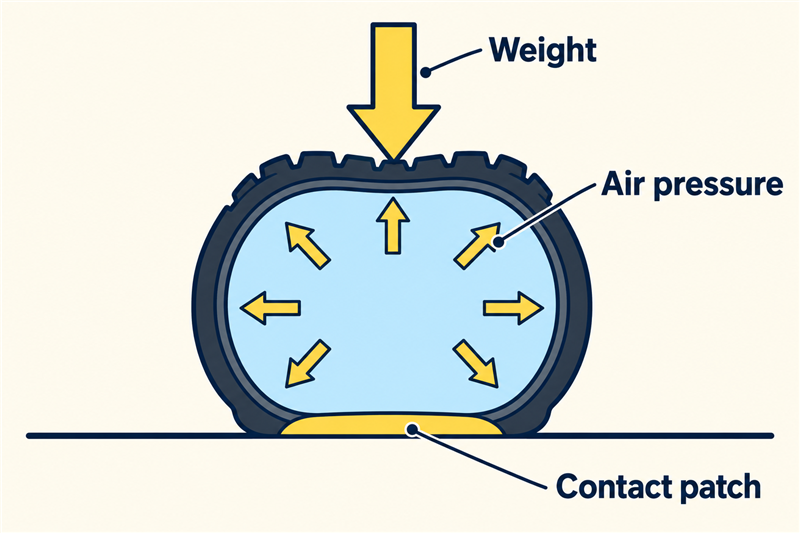
The tyre casing flexes where it meets the road. The air pressure and casing support the car's load; together they shape the contact patch.
Four patches, each about the size of a hand, are all that connects a car to the road.
Finding the right pressure
The pressure the maker recommends depends on your car and often on its load. It is printed in the handbook, and often on a sticker inside the driver's door frame or the fuel flap. Pressure is given in bar, in psi, or both. Typical family cars are somewhere around 2.1 to 2.5 bar, or 30 to 36 psi.
Check pressures when the tyres are cold, ideally before you drive, and use the vehicle maker's recommended value for the load. Driving warms the air inside, which raises the reading. Many newer cars also have a warning light that comes on when a tyre is significantly low; it does not replace regular checks.
Too low, right, and too high
The right pressure is a balance between grip, wear and comfort.
Too low
tyre sagsThe sidewalls flex too much, the tyre heats up, wears on its edges, and uses more fuel.
Right
even contactThe patch is the right shape, the tyre wears evenly and grips well.
Too high
tyre bulgesThe patch shrinks, grip drops, the centre wears out first and the ride is harsher.
Why cold weather matters
Cold air presses less hard on the inside of the tyre. For each 10 degrees Celsius that the temperature drops, a tyre loses roughly 1 to 2 psi. A tyre that was fine on a warm September day can be well down by December without any leak at all.
Tyres also lose a little air naturally through the rubber, a small amount each month. Together these are why checking once a month, and before a long journey, is a good habit. A gauge costs little, and many petrol stations have an air machine.
You can see when a tyre is low.
A modern tyre keeps its shape even when it is well down on air. It can be a fifth low and look perfectly normal. The only way to know is a gauge.
Why you measure cold
Air in a closed space follows a simple rule: if the temperature goes up, the pressure goes up. As you drive, the tyres flex and warm up, and the air inside warms with them. A tyre that reads 2.2 bar cold may read 2.4 bar or more after a fast drive.
If you check hot and let air out to reach the recommended number, the tyre will be under-inflated once it cools. That is why handbook pressures are always cold pressures.
The rule also explains why a tyre loses pressure in cold weather. The air hasn't escaped: its molecules have slowed down, so they push less hard on the inside of the tyre.
Sources: follow the vehicle maker's recommended pressures, usually listed in the handbook or on a vehicle placard. Check tyres cold; typical values vary by vehicle and load.
Key takeaways
- Tyre pressure and the casing work together to support the car.
- The right pressure is in the handbook, not on the tyre.
- Too low or too high both wear tyres and reduce grip.
- Pressure falls in cold weather.
- Check cold, with a gauge, about once a month.
Now you know.
The air holds up the car.
The number on the tyre is the maximum, not the target.
And the cold takes pressure away without a leak.
Last reviewed 3 Nov 2026
Where next?
More in Everyday Life
-
Read
 Everyday Life
Washing machine
How a washing machine fills, heats, tumbles, rinses and spins, and why detergent and gentle tumbling clean…
-
Read
 Everyday Life
Charging an electric car
How charging an electric car works: the difference between kW and kWh, how long a charge takes at home and on…
-
Read
 Everyday Life
Car brakes
How car brakes work: fluid carries your foot's push to each wheel, pads squeeze a disc, and why doubling…