- Home
- Everyday Life
- Solar panels
Solar panels at home
How panels turn daylight into electricity, what the inverter does, and what happens at night.

The short version
A solar panel is a thin slice of silicon that turns daylight straight into electricity, with no moving parts. An inverter changes that electricity into the kind your home uses. Your home uses what it can, a battery can keep some for later, and any extra goes to the grid.
I always thought solar panels needed hot, bright sunshine, and that heat made them work.
They run on light, not heat. In fact, panels work slightly better when they are cool.
How a panel makes electricity
A solar panel is made of many cells, and each cell is a thin sandwich of two layers of silicon. The layers are treated differently, so there is a built-in electrical push across the join between them.
When light hits the cell, its energy knocks electrons loose. The built-in push sends them in one direction, and that flow of electrons is an electric current. Wire the cells together and you can power something. A typical panel turns about a fifth of the light that reaches it into electricity.
From roof to socket
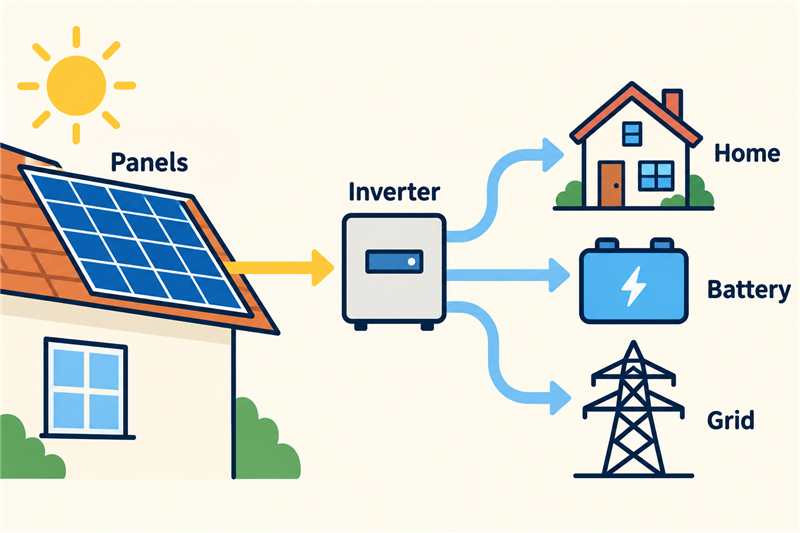
The panels make direct current, the kind a battery gives. Your home runs on alternating current, so an inverter changes one into the other. From there the electricity goes to whatever is switched on in the house.
If the panels make more than the house is using, the extra can go to a battery or out to the grid.
The parts of a home system
Panels
make the electricityThey produce it whenever there is daylight, from first light to dusk.
Inverter
changes its typeIt converts the panels' direct current to the alternating current your home uses.
Battery
It keeps spare daytime electricity for use in the evening.
Smart meter
records import and exportA compatible smart meter can record electricity sent to the grid for export payments.
Solar panels do not work in the UK.
They need daylight, not sunshine. Under cloud they still make electricity, often a tenth to a quarter of their best output. Summer output is far higher than winter, but the UK gets enough light.
What happens at night
Panels stop working when the light fades, so at night your home uses electricity from the grid, or from a battery if you have one. That is why many homes with panels still have a normal supplier.
The best time for the panels is the middle of a summer day, when nobody may be at home. Using appliances such as a washing machine or an electric car charger during the day uses more of your own electricity. A battery moves more of it to the evening. Whatever you do not use can be exported.
To see how an electric car fits in, read charging an electric car.
1,000 W per square metre
The most sunlight that reaches the ground on a clear day at midday. A panel of about two square metres with 20 per cent efficiency makes roughly 400 watts at best.
What a cell does at atomic level
Silicon is a semiconductor. A cell is made of two layers: one doped with a little phosphorus, which has spare electrons, and one with a little boron, which has gaps where electrons could sit.
Where the layers meet, electrons spill across and fill the gaps, which leaves a thin zone with an electric field pointing in one direction. Nothing flows yet.
When a particle of light, called a photon, hits the silicon and has enough energy, it knocks an electron free and leaves a gap behind it. The field sweeps the free electron to one side and the gap to the other. Metal contacts on the two sides collect them.
If you connect a wire between the contacts, the electrons flow through it as a current and do work on the way, before returning to fill the gaps. The cell is not used up.
Sources: Energy Saving Trust on solar panels and the Smart Export Guarantee. Generation varies with daylight, orientation, tilt, shading and system design.
Key takeaways
- A panel turns light into electricity with no moving parts.
- An inverter changes it to the type the home uses.
- Panels work in cloud, at a lower output.
- At night the home uses grid power or a battery.
- Using the electricity in the daytime makes most of it.
Now you know.
Panels run on light, not heat.
The inverter makes the electricity usable.
And a panel works in cloud, at a lower output.
Last reviewed 3 Nov 2026
Where next?
More in Everyday Life
-
Read
 Everyday Life
Washing machine
How a washing machine fills, heats, tumbles, rinses and spins, and why detergent and gentle tumbling clean…
-
Read
 Everyday Life
Charging an electric car
How charging an electric car works: the difference between kW and kWh, how long a charge takes at home and on…
-
Read
 Everyday Life
Car brakes
How car brakes work: fluid carries your foot's push to each wheel, pads squeeze a disc, and why doubling…