- Home
- Everyday Life
- Smart meters
Smart meters
What a smart meter measures, who gets the numbers, and what it does and does not do for your bill.
The short version
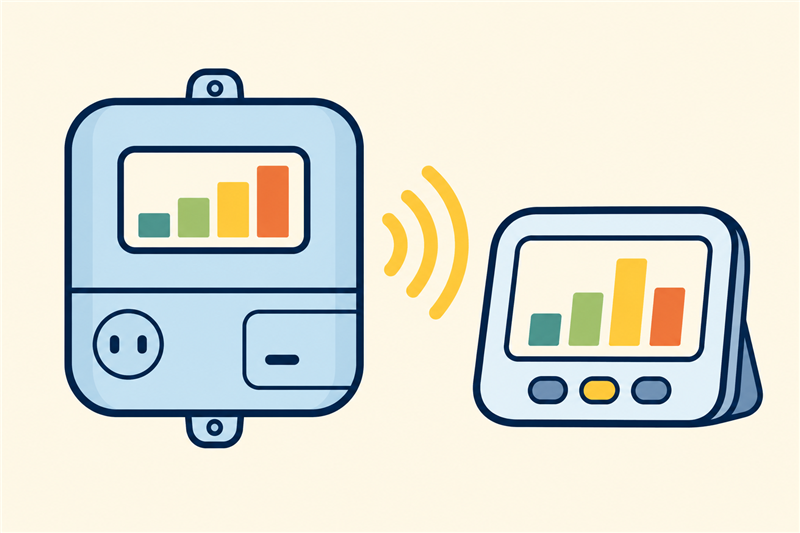
A smart meter measures the electricity (and often gas) you use and sends the readings to your supplier automatically, so you do not have to read the meter. A small display in your home shows what you are using. It does not use your Wi-Fi, and it does not lower your bill by itself.
I always assumed a smart meter used my Wi-Fi and could see what every appliance was doing.
It does neither. It sees the total, and it has its own network.
What a smart meter does
A smart meter works out how much electricity passes through it, like an ordinary meter, which is covered in how an electricity meter works. The difference is what it does with the number.
It records electricity use in half-hour intervals and sends readings to your supplier over its own network. How often readings are shared depends on your meter setup and choices. When readings arrive automatically, bills can be based on actual use rather than estimates. The meter records a total for the home; it cannot tell a kettle from a toaster.
Where the data goes
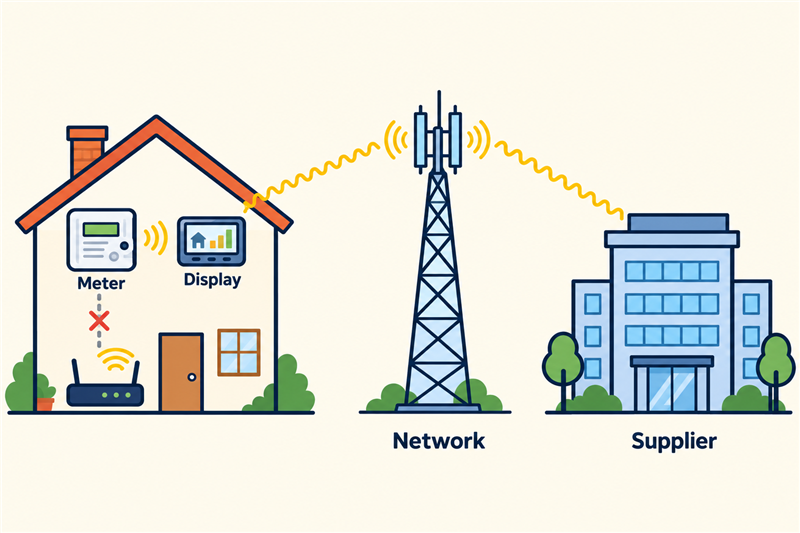
The meter talks to the display in your home over a short-range radio link. It also connects to a national smart meter network, which can pass readings on to your supplier. These links do not use your own broadband or Wi-Fi.
If your broadband goes down, the meter and display can still communicate locally.
Who sees what
The rules for how often your readings are taken depend on how detailed they are.
Monthly readings
a broad totalThey can support billing without showing the daily pattern.
Daily readings
a more detailed totalThe supplier can see how much was used each day.
Half-hourly readings
a detailed patternThey show how use changes through the day; access rules and defaults depend on your setup and agreement.
A smart meter lowers your bill by itself.
It only measures. Any saving comes from what you do with the information, for example by finding what uses the most or moving use to a cheaper time. The meter makes that easier to do.
What you can do with it
The in-home display estimates how much you are using and what it may cost, often with a short delay. Switch off the kettle and see the number change; turn on the oven and it rises. This can help reveal surprise use, such as something left running overnight.
Smart meters also make some tariffs possible, such as ones where electricity is cheaper at off-peak times, because the meter knows when you used it. If you have an electric car or a heat pump, those can be worth a look.
Two radio networks, not one
Inside the meter are two separate radio links, built for different jobs.
The first is a short-range link, using the same type of radio as many smart-home gadgets. It reaches only across your home, and it connects the meter to the display and sometimes to a gas meter. Nothing outside the home can listen in without being close.
The second reaches a national network, called the Data Communications Company (DCC) network. In most of England and Wales it uses the mobile phone network, and in the north of England and Scotland, long-range radio. The meter wakes up, sends its readings in short messages, and goes quiet again.
Because it uses its own network, a smart meter does not depend on your router. It also means your broadband or Wi-Fi provider cannot see what it sends.
Sources: Ofgem's current guidance on smart meter readings and data choices and the government's Data Access and Privacy Framework. Reading defaults can depend on when a meter was installed or a contract changed.
Key takeaways
- A smart meter sends readings to your supplier automatically.
- It measures the total, not each appliance.
- It does not use your Wi-Fi.
- Half-hourly readings need your agreement.
- Savings come from what you do with the information.
Now you know.
A smart meter sees the total, not the toaster.
It uses its own network, not your Wi-Fi.
And any saving comes from you.
Last reviewed 3 Nov 2026
Where next?
More in Everyday Life
-
Read
 Everyday Life
Washing machine
How a washing machine fills, heats, tumbles, rinses and spins, and why detergent and gentle tumbling clean…
-
Read
 Everyday Life
Charging an electric car
How charging an electric car works: the difference between kW and kWh, how long a charge takes at home and on…
-
Read
 Everyday Life
Car brakes
How car brakes work: fluid carries your foot's push to each wheel, pads squeeze a disc, and why doubling…