- Home
- Everyday Life
- LED bulbs
LED bulbs
Why they use so little power, and how to choose one by lumens, not watts.
The short version
An LED makes light directly from electricity, using a tiny chip, instead of heating a wire until it glows. It can give similar brightness to an old filament bulb while using a fraction of the power. Buy by lumens for brightness, not watts.
I used to buy bulbs by the watt, because a 60 watt bulb meant a normal brightness to me.
Watts only say how much power a bulb uses. Brightness is measured in lumens.
Four numbers on the box
Lumens
A bigger number is a brighter bulb; around 800 lumens replaces an old 60 watt bulb.
Watts
An LED giving 800 lumens uses roughly 8 to 10 watts.
Kelvin
About 2,700 K is warm and yellow-white; 4,000 K is cooler; 6,500 K is a bluish daylight.
Hours
how long it lastsLED bulbs are often rated for around 15,000 hours or more, far longer than old bulbs.
How an LED makes light
An old filament bulb passed electricity through a thin wire until it was white hot. It gave out light, but around nine tenths of the energy became heat.
An LED, short for light-emitting diode, is a tiny chip of semiconductor. When electricity passes through it, electrons drop across a gap inside the chip and give up their energy as a particle of light. There is no hot wire. The chip is far smaller than a grain of rice, and a bulb contains several. A small circuit in the base, called a driver, changes the mains electricity into the low, steady current that the chip needs.
Inside an LED bulb
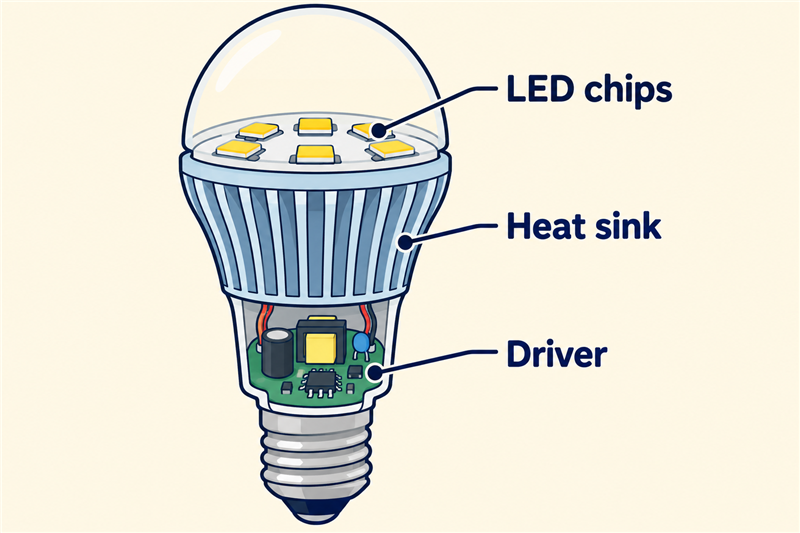
The chips sit at the top, behind the dome. The base holds the driver. The metal in between spreads out the small amount of heat the chips do make, because LEDs stop working properly if they get too hot.
The LED itself is small. Most of what you see is a case, a heat sink and a plastic dome.
Light for each watt of electricity
Do they still make heat?
They do. Not all the electricity becomes visible light; some becomes heat in the LED and its driver. A heat sink spreads that heat away from the chips so they can work reliably.
An LED usually uses much less power than an old filament bulb for similar light, so it adds less heat to a room. How warm the bulb gets depends on its design and fitting. Enclosed fittings can trap heat, so check whether the bulb is rated for that use.
LED bulbs give off no heat.
They give off less heat for a similar amount of light, but they still produce heat. That is why many designs include a heat sink.
How a blue chip makes white light
The first practical LEDs were red, then green. White light needs blue, and a bright blue LED was hard to make. It was achieved in the early 1990s, which won its inventors the Nobel Prize in Physics in 2014.
Most white LED bulbs use a blue chip with a thin coating of a yellow powder, called a phosphor. Some of the blue light passes straight through. Some is absorbed by the phosphor and re-emitted as yellow. Your eye mixes the blue and the yellow and sees white.
A thicker phosphor layer gives a warmer, more yellow white. A thinner one gives a cooler, bluer white. That choice is what the kelvin number on the box describes. Some bulbs add red phosphor too, for a more natural look to the colours in a room.
Sources: Energy Saving Trust guidance on lighting and the 2014 Nobel Prize in Physics. Brightness and efficiency vary by product; check the packaging.
Key takeaways
- LEDs make light with a chip, not a hot wire.
- They use much less power than old filament bulbs for similar brightness.
- Choose bulbs by lumens, not watts.
- Kelvin tells you how warm or cool the light looks.
- LEDs make some heat; the base needs to shed it.
Now you know.
Watts measure power; lumens measure brightness.
An LED is mostly light, not heat.
And kelvin is the colour of the light.
Last reviewed 3 Nov 2026
Where next?
More in Everyday Life
-
Read
 Everyday Life
Washing machine
How a washing machine fills, heats, tumbles, rinses and spins, and why detergent and gentle tumbling clean…
-
Read
 Everyday Life
Charging an electric car
How charging an electric car works: the difference between kW and kWh, how long a charge takes at home and on…
-
Read
 Everyday Life
Car brakes
How car brakes work: fluid carries your foot's push to each wheel, pads squeeze a disc, and why doubling…