- Home
- The Human Body
- Kidneys
Your kidneys
How two bean-shaped organs filter your blood, keep your water balance steady and make urine.
The short version
Your two kidneys filter fluid from the blood continuously. They return most water and useful substances to the blood, and the remaining fluid becomes urine. In doing so they also keep the water, salt and acid in your body at the right levels.
I always assumed the kidneys catch waste and let the rest pass.
They do the opposite. They let almost everything through first.
Then they take back what the body wants.
A fist-sized filter
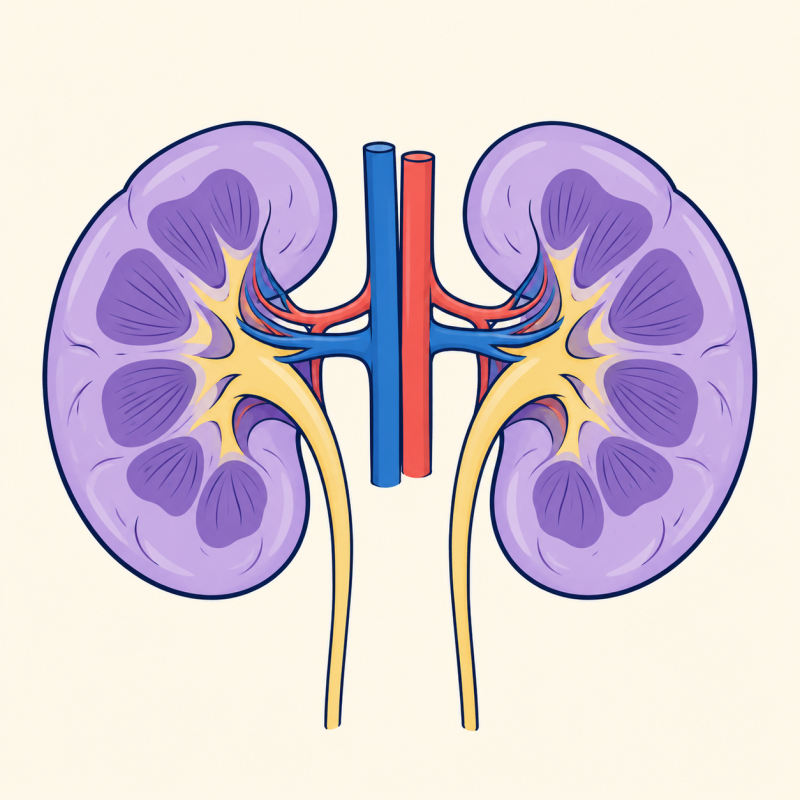
Each kidney is about the size of a fist, shaped like a bean, and sits towards the back of the body under the ribs. Blood arrives from the main artery, and cleaned blood leaves through a vein. Each kidney contains about a million tiny filtering units called nephrons.
What a nephron does
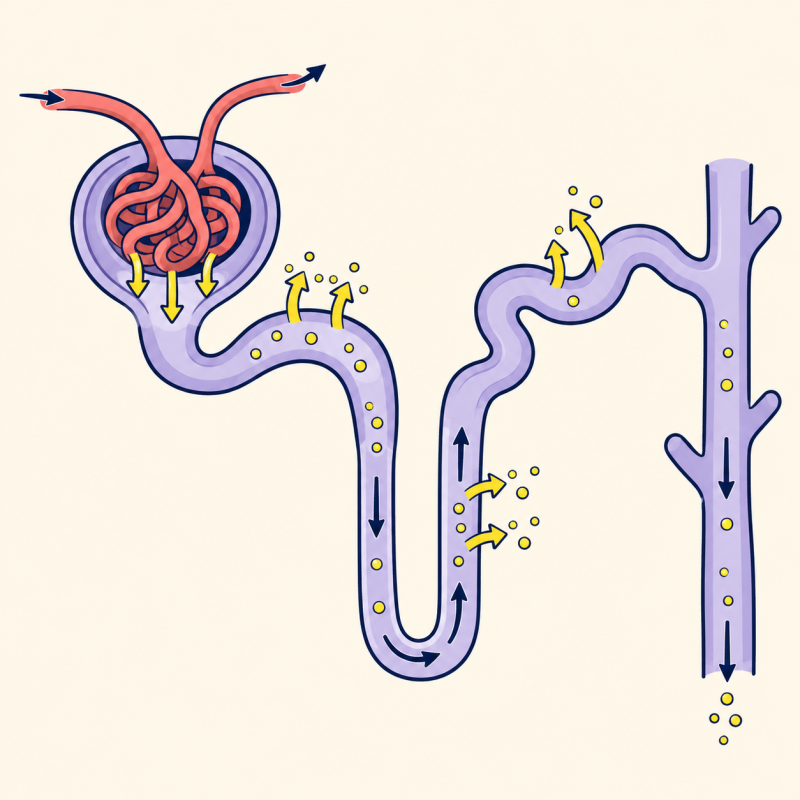
In each nephron, blood passes through a tiny knot of vessels called a glomerulus. Its walls act as a sieve. Water, salts, sugar and waste pass through, while blood cells and large proteins stay in the blood.
The liquid then flows along a long, winding tube. Along the way the tube walls take back the water, sugar and salts the body needs, and add more waste. What is left in the tube is urine.
Urine drains through a tube from each kidney into the bladder, where it is stored until you go to the toilet.
Where the urine goes
Each kidney is joined to the bladder by a thin tube called a ureter. Small waves of muscle push the urine down it, a little at a time. The bladder is a stretchy bag that can hold about half a litre. When it is full enough, nerves tell your brain that you need to go, and a ring of muscle at the bottom holds the urine in until you choose to relax it.
About 180 litres
The amount of fluid the kidneys filter out of the blood each day. Almost all of it is taken back, and about 1.5 litres is passed as urine.
The kidneys only remove waste.
They filter water and small dissolved substances, then return useful substances to the blood. They also help control blood pressure, balance acidity, and make a hormone that prompts red blood cell production.
How thirst fits in
Your kidneys adjust how much water they save. If you have not drunk much, a part of your brain notices that the blood is more concentrated and releases a hormone that tells the kidneys to take back more water. The urine becomes smaller in amount and darker. At the same time the brain makes you feel thirsty.
If you have drunk plenty, the hormone is switched off, and the kidneys let more water go.
Why the kidneys filter so much
The kidneys filter a large volume of fluid, then selectively reabsorb water and substances the body needs. The often-quoted figure of about 180 litres per day refers to this filtered fluid, not 180 litres of urine or blood lost. The exact amount varies.
Note: this explains how it works in general. It is not advice for your situation. For a decision about your health, money or legal position, check an official source or ask a qualified professional. If you are worried about your kidneys or your urine, speak to your GP.
Sources: Wye Valley NHS: kidneys and kidney disease; Oxford University Hospitals: about the kidneys. Filtration volumes are approximate adult values.
Key takeaways
- Kidneys filter blood in about a million units each.
- Most of the filtered fluid is taken back.
- What is left becomes urine.
- Kidneys balance water, salt and acid.
- Thirst and the kidneys work together.
Now you know.
The kidneys filter first.
Then they take back what is useful.
And what is left is urine.
Last reviewed 3 Nov 2026
Where next?
More in The Human Body
-
Read
 The Human Body
Your eyes
How the eye focuses light onto the retina, how rods and cones work, how we see colour, and what colour…
-
Read
 The Human Body
Your ears
How the ear turns air vibrations into sound through the eardrum, three tiny bones and the cochlea, and how…
-
Read
 The Human Body
Sleep
What happens during sleep, how the sleep stages and body clock work, why the brain stays active at night and…