- Home
- The Human Body
- Digestion
Digestion
What happens to your food on its trip through you, and why your stomach does not digest itself.

The short version
Digestion breaks food down into pieces small enough to pass into your blood. Chewing and stomach churning do it physically, and acid and enzymes do it chemically. Most nutrients are absorbed in the small intestine, and the large intestine takes back water. The whole trip takes about a day or two.
I always assumed food landed in the stomach and was digested there.
The stomach only gets it started.
Most of the real work happens afterwards, in the small intestine.
The journey of a meal
- Mouth Teeth chop the food, and saliva starts breaking down starch.
- Gullet Muscles squeeze the food down in a wave, in about 5 to 10 seconds.
- Stomach Acid and churning turn it to a thick liquid over a few hours.
- Small intestine Enzymes finish the job, and nutrients pass into the blood.
- Large intestine Water is taken back, and the leftovers move on.
Stomach: a mixing bag
The stomach is a muscular bag that holds food and churns it with strong acid and an enzyme that breaks down protein. The acid is strong enough to kill many germs. After a few hours the food has turned into a thick liquid, which is released a little at a time into the small intestine.
Small intestine: where it is absorbed
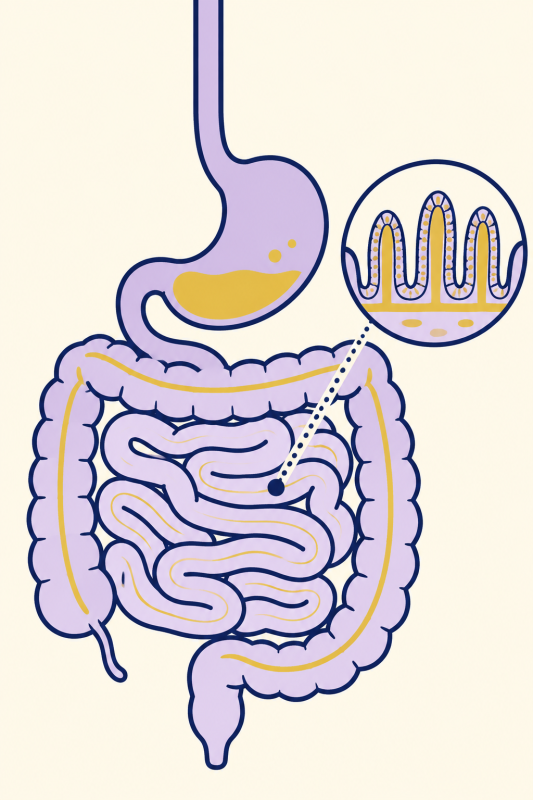
The small intestine is a coiled tube, about five to seven metres long. Its inner surface is covered in millions of tiny finger-like bumps called villi, which give it a very large surface area. Each one has tiny blood vessels, and nutrients pass through the thin wall into the blood.
The large intestine is shorter but wider. It takes back water and holds the rest, which contains fibre and gut bacteria.
About 1 to 3 days
How long food usually takes to travel through the whole system. It varies from person to person.
Swallowed chewing gum stays in your stomach for seven years.
Gum base cannot be digested, but it does not stay behind. It moves through the gut with everything else and leaves the body in the normal way.
Where the food goes next
Not everything you swallow is absorbed. Fibre, found in vegetables, fruit and wholegrain foods, cannot be broken down by your own enzymes, so it passes through the small intestine and reaches the large intestine. There it feeds the gut bacteria and adds bulk, which helps keep things moving.
The liver and the pancreas also help. The liver makes bile, which emulsifies fats into smaller droplets, and the pancreas releases enzymes into the small intestine to finish breaking down starch, protein and fat.
Why your gut is full of bacteria
Your large intestine contains trillions of bacteria. Many are harmless, and some help by breaking down fibre that your own enzymes cannot and by making some vitamins. A healthy mix of them also helps crowd out harmful ones.
Why the stomach does not digest itself
The stomach lining makes a thick layer of mucus that coats its inner wall. The cells also release a substance that neutralises acid right at the surface. And the lining is renewed quickly, with the surface cells replaced every few days.
When this protection fails in one spot, for example because of an infection with a particular bacterium or long-term use of some painkillers, the acid can damage the wall and cause an ulcer.
Note: this explains how it works in general. It is not advice for your situation. For a decision about your health, money or legal position, check an official source or ask a qualified professional.
Sources: Great Ormond Street Hospital: how digestion works; University Hospitals Plymouth: bowel transit and constipation. Lengths and transit times vary.
Key takeaways
- Digestion breaks food into tiny pieces.
- The stomach mixes and starts the process.
- The small intestine absorbs most nutrients.
- The large intestine takes back water.
- Gut bacteria help with what is left.
Now you know.
The stomach only starts it.
The small intestine absorbs the food.
And a mucus layer stops the stomach digesting itself.
Last reviewed 3 Nov 2026
Where next?
More in The Human Body
-
Read
 The Human Body
Your eyes
How the eye focuses light onto the retina, how rods and cones work, how we see colour, and what colour…
-
Read
 The Human Body
Your ears
How the ear turns air vibrations into sound through the eardrum, three tiny bones and the cochlea, and how…
-
Read
 The Human Body
Sleep
What happens during sleep, how the sleep stages and body clock work, why the brain stays active at night and…