The short version
Sound is a vibration that travels through the air as a wave of squeezed and stretched air. Your ear and brain turn it into what you hear. How fast it vibrates sets the pitch, how big the vibration is sets the volume, and an echo is sound bouncing back off a hard surface.
I always imagined sound as something that flew through the air from the speaker to my ear, like a thrown ball.
Nothing travels all the way. Each bit of air only shuffles a tiny distance and passes the push on.
Sound is a wobble, not a thing.
Sound starts with a vibration
A guitar string, a speaker cone and your vocal cords all do the same thing: they move rapidly backwards and forwards. Each movement pushes on the air next to it, squeezing it. Then the surface moves back and the air is stretched. Squeeze, stretch, squeeze, stretch.
The squeezes and stretches travel outwards, and when they reach your ear they push on your eardrum in the same pattern.
You can think of a Mexican wave in a stadium. Each person only stands up and sits down, but the wave runs all the way round. It is not a perfect picture: in a stadium the people move up and down while the wave goes sideways, but in sound the air moves back and forth in the same direction the wave travels.
A wave of squeezed air
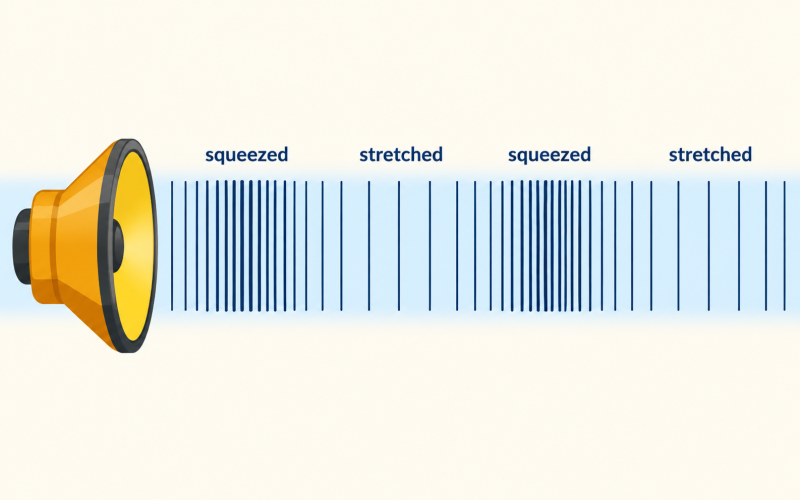
Where the air is squeezed, its pressure is a little higher than normal. Where it is stretched, the pressure is a little lower. These bands of high and low pressure move away from the speaker at the speed of sound.
Your ear senses those pressure changes. Hearing is your brain's way of making sense of them.
Pitch, volume and speed
Three words that are often mixed up.
Pitch
How many vibrations there are each second. A fast vibration makes a high note, a slow one makes a low note.
Volume
How big the push is. A bigger vibration carries more energy and sounds louder.
Speed
About 343 metres per second in air at 20 °C, whatever the pitch or volume.
How loud is it?
Loudness in decibels. Every 10 decibels more is ten times as much sound energy, which sounds about twice as loud, so the real gaps are much bigger than the bars.
Sound needs something to travel through
A sound wave is a push passed from one bit of matter to the next, so it needs matter to pass through. Air will do, but sound travels faster through water, at about 1,480 metres per second, and faster still through steel, at around 5,000.
In space there is almost nothing to pass the push along. The pushes fade away, so no sound reaches you.
In space, you could hear an explosion.
Space is close to empty, so there is almost nothing for a sound wave to travel through. Space is silent, whatever the films show.
Echoes
When a sound wave hits a hard, flat surface such as a cliff or a wall, much of it bounces back. That is an echo.
Your ear needs about a tenth of a second between the sound and its echo to hear them as separate. In that time sound travels about 34 metres there and back, so the surface needs to be at least 17 metres away. In a smaller room the echo comes back so fast that it blends into the original sound, and the room sounds "live".
343 m/s
The speed of sound in air at 20 °C. That is about 1,235 kilometres an hour, or roughly a kilometre every three seconds.
Why your own voice sounds different on a recording
When you speak, your voice reaches your ears in two ways: through the air, as for everyone else, and through the bones of your head. Bone conduction adds low-frequency vibrations to the sound you hear, making your own voice seem deeper and fuller to you.
A recording only picks up the sound that has travelled through the air. So it sounds higher and thinner than the voice you are used to, even though it is the voice everyone else hears.
Sources:
- Speed of sound in air, National Physical Laboratory
- Sound, Hearing and Noise, University of Southampton
- Typical loudness figures, NHS
Key takeaways
- Sound is a vibration passed along as squeezes and stretches of air.
- Pitch is how fast the vibration is; volume is how big.
- Sound needs matter to travel through, so space is silent.
- Sound travels at about 343 metres per second in air.
- An echo is sound bouncing off a hard surface.
Now you know.
Sound is a wobble passed from one bit of air to the next.
The faster the wobble, the higher the note.
And with no air to pass it on, there is no sound in space.
Last reviewed 3 Nov 2026
Where next?
More in Science
-
Read
 Science
Why the sky is blue
The sky is blue because air scatters blue light about six times more than red. See why sunsets turn red and…
-
Read
 Science
Rainbows
A rainbow is sunlight bent and bounced inside raindrops. See why it is an arc, why red is on the outside, and…
-
Read
 Science
Why the sea is salty
The sea is salty because rivers carry dissolved minerals from rock into it and evaporation leaves them…