The short version
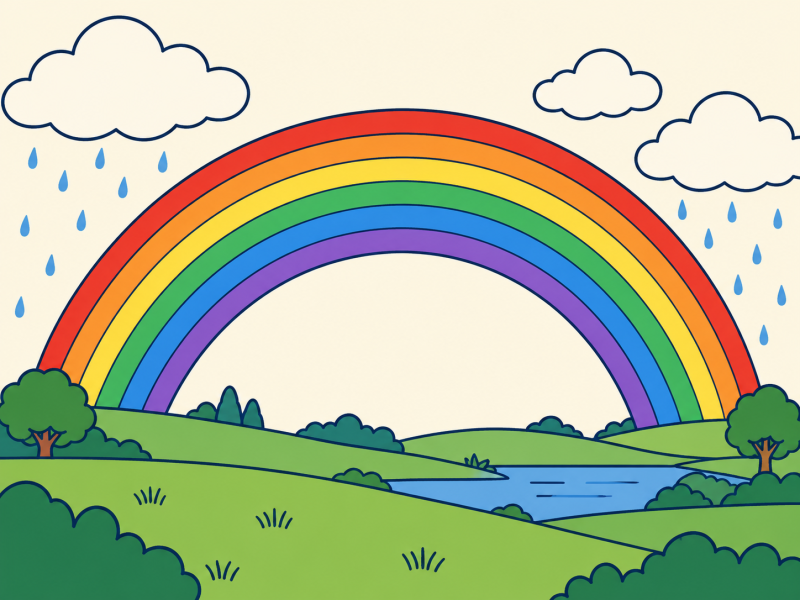
A rainbow is sunlight bent and bounced inside millions of raindrops. Each drop splits the light into its colours and sends it back towards where it came from. You see a rainbow when the Sun is behind you and rain is in front of you, and every person sees a slightly different one.
I always pictured a rainbow as a thing hanging in the sky, like a bridge you could walk up to and touch.
It is not an object in one place. It is where your eyes meet the light.
A rainbow is not a thing. It is a view.
Water bends light
Light travels more slowly in water than in air, so it changes direction when it enters water at a slant. This bending is called refraction. Each colour bends by a different amount: blue and violet bend the most, red the least. That is how a glass prism spreads white light into a band of colours.
A raindrop does the same job, with a bonus. The back of the drop works like a mirror.
Inside one raindrop
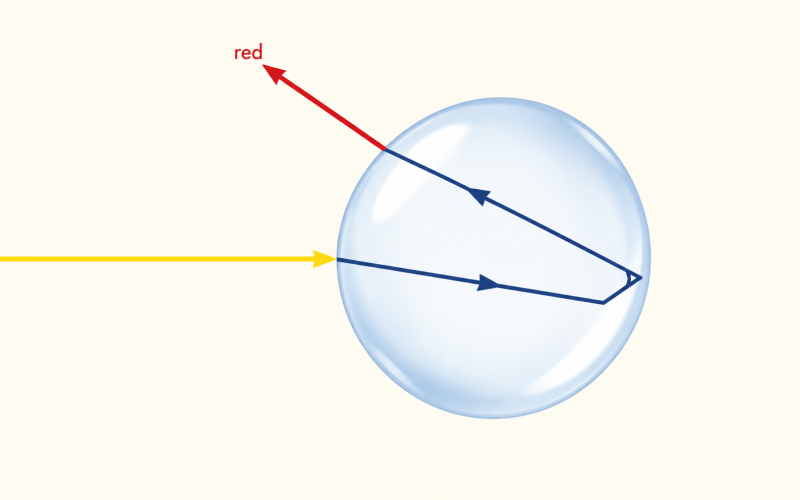
Sunlight enters the front of a drop and bends, splitting into colours. It hits the back of the drop and bounces. It then leaves through the front, bending again and spreading out further.
The light comes out heading roughly back towards the Sun, but at a slight angle that depends on the colour. Red leaves at about 42 degrees from the line pointing straight away from the Sun. Violet leaves at about 40.
Light that enters other parts of the drop comes out at other angles, but it is spread thin. Most of the bright, concentrated light leaves close to that 42 degree mark, and that is what we see.
Why it makes an arc
Imagine a line from the Sun, through the back of your head, and on into the ground in front of you. Every raindrop that sits 42 degrees from that line sends red light to your eyes. Together those drops form a circle around the line, and that circle is the red edge of the rainbow.
Drops a little closer to the line, at about 40 degrees, send violet to you instead. The other colours fill the space between. Red ends up on the outside because the red drops are higher in the sky than the violet ones.
The ground cuts off the bottom of the circle, so we usually see an arch. From a hill or an aeroplane you can sometimes see the full circle.
One bow, two bows
Sometimes the light bounces twice inside each drop, and you see more than one.
Main rainbow
the bright oneThe light bounces once inside each drop. Red is on the outside.
Double rainbow
the faint oneThe light bounces twice, giving a dimmer bow at about 51 degrees from the point opposite the Sun, with the colours in reverse order.
Alexander's dark band
the dark gapThe sky between the two bows looks darker, because no light from the drops reaches your eyes at those angles.
When you can see a rainbow
You need rain in front of you and the Sun behind you. For the primary bow, red light reaches your eye at about 42 degrees from the point opposite the Sun. As the Sun climbs, the bow appears lower. Once the Sun is higher than 42 degrees, the whole bow is below the horizon.
That is why rainbows are mostly seen in the morning and late afternoon, and why you almost never see one at midday in a UK summer, when the Sun is high. At noon in midsummer in southern England the Sun is about 60 degrees up. The reason is the same one behind the seasons: the Sun's height changes through the year.
You can walk to the end of the rainbow.
A rainbow is not in one place. It depends on where your eyes are, so when you move, the rainbow moves with you. Two people standing side by side see two slightly different rainbows.
Why we say there are seven colours
A rainbow has no separate stripes. The colours fade smoothly into each other, and the eye can tell apart many more than seven shades.
The usual list of red, orange, yellow, green, blue, indigo and violet comes from Isaac Newton, who published it in 1704. He chose seven partly because of the seven notes of the musical scale. Many people cannot pick out indigo at all, and some languages and cultures name fewer or more colours in a rainbow.
Why the sky itself is blue, and why a low Sun looks red, is a different effect: see why the sky is blue.
Sources:
- Rainbows, Met Office
- How rainbows form, NASA Space Place
- Isaac Newton, Opticks, 1704
Key takeaways
- Raindrops bend, bounce and split sunlight into colours.
- Red leaves at about 42 degrees, violet at about 40.
- The bow is a circle of drops, seen from the ground as an arc.
- You need the Sun behind you and rain in front.
- Everyone sees their own rainbow.
Now you know.
A raindrop bends sunlight, bounces it, and bends it again.
Each colour comes out at a slightly different angle.
So a rainbow is not a place. It is a view, and it belongs to you.
Last reviewed 3 Nov 2026
Where next?
More in Science
-
Read
 Science
Why the sky is blue
The sky is blue because air scatters blue light about six times more than red. See why sunsets turn red and…
-
Read
 Science
Why the sea is salty
The sea is salty because rivers carry dissolved minerals from rock into it and evaporation leaves them…
-
Read
 Science
How tides work
Tides come from the Moon's gravity pulling on the sea. See why there are two high tides a day, why each comes…