The short version
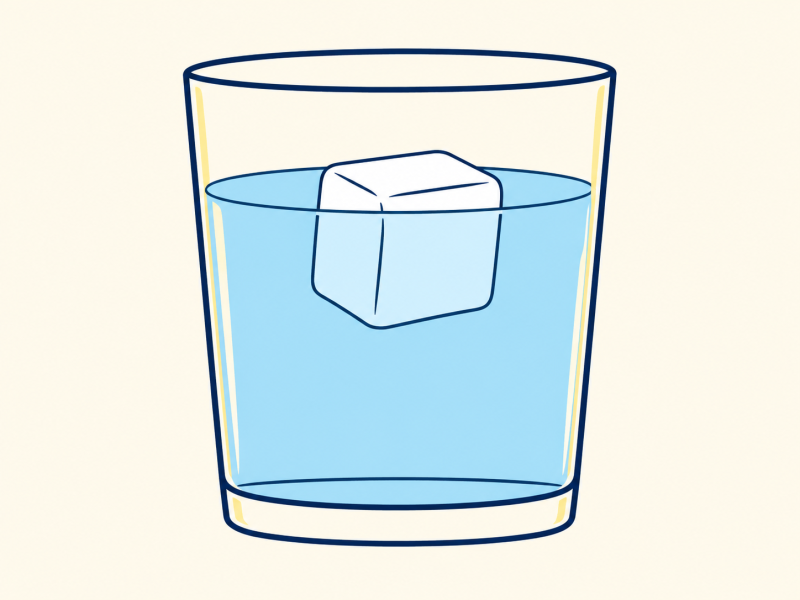
Ice floats because it is less dense than liquid water: about about 8% less dense than liquid water. When water freezes, its molecules lock into an open, six-sided pattern that takes up about 9% more room. The same mass spread through more space has a lower density.
I always assumed freezing packs things tighter, so a solid should sink into its own liquid. For almost every substance, that is exactly what happens.
Water does it backwards.
Frozen water is one of the few solids that floats on its own liquid.
Density
How much matter is packed into a given space. A litre of water weighs about one kilogram. Anything less dense than water floats on it; anything denser sinks.
Floating is about density
Whether something floats or sinks comes down to density. A stone is denser than water and sinks. A piece of cork is much less dense and floats. A steel ship floats because its shape encloses so much air that the whole ship, steel and air together, is less dense than the water it displaces.
Ice sits in a narrow gap: only about 8% less dense than the water it came from. That is enough to float, but by a narrow margin.
How dense are they?
Kilograms per litre. Anything below fresh water at 1.00 floats in it.
What water molecules do when they freeze
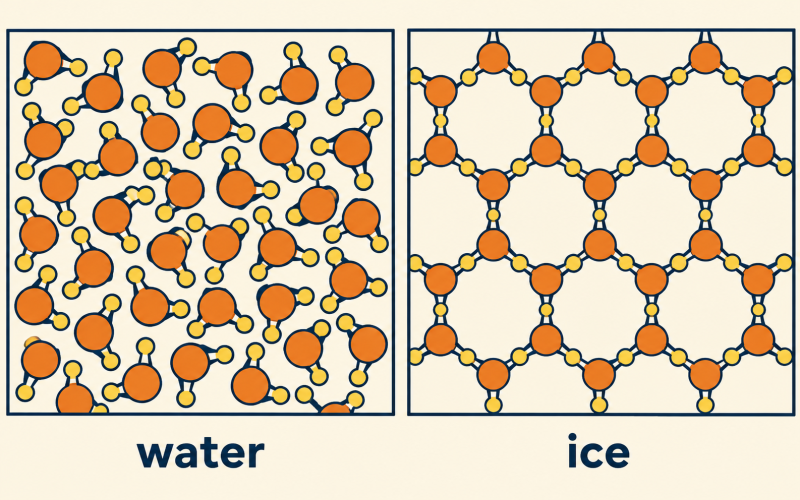
A water molecule has one oxygen atom and two hydrogen atoms. In liquid water the molecules jostle past each other, sticking together loosely and packing quite closely.
As the water freezes, each molecule locks onto four neighbours in a rigid pattern. This pattern is open, with gaps built in, and it takes up more space than the jostling liquid did. That open six-sided pattern is also why snowflakes have six sides.
Freezing water pushes outwards with great force. It is why water pipes can burst when they freeze, and why you should not freeze a full glass bottle.
Ice floats because it is full of air bubbles.
Bubbles can make ice cloudy, but they are not the reason. Perfectly clear ice, with no bubbles, floats as well.
Why this matters
If ice sank, lakes and ponds would freeze from the bottom up, and many would freeze solid. Instead, ice forms on the top and stays there. It acts as a lid that slows further freezing, so the water underneath stays liquid and fish and other pond life can survive the winter.
It also explains icebergs. Because ice is only a little lighter than sea water, most of an iceberg sits below the surface.
About 90%
How much of an iceberg floats below the waterline. Only the top tenth shows.
Why water is densest at 4 degrees
Most liquids get denser as they cool. Water does too, but only down to about 4 °C. Below that, the molecules begin to arrange themselves into small ice-like clusters, which take up more room, so the water gets slightly less dense as it gets colder.
In a deep lake in winter, that makes the water arrange itself in layers: the 4 °C water, the densest, sinks to the bottom, the colder water sits above it, and ice forms on top.
Sea water behaves differently. With enough salt in it, the water keeps getting denser all the way down to its freezing point, about −1.8 °C.
Sources:
- Water properties: ice, USGS Water Science School
- CRC Handbook of Chemistry and Physics, densities of common substances
- Sea ice density and properties, NSIDC
Key takeaways
- Things float when they are less dense than the liquid.
- Ice is about 8% less dense than liquid water.
- Freezing locks molecules into an open, six-sided pattern.
- Floating ice protects the water and life below it.
- About nine-tenths of an iceberg is underwater.
Now you know.
When water freezes, it expands.
So ice is less dense than water, and it floats.
That floating lid is why lakes freeze from the top down.
Last reviewed 3 Nov 2026
Where next?
More in Science
-
Read
 Science
Why the sky is blue
The sky is blue because air scatters blue light about six times more than red. See why sunsets turn red and…
-
Read
 Science
Rainbows
A rainbow is sunlight bent and bounced inside raindrops. See why it is an arc, why red is on the outside, and…
-
Read
 Science
Why the sea is salty
The sea is salty because rivers carry dissolved minerals from rock into it and evaporation leaves them…