The short version
Your employer takes income tax and National Insurance from your pay before you receive it. Income tax is charged in slices: none on the first £12,570, then a rising rate on each further slice. Only the part above each threshold is taxed at the higher rate. The money pays for public services.
I always thought that if a pay rise took me into a higher tax band, all my pay would be taxed at the higher rate.
It would not.
Only the pay above the line is.
What comes off a payslip
Your payslip begins with gross pay, the amount you earn, and ends with net pay, the amount you receive. Between them come deductions. The usual ones are income tax, National Insurance, and a workplace pension if you are in one. Some people also pay back a student loan.
Employers do this under a system called PAYE, which means the tax is paid to HM Revenue and Customs before the money reaches you.
The bands in England, Wales and Northern Ireland
Rates for the 2026 to 2027 tax year in England, Wales and Northern Ireland. Scotland sets its own bands.
Personal allowance
0%Tax-free: the first £12,570 of income.
Basic rate
20%The part of income from £12,570 up to £50,270.
Higher rate
40%The part from £50,270 up to £125,140.
Additional rate
45%The part above £125,140.
A worked example
Take a salary of £30,000. The first £12,570 is tax-free. The other £17,430 is taxed at 20%, which is £3,486 of income tax. National Insurance on the same £17,430 is 8%, which is £1,394. Together they take about £4,880 and leave about £25,120.
The same idea applies in the higher band. For a taxpayer with the standard allowance, a salary of £51,000 puts only the £730 above £50,270 into the 40% band. Personal circumstances can change the calculation.
What happens to £30,000
Before any pension or student loan.
A pay rise into a higher band can leave me with less take-home pay.
Only the extra pay is taxed at the higher rate, so more pay normally means more take-home pay. Some allowances and benefits are reduced at higher incomes.
Where the money goes
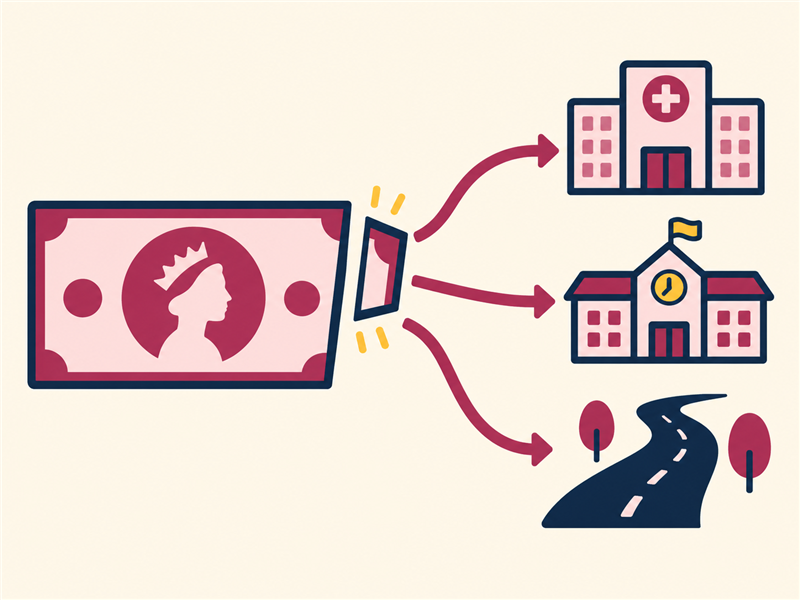
Tax pays for things we use together. The biggest areas of government spending are social security, including the state pension and benefits, health, and education. Others include defence, roads, courts and police, and the interest on government debt.
Tax does not go into a pot labelled with the department it pays for. The Government decides its spending each year, and the Office for Budget Responsibility publishes the figures.
The tax code on your payslip
Your payslip shows a tax code, such as 1257L. The number is your tax-free amount, divided by ten: £12,570 gives 1257. The letter says how you are treated; L is the standard personal allowance.
If the code is wrong, you can be taxed too much or too little. HM Revenue and Customs fixes it if you tell them. Jobs, benefits in kind and unpaid tax from earlier years can all change a code. The personal allowance is also reduced for incomes above £100,000.
Note: this explains how it works in general. It is not advice for your situation. For a decision about your money, check an official source or ask a qualified professional. Rates are for England, Wales and Northern Ireland and can change at a Budget.
Sources: GOV.UK, Income Tax rates and National Insurance rates; HM Treasury and Office for Budget Responsibility, public spending figures. Rates are for 2026 to 2027.
Key takeaways
- Tax comes off before you are paid.
- Only the slice above each threshold is taxed at the higher rate.
- The first £12,570 is tax-free for most people.
- National Insurance comes off too.
- Tax pays for services we share.
Now you know.
Tax is charged in slices.
Only the top slice pays more.
More pay means more take-home.
Last reviewed 3 Nov 2026
Where next?
Explained further by
More in Finance
-
Read
 Finance
Interest
How interest works: the price of borrowing money, why it grows your savings and your debts, and what a rate…
-
Read
 Finance
Inflation
What inflation is, how the UK measures it, why prices keep rising, who aims to keep it at 2%, and why falling…
-
Read
 Finance
How banks work
How a bank works: why your balance is a promise rather than a pile of cash, how banks lend, what stops them…