The short version
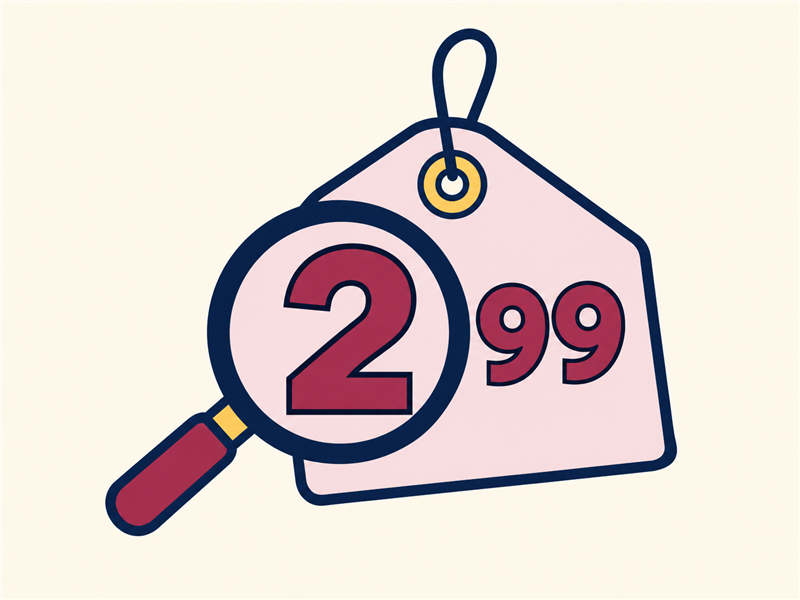
Prices ending in .99 work because we read from left to right. £2.99 gets read as "two pounds and a bit", not as three pounds. Studies have found people buy more at a price like £2.99 than at £3.00. Shops use it because it works.
I always thought nobody was fooled by £2.99. We all know it is nearly £3.
We know. It still works.
The first digit does its work before we think about the rest.
The left-digit effect
When we read a number, the first digit stands out and gets the most weight. A price of £2.99 starts with a 2, so it feels like it belongs with the £2 prices. A price of £3.00 starts with a 3, and feels like a £3 item. The difference is one penny, but the feeling is bigger.
Researchers call this the left-digit effect. It is a shortcut the brain uses so we can compare prices fast, and it makes a price feel slightly smaller than it is.
Three kinds of price ending
.99
Charm priceMakes a price look lower, so it is common on everyday goods and sale items.
.00
Round priceFeels clean and calm, and is often used for premium goods and restaurants.
.95
Another charm endingWorks in the same way as .99, by keeping the first digit low.
Prices end in .99 so that the cashier has to open the till for change.
That is a popular story, but there is no good evidence for it. The effect comes from how we read numbers.
Why not every price ends in .99
A round price can say something too. A restaurant that charges £20 for a main course looks more careful than one that charges £19.99. The same goes for a fine watch, which would look odd at £999.99.
Some shops use a price with a different ending to show a sale or a clearance. Others use whole numbers because it makes tills and menus simpler.
Why the effect is not magic
The left-digit effect is one influence on a purchase, not a switch that makes everyone buy. People can notice the penny difference, compare unit prices, or judge the product by quality and need instead. Retail studies have found sales can change when a price ending changes, but the size of the effect depends on the product, the shopper and the way the price is presented. A price ending may also be chosen to fit a store's style or promotion. That is why the same ending does not work equally well for every item.
Why a shop might choose another ending
A business can use a price ending to make the shelf easier to scan, show a discount, or keep prices consistent across a range. Some customers also respond to round prices as a signal of quality or simplicity. Those are possible reasons for a pricing choice, not guarantees about what a buyer will think. The best-known experiments tested particular products and settings; they do not prove that every shopper reacts the same way. The price still needs to make sense for the item and the people buying it.
Sources: Thomas and Morwitz, "Penny wise and pound foolish: the left-digit effect in price cognition", Journal of Consumer Research, 2005; Schindler and Kibarian, "Increased consumer sales response through use of 99-ending prices", Journal of Retailing, 1996.
Key takeaways
- We read numbers from left to right.
- The first digit has the most effect.
- £2.99 feels like a £2 price.
- Round prices suggest quality.
Now you know.
The first digit leads.
A penny can feel like a pound.
Round prices say quality.
Last reviewed 3 Nov 2026
Where next?
More in Finance
-
Read
 Finance
Interest
How interest works: the price of borrowing money, why it grows your savings and your debts, and what a rate…
-
Read
 Finance
Inflation
What inflation is, how the UK measures it, why prices keep rising, who aims to keep it at 2%, and why falling…
-
Read
 Finance
How banks work
How a bank works: why your balance is a promise rather than a pile of cash, how banks lend, what stops them…