The short version
Before 1971, a British pound was 240 pennies: 12 pence made a shilling and 20 shillings made a pound. The system is more than a thousand years old. It began as a count of silver pennies in a pound weight of silver, and it was replaced by decimal money on 15 February 1971.
I always wondered why anyone would choose 240 for a pound.
Nobody chose it. It grew.
A pound of silver was cut into 240 pennies, and the other units were made to fit.
Where 240 came from
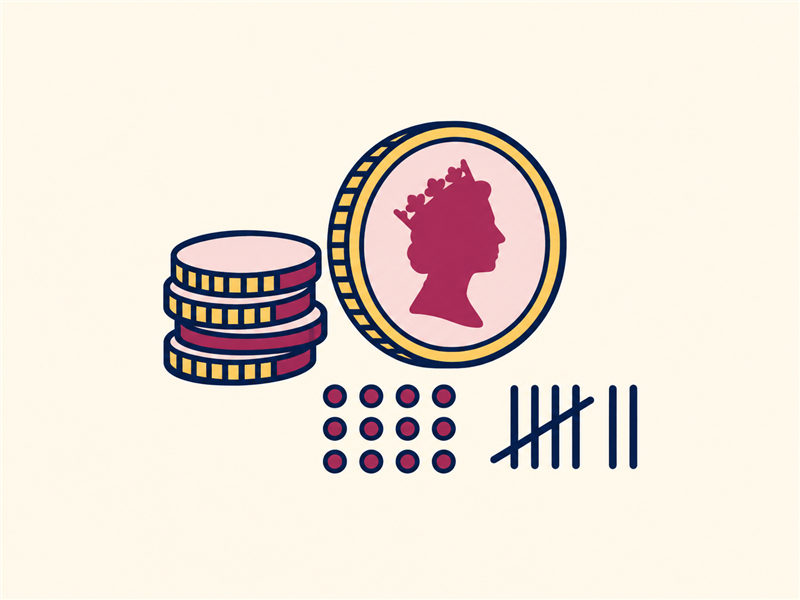
In about the 8th century, rulers in western Europe began to use a system based on a pound weight of silver. A pound was cut into 240 silver pennies. Twelve pennies were counted as a shilling, which made the numbers easy to divide by 2, 3, 4 and 6.
The system spread, and England kept it for more than a thousand years. That is why £ stands for libra, the Latin for a pound, and the penny was written as d, from denarius, a Roman coin. A shilling was s, from solidus.
Coins in old pennies
240
Pennies in a pre-decimal pound. The number has many factors, which made it easy to split a pound into halves, thirds, quarters and sixths without fractions of a penny.
Guineas and other names
Alongside these were other terms. A guinea was 21 shillings, and was used for professional fees and for the price of luxury goods. A farthing was a quarter of a penny, and a halfpenny half a penny.
Slang added more. A shilling was a "bob", and a pound could be a "quid".
From pennies to decimals
- 8th century Silver pennies are minted in Britain, 240 to a pound of silver.
- 1816 Britain moves to a gold standard, with the pound as a gold coin, the sovereign.
- 1966 The Government decides to adopt a decimal currency.
- 1971 On Decimal Day, 15 February, the pound becomes 100 new pence.
Decimal money made everyday life simpler overnight.
It took years of preparation, with a Decimal Currency Board, a two-year changeover period and new coins phased in from 1968. Many shops and people found the change hard.
Looking further back
The story is part of a longer one about trade and weights. More of it is in History, which looks at how people measured, counted and recorded the world. The 240 figure described a relationship between monetary units; it was not a large coin you could carry in your pocket.
What changed on Decimal Day
The pound itself stayed: what changed was the number of pence in it. One old shilling became five new pence, while one old penny was worth a little less than half a new penny. During the changeover, shops showed prices in both systems so people could learn the new values. Some familiar coins continued for a while at their decimal equivalents, then were withdrawn. The conversion table helped people see that decimalisation changed the arithmetic, not the value of the money they held.
Sources: The Royal Mint, decimalisation and Decimal Day; Bank of England, history of the pound. Dates and figures are for the UK.
Key takeaways
- A pound was 240 pennies, or 20 shillings of 12 pence.
- It began with a pound weight of silver.
- £, s and d come from Latin.
- Decimal Day was 15 February 1971.
Now you know.
A pound was 240 pennies.
£sd comes from Latin.
Decimals arrived in 1971.
Last reviewed 3 Nov 2026
Where next?
More in Finance
-
Read
 Finance
Interest
How interest works: the price of borrowing money, why it grows your savings and your debts, and what a rate…
-
Read
 Finance
Inflation
What inflation is, how the UK measures it, why prices keep rising, who aims to keep it at 2%, and why falling…
-
Read
 Finance
How banks work
How a bank works: why your balance is a promise rather than a pile of cash, how banks lend, what stops them…