- Home
- Technology
- How a screen works
- Touchscreens
Touchscreens
How a flat piece of glass knows where your finger is, and why gloves do not work.
The short version
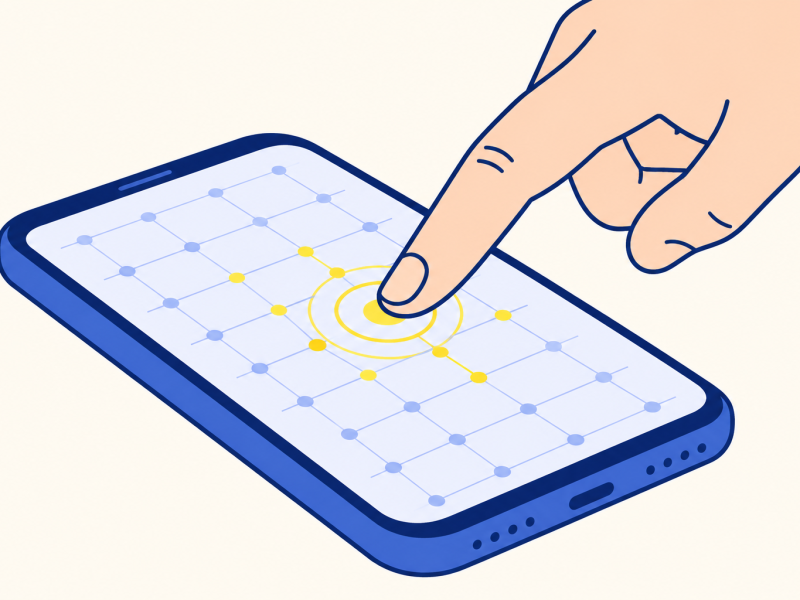
A phone screen has a grid of tiny wires under the glass, each carrying a faint electric field. A finger is slightly conductive, so touching the glass changes the field at that point. The phone finds where the change is. It builds on how a screen makes a picture.
I always thought touchscreens felt the pressure of my finger.
Most of them feel your electricity.
That is why an ordinary glove does nothing.
The grid under the glass
Under the glass is a transparent grid of wires. The phone keeps a tiny electric charge in them, called capacitance. A fingertip changes the electric field and the measured capacitance at nearby parts of the grid. The phone checks the whole grid many times a second, sees which crossings changed, and works out where you touched.
Because it measures many points at once, it can follow several fingers, which is how pinching to zoom works.
You can use a touchscreen with anything.
A bare finger usually works; an ordinary glove or plastic pen often does not because it changes the electric field too little. A compatible stylus or conductive glove is designed to register.
Key takeaways
- A grid of wires holds a weak electric charge.
- A finger changes the charge where it touches.
- Many points are measured at once.
- Non-conductive things do not register.
Now you know.
It senses electricity, not pressure.
Ordinary gloves block it.
Many fingers at once.
Last reviewed 3 Nov 2026