- Home
- Technology
- Radio and TV
- AM, FM and DAB
AM, FM and digital radio
Three ways of putting sound on a radio wave, and what each is good at.
The short version
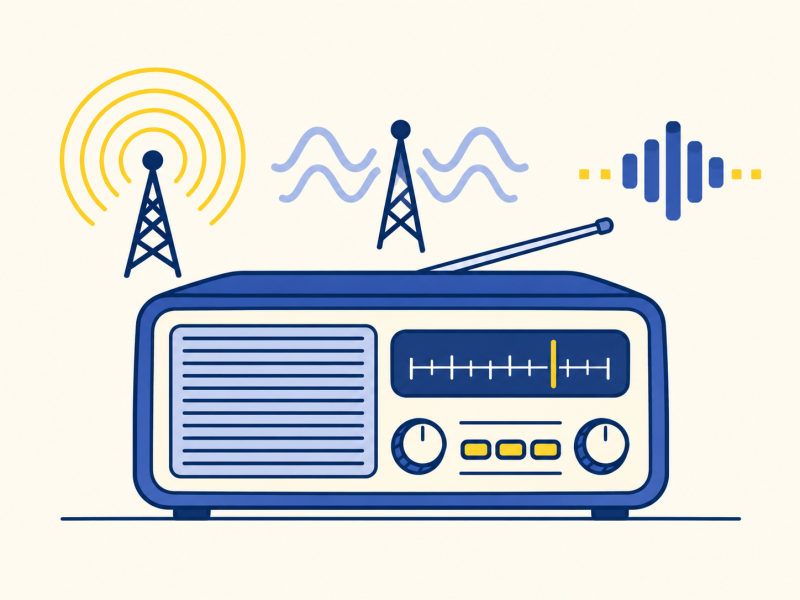
AM changes the strength of the radio wave, FM changes its frequency, and DAB sends the sound as digital data. AM travels furthest but crackles. FM sounds clearer over a shorter distance. DAB sounds clean and fits many stations in one signal, but it can break up. It builds on radio and broadcast TV.
I always thought AM and FM were the old and the new version of the same thing.
They are different ways of writing on the same wave.
Each has a different weakness.
Three ways of broadcasting
AM
StrengthLong range and simple, but picks up crackle from electrical interference.
FM
FrequencyClearer and less affected by interference, but covers a shorter range.
DAB
DigitalCleaner sound and many stations in one multiplex, but the signal drops out suddenly rather than fading.
Why they behave differently
Electrical noise, such as lightning or a faulty appliance, mostly changes the strength of a wave. AM listens to the strength, so it hears the noise. FM listens to the frequency, so mostly it doesn't.
Lower frequencies, such as long and medium wave, bend round hills and, at night, bounce off the upper atmosphere, so they travel far. FM and DAB use higher frequencies that travel in straight lines, so they only reach as far as the line of sight.
DAB sends data. Several stations are packed into one block, called a multiplex, which uses less airspace and lets stations be found by name. If the data is damaged beyond repair, it cuts out instead of fading.
Digital radio always sounds better than FM.
At a low data rate, DAB can sound thin, because the sound is squeezed to fit more stations in. A strong FM signal can sound as good or better.
Why the change
Digital lets broadcasters offer more stations in the same space, and shows the name and what is playing. The trade-off is coverage: DAB is not available everywhere, and a weak signal can drop out entirely. The UK has not set a date to switch off FM.
Key takeaways
- AM changes strength; FM changes frequency.
- AM goes furthest; FM is clearer.
- DAB is digital and packs many stations into one.
- Digital fails suddenly; analogue fades.
Now you know.
AM changes the strength.
FM changes the frequency.
DAB sends data.
Last reviewed 3 Nov 2026
