- Home
- Technology
- Mobile phones
- Phone masts
How phone masts work
What is on top of the mast, why it is tall, and why there are so many.

The short version
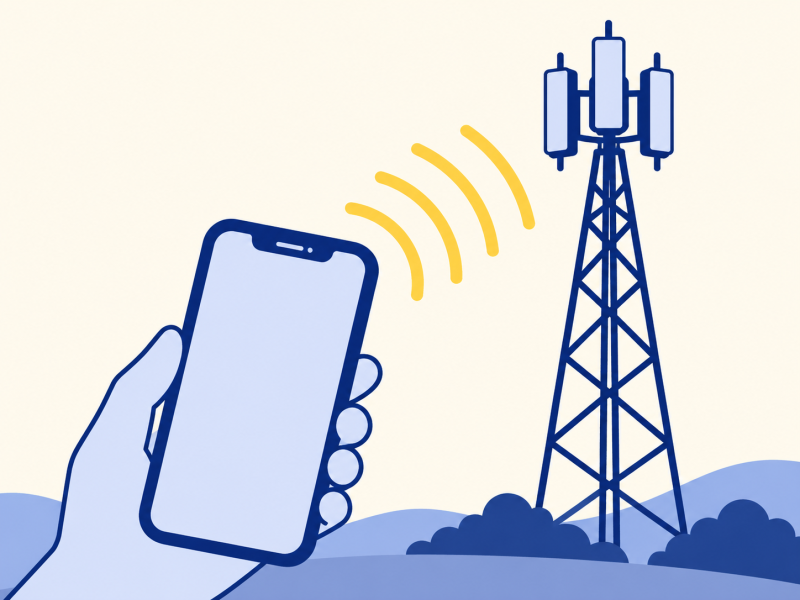
A phone mast is a tall pole carrying flat panel aerials that beam radio towards the area around it. It is tall so that the signal can travel a long way without hitting hills and buildings, and there are many of them because each can serve only so many phones. It builds on mobile phones.
I always assumed the round bits on a mast were the antennas.
The flat panels are. The round dishes are something else.
Look for what points where.
What you are looking at
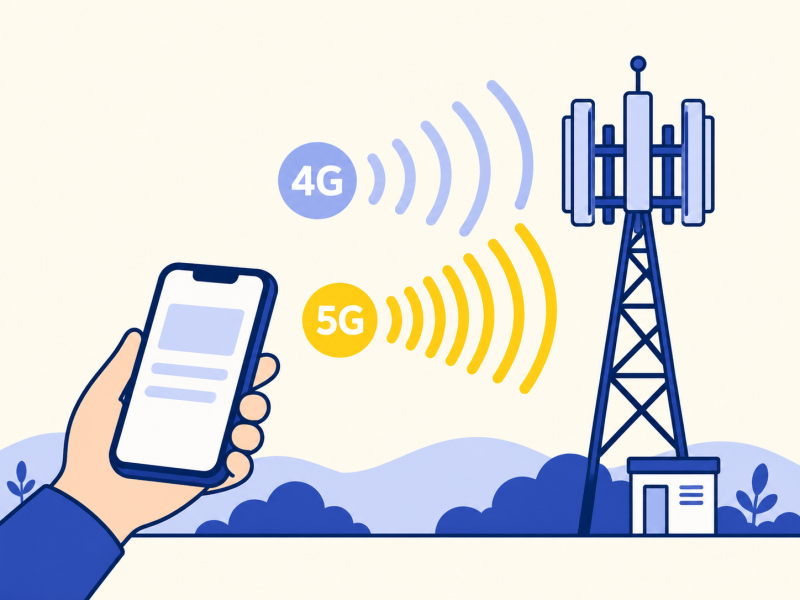
The tall flat rectangles are the aerials that talk to phones. Three sets are usually mounted at 120 degrees to each other, each covering a third of the circle, so together they cover all directions.
The round dishes are microwave links. They beam a narrow, focused signal in a straight line to another dish on a mast or building nearby, passing the data on to the wider network. Where fibre is available the dishes are not needed.
At the bottom, in a cabin or cabinet, are the radio equipment, power supply and batteries that keep the mast working through a power cut.
Why tall, and why many
Radio at these frequencies travels in straight lines, so height lets a signal clear obstacles. But each mast can serve only a limited number of phones at once. So in busy places, operators add more masts, and smaller ones on lamp posts and rooftops, to share the load.
A phone transmits with only a fraction of a watt. If you are near a mast, your phone lowers its power. If you are far, it raises it, which is why a poor signal flattens your battery faster.
Sources: UK Health Security Agency and Ofcom publish public information on mobile signals and exposure. Figures vary by site.
Key takeaways
- Flat panels talk to phones.
- Round dishes link masts to each other.
- Height helps radio travel in straight lines.
- More masts mean more capacity, not only more reach.
Now you know.
Panels talk to phones.
Dishes talk to other masts.
More masts mean more capacity.
Last reviewed 3 Nov 2026