The short version
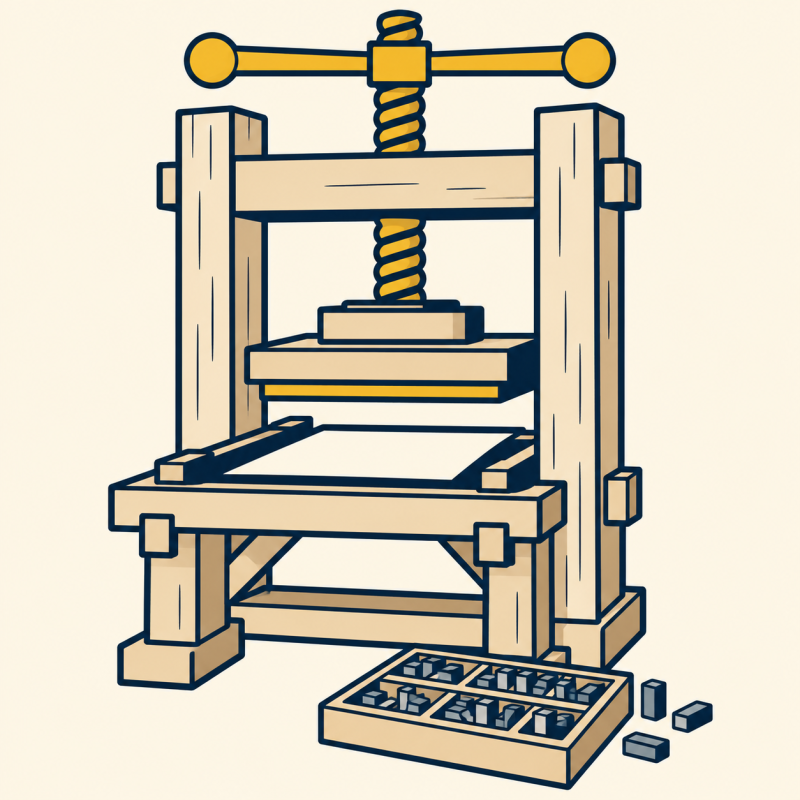
Around 1450 Johannes Gutenberg, a goldsmith in Mainz, combined a screw press, oil-based ink and reusable metal letters. One workshop could now print hundreds of identical pages, where a scribe copied one book in months. Books became cheaper, and ideas began to travel much faster.
I always thought Gutenberg invented printing.
He did not. Printing was already centuries old.
What he changed was how quickly you could set up a page.
Books before the press
Before printing, every book in Europe was copied by hand, usually by monks or paid scribes. A single Bible could take a scribe well over a year. Each copy was slightly different, because every scribe made small mistakes, and each one was expensive. Most people never owned a book.
Printing from carved wooden blocks already existed. In China and Korea it had been used for centuries, and Europeans were using it for playing cards and religious pictures. The problem was that a block was carved for one page and could not be used for anything else.
The clever part: reusable letters
Gutenberg's big idea was to make each letter as a separate small block of metal, called type. A printer picked out the letters for a page and arranged them in a frame. Once enough copies were printed, the letters were taken apart and used again for the next page.
Making good type was the hard part. Gutenberg cast the letters in a mould from a mix of lead, tin and antimony. It melts easily, sets hard and holds a sharp edge. Each letter had to be exactly the same height, or it would print faintly.
The Latin alphabet helped. A few dozen letters, plus capitals and punctuation, could set any page. A language written with thousands of different characters needs far more pieces of type.
What the press did
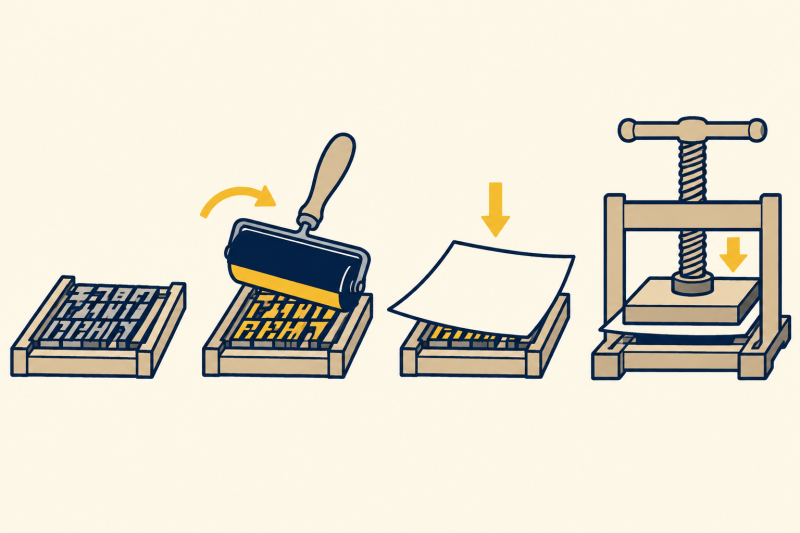
The press itself was borrowed from the screw presses used for wine and olives. The printer fixed the frame of letters in place, rolled an oily ink over the letters and laid a sheet of paper on top. Turning the handle drove a flat plate down on the paper and pressed it against the ink.
Gutenberg also needed a new ink. Water-based ink slid off metal, so he used a thicker ink made with oil, like the paint used by artists of his time.
From scribes to press
- about 1040 Bi Sheng in China makes movable type from baked clay.
- 1377 Korean monks print the Jikji using metal type.
- about 1450 Gutenberg sets up his press in Mainz.
- about 1455 The Gutenberg Bible is finished, with about 180 copies printed.
- about 1476 William Caxton sets up the first press in England, at Westminster.
- 1500 Presses are working in more than 200 European towns.
About 180
The number of Bibles in Gutenberg's first print run. A scribe could take a year or more to copy a single Bible by hand.
What changed
Books fell in price and rose in number. A new kind of reader appeared: students, merchants and craftspeople who could now afford a few books. Writers could reach people in other countries, and new ideas, from religious reform to science, travelled faster than any authority could easily stop.
The same pattern later repeated with the telephone and the internet: when copying becomes cheap, information spreads quickly.
Gutenberg invented printing.
Printing from blocks was already used in Asia, and movable type had been made in China and Korea. Gutenberg's contribution was a fast way of making metal type and printing with it that suited the Latin alphabet.
Why metal type worked when clay and wood did not
Clay type wears down and breaks. Wooden type swells and warps with damp paper and ink. Metal type is hard, so it keeps its shape for thousands of copies.
Gutenberg's workshop cast letters in a hand mould. The mould made one letter at a time, but a skilled worker could make hundreds in a day, all exactly the same height. That uniformity matters because the press pushes the whole frame down at once. A single letter that sits too low leaves a blank patch on the page.
Sources: Cambridge University Library, The print revolution; British Library, The Mainz indulgences of 1454/5. Copy totals and dates are estimates.
Key takeaways
- Gutenberg did not invent printing.
- His breakthrough was fast, reusable metal type.
- The press came from wine and olive presses.
- Oil-based ink stuck to metal.
- Cheap books spread ideas quickly.
Now you know.
The big idea was reusable letters.
Metal type made printing fast.
And fast copying made books, and ideas, common.
Last reviewed 3 Nov 2026
Where next?
More in History
-
Read
 History
Dating the past
How scientists work out the age of bones, wood and rocks using radiocarbon dating, tree rings and rock…
-
Read
 History
Roman roads
How the Romans surveyed and built long straight roads, with layers of stone, a curved surface and ditches…
-
Read
 History
The calendar
Why a year needs leap days, how the Julian and Gregorian calendars differ, why month names look odd, and how…