
The short version
The Great Fire began in a baker's shop in Pudding Lane in the early hours of Sunday 2 September 1666. Wooden houses, narrow streets, a dry summer and a strong wind let it spread for five days. About 13,000 houses burned, and afterwards London was rebuilt in brick and stone with new rules.
I always assumed the fire was so bad because London had no way to put out fires.
It did. The problem was how close everything was.
The houses were close enough to pass the fire from one to the next.
How it started
In 1666 London was a crowded city of timber houses, many covered in pitch to keep out the rain. Thomas Farriner's bakery in Pudding Lane had banked its ovens at night. Sparks from the oven are thought to have set fire to fuel stored nearby and the fire began in the early hours of Sunday 2 September.
A fire in a London street was not unusual, and the first reaction was to try to put it out with buckets. The Lord Mayor, called to see the blaze, judged it small and went home. By the time it was clear that it was not, the wind had carried it to neighbouring streets.
Why it spread so fast
Several things came together:
- Wood. Most houses were built from timber, and many had thatched or pitch-covered roofs.
- Narrow streets. The upper floors of houses were built to stick out over the street, so neighbours across a lane almost touched.
- A dry summer. The timber had dried out for weeks.
- A strong east wind. It blew the fire and burning pieces westward across the city.
- A slow response. Firefighting meant leather buckets, hand squirts and hooks to pull houses down.
Stopping a fire by removing what it burns
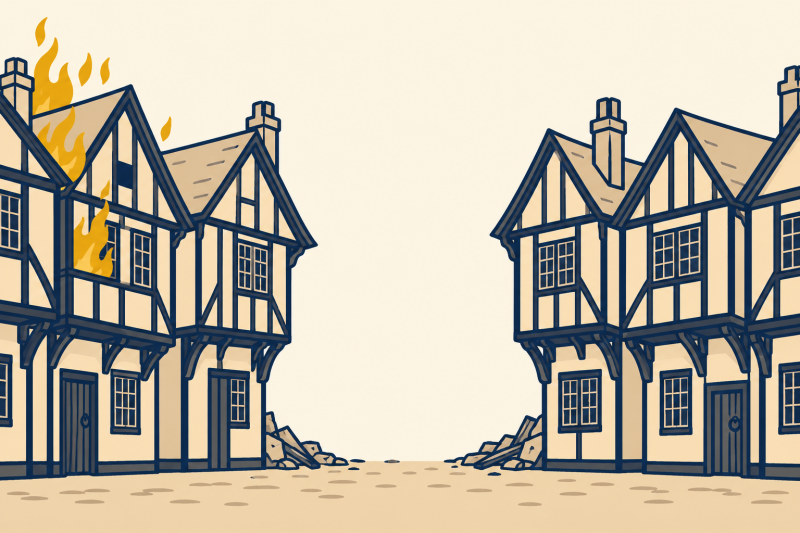
The only way to stop a fire in a street of wooden houses was to pull down houses ahead of it, creating a gap for it to cross. This is called a firebreak. Pulling houses down needed permission from their owners, and in the first day the order was delayed.
From Monday, the Duke of York took charge of the firefighting, and gunpowder was used to blow up houses and make wider gaps. On Wednesday night the wind dropped, and the fire was brought under control by the Thursday.
Most people escaped with what they could carry, many of them by boat on the Thames.
Five days
- Sunday 2 September The fire starts in Pudding Lane around 1 am.
- Monday 3 September It spreads west and reaches the river front warehouses.
- Tuesday 4 September St Paul's Cathedral catches fire.
- Wednesday 5 September Firebreaks and a falling wind begin to hold it.
- Thursday 6 September The last large fires are put out.
About 13,200
The number of houses usually estimated to have burned, along with 87 parish churches and St Paul's Cathedral. Only a handful of deaths were recorded, though the true number is unknown.
How London was rebuilt
The Rebuilding Act of 1667 required new houses to be built of brick or stone, not timber, and made streets wider. It banned overhanging upper floors. Christopher Wren rebuilt St Paul's Cathedral and dozens of city churches. A tall column called the Monument, 202 feet high, was built close to where the fire began, as a memorial. By tradition it stands 202 feet from where the fire began, the same as its height.
The fire also helped create a new business. In 1680 Nicholas Barbon set up the Fire Office, an early fire insurance business that helped pay for rebuilding after a fire. Insurers later hired their own firefighters, who worked only for houses that carried the company's badge, called a fire mark.
The Great Fire ended the Great Plague.
The plague of 1665 was already fading by the time of the fire. The fire burned the old city inside the walls, while the worst plague areas were mostly outside it and survived.
Why overhanging floors made it worse
Each upper floor was built a little wider than the one below, partly to gain space. In a narrow lane the top floors of opposite houses could be a few feet apart.
A fire needs fuel, heat and air. Heat from a burning house shines across a gap and dries and ignites the timber opposite. Close gaps meant the fire needed no sparks to travel, only heat. A wider street, built in brick, put out more of the heat before it reached the next house.
Sources: City of London, The Great Fire; UK Parliament, The Act for rebuilding the City of London; London Museum, How the Great Fire created insurance. Counts are estimates.
Key takeaways
- The fire began in a bakery on 2 September 1666.
- Timber, narrow streets and wind spread it.
- Firebreaks and falling wind stopped it.
- London was rebuilt in brick and stone.
- Fire insurance began soon after.
Now you know.
It spread because everything was close and made of wood.
It stopped when firebreaks left nothing to burn.
And London was rebuilt in brick.
Last reviewed 3 Nov 2026
Where next?
More in History
-
Read
 History
Dating the past
How scientists work out the age of bones, wood and rocks using radiocarbon dating, tree rings and rock…
-
Read
 History
Roman roads
How the Romans surveyed and built long straight roads, with layers of stone, a curved surface and ditches…
-
Read
 History
The calendar
Why a year needs leap days, how the Julian and Gregorian calendars differ, why month names look odd, and how…